Offer
An offer (interchangeably referred to as the ask price) is the minimum price at which a seller, designated market maker, or liquidity provider is willing to sell a financial instrument, currency, or security in a two-way quoted market.
What Is an Offer?
In financial market microstructure, an offer—universally synonymous with the ask price—represents the price level at which a market maker, dealer, or resting seller is prepared to sell a currency pair, equity, or derivative contract. Together with the bid (the price at which buyers are willing to purchase), it forms the fundamental two-way price quotation that underpins modern electronic trading:
$$\text{Quotation} = \text{Bid} \ / \ \text{Offer}$$
When a trader places an immediate market buy order (“buying at the market”), the transaction executes at the prevailing offer price. Conversely, when placing a market sell order, execution occurs at the bid price. The mathematical differential between the offer and the bid represents the bid-ask spread, which serves as the primary compensation mechanism for liquidity providers and an unavoidable transaction cost for liquidity takers.
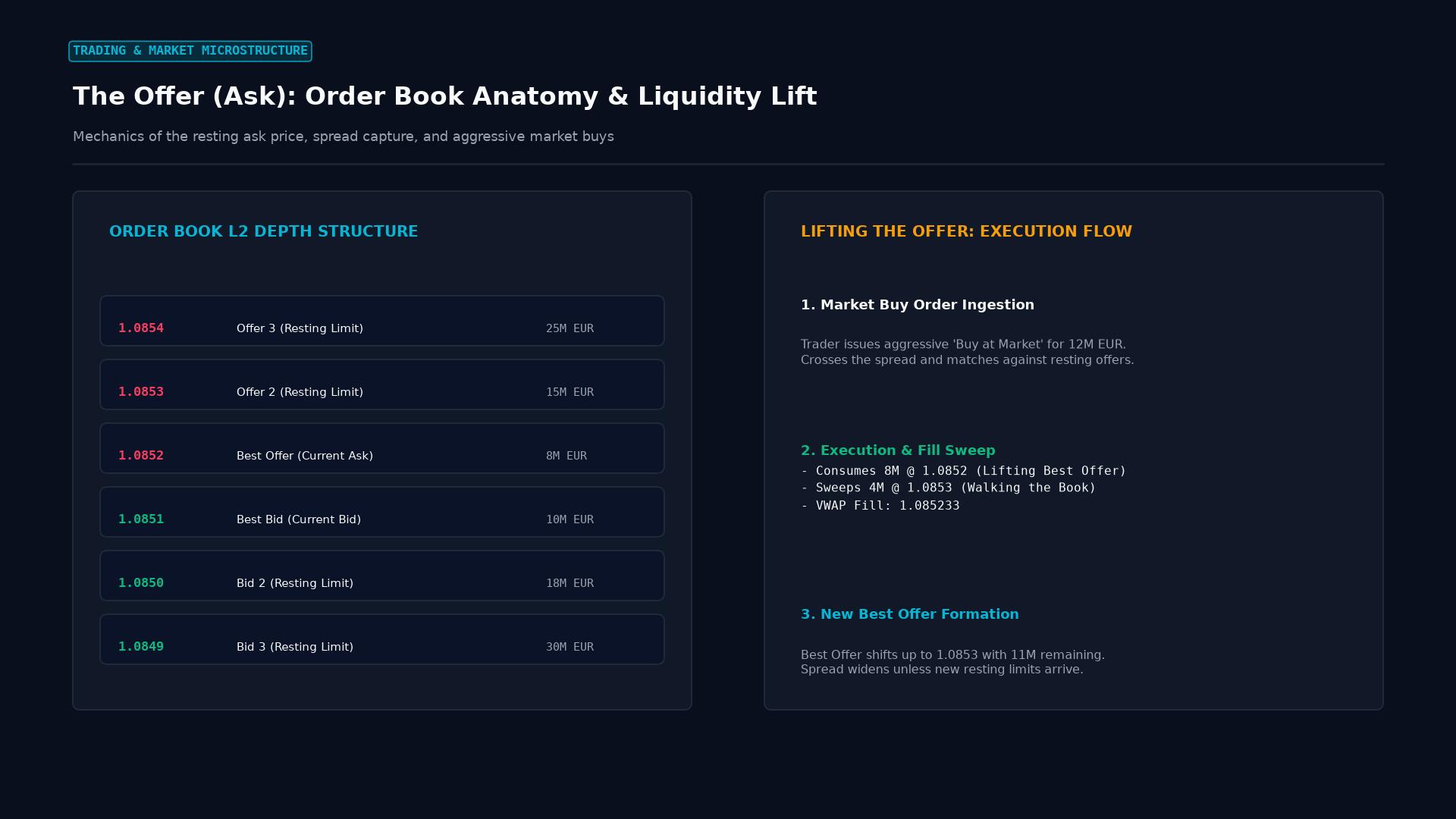 Figure: Order book ask depth: aggressive market buys lifting the resting offer, walking the ladder, and establishing new higher offer prices.
The Mechanics of Quoting: Hitting vs. Lifting
Market participants interact with the bid and offer through distinct order routing behaviors:
1. Lifting the Offer (Taking Liquidity)
When an aggressive institutional buyer or retail market participant wants immediate execution, they send a market buy order to “lift the offer” (also described as “paying the offer” or “hitting the ask”). This removes resting liquidity from the order book. If the volume of the buy order exceeds the volume available at the best offer, the remaining shares or contracts sweep upward to higher resting offers, causing price slippage.
2. Posting on the Offer (Providing Liquidity)
A passive trader or algorithmic market maker places a limit sell order above the current market price. This resting order becomes part of the electronic order book’s market depth (Level 2). By posting on the offer, the trader provides liquidity to other market participants and avoids paying the spread, instead capturing the spread when an incoming market buyer lifts their quote.
Offer Dynamics Across Global Financial Markets
The structure and quoting conventions of the offer vary across electronic exchanges and over-the-counter (OTC) dealing networks:
| Market | Quoting Convention | Typical Spreads | Primary Drivers of the Offer |
|---|---|---|---|
| Spot Forex (EUR/USD) | Expressed in 5-digit pips (e.g., 1.08512) | 0.1 to 1.5 pips | Interbank tier-1 bank feeds, central bank policy divergence, macroeconomic news releases. |
| US Equities (e.g., AAPL) | Expressed in dollars and cents ($225.50) | $0.01 (penny increments) | Order routing via NBBO, wholesaler internalization, corporate earnings releases. |
| Treasury Bonds (US 10Y) | Quoted in 32nds or fractions (e.g., 98-16+) | 1/64th to 1/32nd of a point | Primary dealer repo rates, Fed OMO auctions, inflation prints (CPI/PCE). |
| Options Contracts | Premium in dollars per share (e.g., $3.40 offer) | $0.05 to $0.50+ | Underlying asset price, implied volatility (IV), time decay (Theta). |
Market Depth and the Limit Order Book (LOB)
The best offer visible on a trader’s chart is simply the lowest price among all resting sell orders, known as the Top of Book or Level 1 data. Beneath the surface, the electronic limit order book contains multiple tiers of liquidity at progressively higher prices:
               LIMIT ORDER BOOK: LEVEL 2 DEPTH OF MARKET

  Price Level (EUR/USD)     Resting Offer Volume     Cumulative Volume
  --------------------------------------------------------------------
  1.08530                   50,000,000 Units         105,000,000 Units
  1.08520                   35,000,000 Units          55,000,000 Units
  1.08510 (Best Offer)      20,000,000 Units          20,000,000 Units
  ======================= MIDPOINT: 1.08505 ==========================
  1.08500 (Best Bid)        15,000,000 Units          15,000,000 Units
  1.08490                   30,000,000 Units          45,000,000 Units
  1.08480                   45,000,000 Units          90,000,000 Units
If a large hedge fund executes a market buy order for 40,000,000 EUR/USD:
- It fills the entire 20,000,000 units available at the Best Offer of 1.08510.
- The remaining 20,000,000 units are filled from the next tier at 1.08520.
- The volume-weighted average price (VWAP) of the execution is: $$\text{VWAP} = \frac{(20{,}000{,}000 \times 1.08510) + (20{,}000{,}000 \times 1.08520)}{40{,}000{,}000} = 1.08515$$
- The new Best Offer shifts upward to 1.08520 (with 15,000,000 units remaining).
Real-World Case Study: Spread Blowout and Offer Evaporation During Flash Crashes
During the European morning on January 15, 2015, the Swiss National Bank (SNB) unexpectedly discontinued its three-year-old minimum exchange rate peg of 1.2000 CHF per Euro.
Prior to the announcement, EUR/CHF traded at 1.2000 Bid / 1.2001 Offer, backed by massive SNB currency purchase operations. Within seconds of the peg abandonment:
- Institutional market makers on EBS pulled all resting bids to avoid absorbing catastrophic losses.
- Sellers flooded the market with market orders, but resting bids collapsed to 0.8500.
- On the other side, liquidity providers pulled their offers or quoted astronomical spreads (e.g., EUR/CHF 0.9000 Bid / 1.1500 Offer).
- Retail trading algorithms attempting to cover short euro positions by buying on the offer experienced execution slippage of hundreds of pips, pushing multiple retail brokerages into insolvency within minutes.
This event demonstrated that the offer is not a fixed guarantee of liquidity—it reflects dynamic willingness to trade that can vanish entirely during systemic shocks.
Frequently Asked Questions
What is the exact difference between “Offer” and “Ask”?
In modern financial markets, “offer” and “ask” are completely interchangeable terms describing the price a seller is willing to accept. Historically, London and European interbank forex desks preferred the term “offer” (Bid/Offer), while North American equity and futures exchanges favored the term “ask” (Bid/Ask).
Why do I always enter a trade at a slight floating loss?
When you enter a buy position using a market order, you execute at the higher offer price. However, the current market value of your position is calculated based on what you could immediately sell it for—which is the lower bid price. This instant difference equals the bid-ask spread and represents the cost of executing an immediate market trade.
What does “offered tone” mean in market commentary?
When financial market analysts state that a currency or index has an “offered tone,” it indicates that selling pressure dominates the order book. Institutional sellers are actively placing heavy volume on the offer, capping upward price movement and pushing the market downward toward lower bid support levels.
Ready to trade forex?
Open a free demo account with a regulated broker. Practice with virtual funds before risking real money.