Bid Price
The bid price is the price at which the market (or broker) will buy a currency pair from you — the price you receive when selling. It is always the lower of the two quoted prices (the other being the ask price). The difference between the bid and ask is the spread, which represents the primary transaction cost of a forex trade.
The Two-Sided Quote
Every forex quote shows two prices simultaneously:
- Bid: The price at which you can sell the base currency (the broker buys from you)
- Ask (Offer): The price at which you can buy the base currency (the broker sells to you)
Example: EUR/USD quoted as 1.0851 / 1.0852
- Bid: 1.0851 (if you want to sell EUR/buy USD, you sell at 1.0851)
- Ask: 1.0852 (if you want to buy EUR/sell USD, you buy at 1.0852)
- Spread: 1 pip (0.0001)
The bid is always lower than the ask. You always sell at the lower price and buy at the higher price. This gap — the spread — is the cost you pay to enter and exit every trade, regardless of whether the trade is profitable.
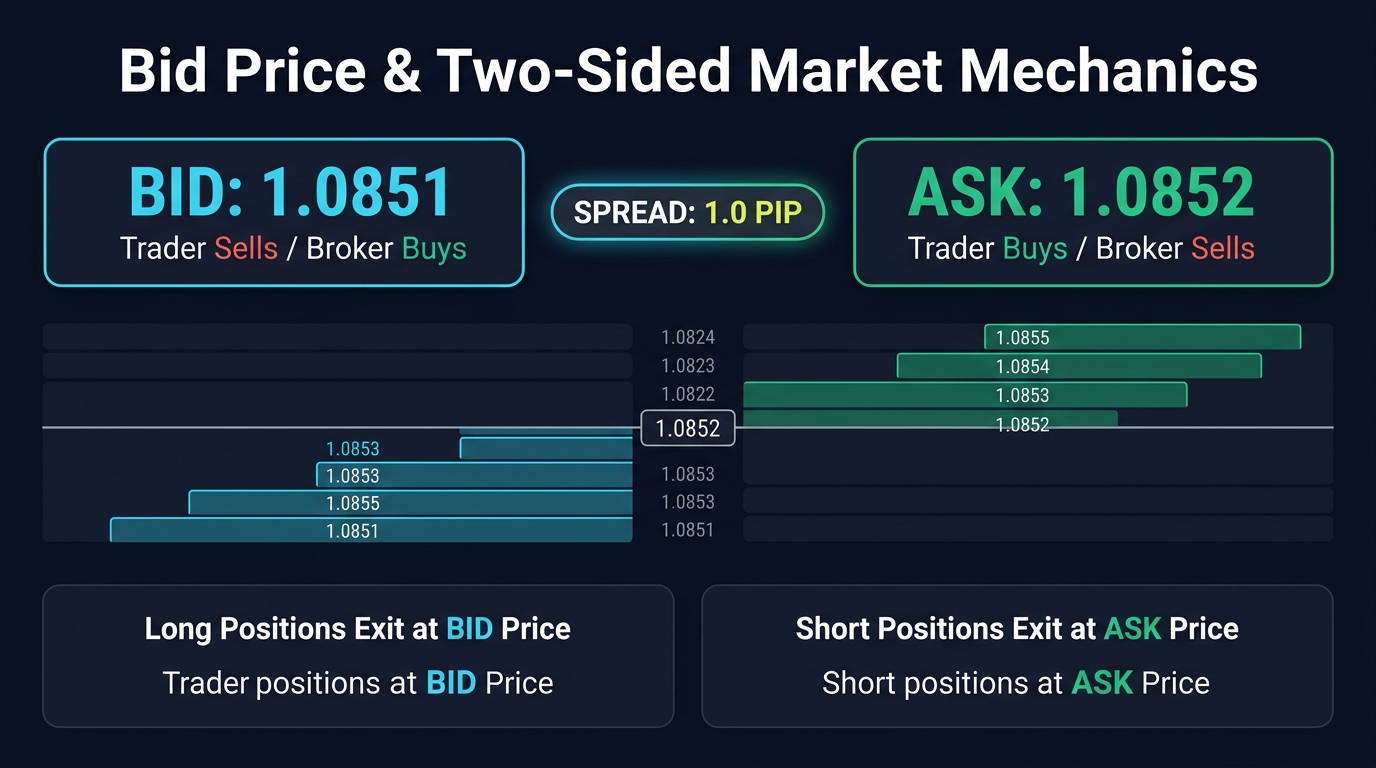
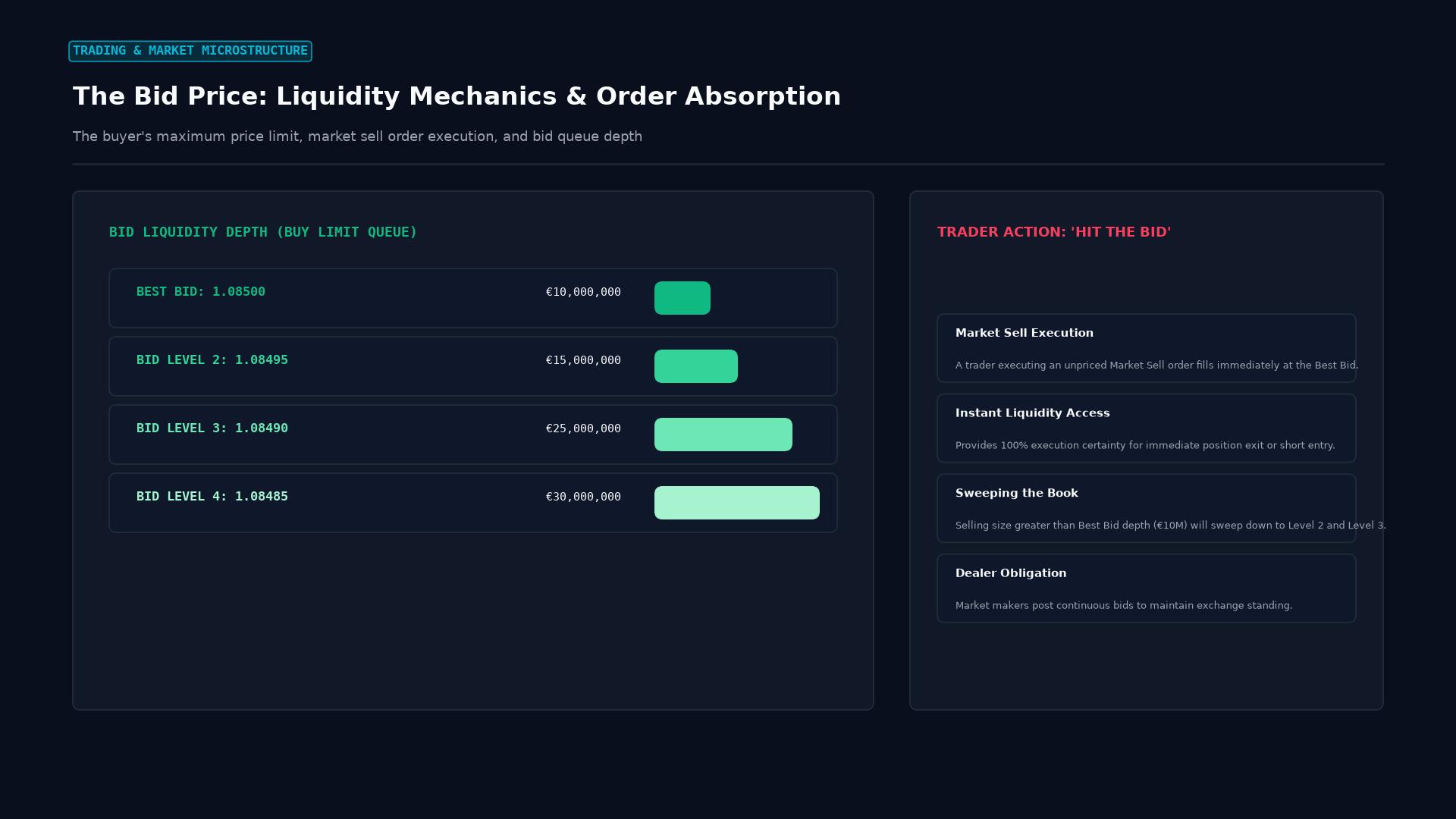 Figure: Buyer reservation pricing on the limit order book: resting bid queues, market sell absorption, and immediate execution pricing for liquidity consumers.
Why the Bid Price Matters in Practice
The bid price is the price displayed for open long positions in your MetaTrader or cTrader account. When you hold a long EUR/USD position, the unrealized P&L is calculated based on the current bid price — because that’s what you’d receive if you chose to close (sell) the position right now.
When you place a stop-loss on a long position, it triggers when the bid price reaches your stop level. This is important: if your stop is at 1.0820 and the bid price touches 1.0820, the stop executes — even if the ask never dropped that low.
Similarly, take-profit orders on long positions trigger when the bid price reaches the target level.
Bid vs. Ask for Short Positions
When you’re short (sold the base currency), the logic reverses:
- You entered at the bid price (you sold)
- Your open position P&L is now tracked against the ask price — what it would cost to buy back and close the short
- Your stop-loss on a short position triggers when the ask price reaches the stop level
- Your take-profit triggers when the ask price drops to the target
This distinction matters during volatile markets: the ask price is higher than the bid, so stop-losses on short positions trigger slightly later than equivalent stops on long positions (and vice versa for take-profits). In normal conditions this is negligible; during news events with wide spreads, it becomes more significant.
How Bid Prices Are Determined
In the interbank market, banks continuously post bid and ask prices for large transaction sizes. These quotes are aggregated by ECN platforms, which display the best bid and ask available across all liquidity providers.
In practice for retail traders:
- ECN accounts: The bid displayed reflects real interbank pricing (minus broker markup). Very tight spreads during liquid sessions.
- Market maker accounts: The broker sets the bid/ask spread. Typically fixed during normal hours but may widen during news events or illiquid sessions.
Bid Price in Currency Crosses
In cross-currency pairs (no USD), the bid price is synthetically derived from two USD pairs. EUR/GBP’s bid and ask are essentially calculated from EUR/USD and GBP/USD rates. This is why cross pairs have slightly wider spreads — the spread from two pairs is effectively compounded.
Key Takeaways
- Bid = price at which you can sell the base currency (you receive this price when closing a long)
- Bid is always lower than the ask — the gap between them is the spread (transaction cost)
- Long position P&L tracked vs. bid; short position P&L tracked vs. ask
- Stop-losses on long positions trigger when bid price hits the stop level
- ECN brokers display market-sourced bid prices; market makers set their own
FAQ
Is the bid price negotiable? No — for retail traders, the bid is the price the liquidity system offers. You take it or don’t trade. Institutional traders dealing in sizes of $10M+ have some pricing leverage with banks, but retail clients have no bid negotiation ability.
Why does the bid price widen during news events? Liquidity providers widen their bid-ask spread when they’re uncertain about price direction. During a major news release, the risk of quoting a tight price and being immediately picked off is high — so providers protect themselves by widening. The bid price drops while the ask price rises, creating the temporary spread expansion you observe on your platform.
Ready to trade forex?
Open a free demo account with a regulated broker. Practice with virtual funds before risking real money.