Official Settlements Account
The official settlements account (also known as the official reserve transactions account) is a subdivision of a nation's balance of payments that tracks changes in the reserve assets held by domestic and foreign central banks and monetary authorities.
What Is the Official Settlements Account?
In international macroeconomics, the Official Settlements Account (frequently designated as the Official Reserve Transactions Balance) is an essential accounting ledger within a country’s Balance of Payments (BoP) framework. It records the net international transactions undertaken by domestic and foreign monetary authorities—such as central banks, sovereign wealth entities, and the International Monetary Fund (IMF)—in official reserve assets.
Because a nation’s overall Balance of Payments must mathematically sum to zero under double-entry bookkeeping rules, any fundamental imbalance between autonomous private transactions (the sum of the Current Account and private Capital and Financial Accounts) must be reconciled through official reserve operations:
$$\text{Current Account (CA)} + \text{Capital & Financial Account (FA)} + \text{Official Settlements Balance (OSB)} = 0$$
$$\text{OSB} = -(\text{CA} + \text{FA})$$
When private autonomous transactions result in a net deficit (more capital flowing out than entering), official monetary authorities must either sell foreign exchange reserves or accumulate official foreign debt to support the domestic currency, resulting in an official settlements balance change.
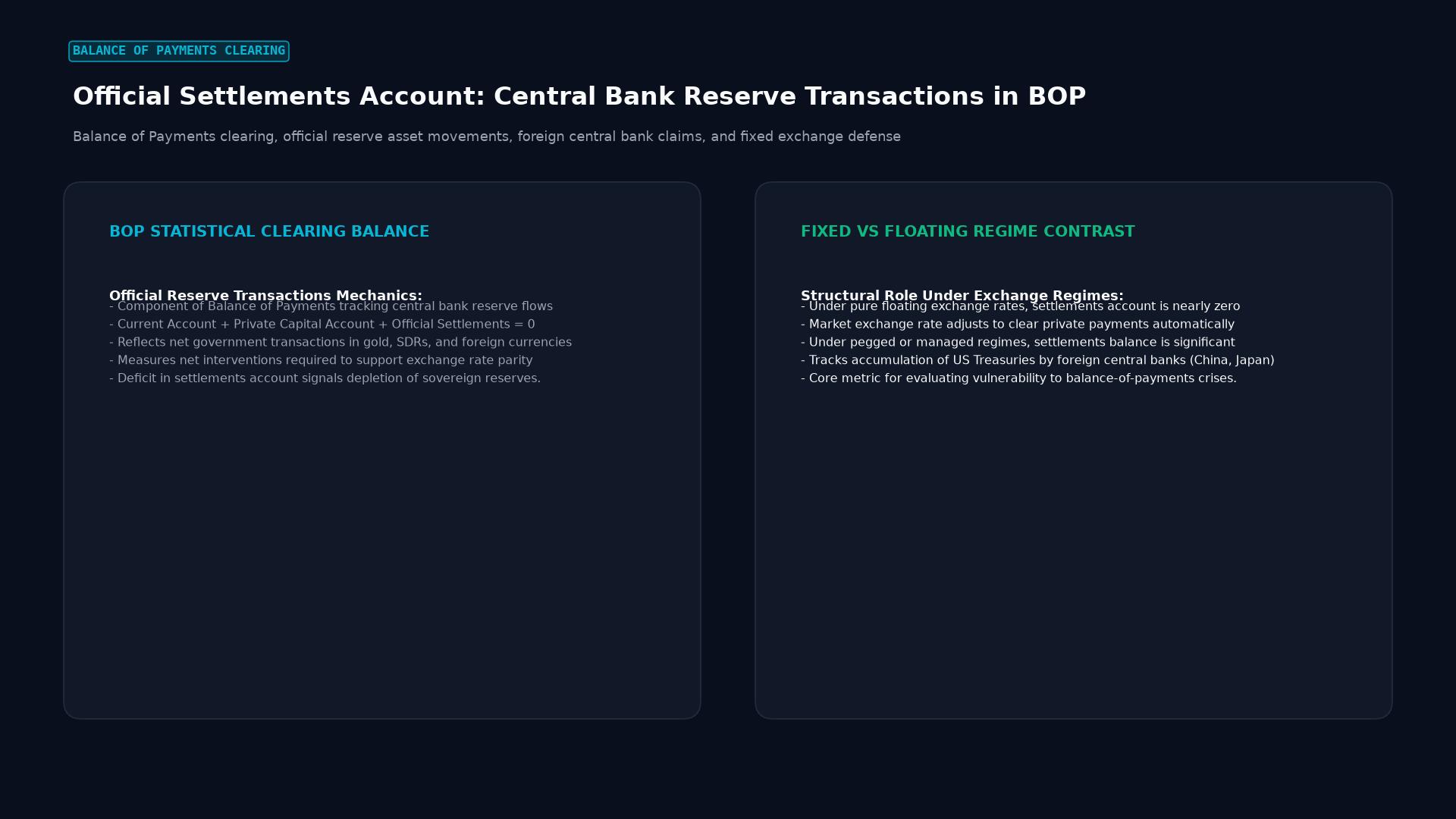 Figure: Balance of Payments clearing, official reserve asset movements, foreign central bank claims, and fixed exchange defense
Components of Official Reserve Assets
The official settlements balance tracks fluctuations across four recognized categories of sovereign reserve assets defined by the IMF’s Balance of Payments and International Investment Position Manual (BPM6):
- Foreign Currency Reserves: Readily available claims on non-residents denominated in foreign convertible currencies (e.g., US Treasury securities, German Bunds, Japanese government bonds, or cash deposits in foreign central banks).
- Monetary Gold: Physical bullion and unallocated gold accounts held by the central bank with international financial institutions, valued at prevailing market prices.
- Special Drawing Rights (SDRs): International reserve assets created by the IMF in 1969 to supplement member countries’ official reserves, based on a basket of five major currencies (USD, EUR, CNY, JPY, GBP).
- Reserve Position in the Fund (Reserve Tranche): The portion of a member country’s quota paid in foreign currencies or SDRs that can be drawn unconditionally upon demand to meet balance-of-payments shortfalls.
Fixed vs. Floating Exchange Rate Regimes
The economic significance of the official settlements account depends directly on a nation’s exchange rate framework:
| System | Role of Official Settlements Account | Impact on FX Reserves | Market Mechanism |
|---|---|---|---|
| Fixed / Pegged Exchange Rate | Active Intervention Tool: The central bank must continuously buy or sell reserves to defend the fixed currency parity. | Reserves fluctuate dramatically; high risk of depletion during speculative attacks. | Private market imbalances are absorbed entirely by official reserve changes. |
| Clean Floating Exchange Rate | Passive / Minimal Role: The central bank allows market forces to determine the currency value without regular intervention. | Official reserves remain largely static (aside from interest earned or revaluation effects). | Exchange rate adjusts continuously to clear autonomous trade and capital flows (OSB ≈ 0). |
| Managed Float (“Dirty Float”) | Counter-Cyclical Buffering: Central bank intervenes during excessive exchange rate volatility to smooth market turbulence. | Intermittent changes in reserve holdings during periods of geopolitical or macro stress. | Hybrid model; partial adjustment through currency rates, partial through reserve drawdowns. |
Real-World Case Study: The 1997 Asian Financial Crisis and Reserve Exhaustion
In early 1997, Thailand maintained a fixed exchange rate pegging the Thai Baht (THB) to a basket of currencies heavily weighted toward the US Dollar at approximately 25 Baht per USD.
- Macro Disbalance: Thailand ran a massive current account deficit exceeding 7% of GDP, financed by short-term private foreign borrowing.
- Speculative Pressure: Foreign hedge funds, anticipating an unsustainable peg, engaged in aggressive short-selling of the Baht.
- Official Settlements Depletion: To maintain the peg, the Bank of Thailand conducted massive intervention through its official settlements account, selling US Dollar reserves and entering billions in forward commitments to buy Baht.
- The Breakpoint: By June 1997, Thailand’s net usable foreign exchange reserves were virtually exhausted (dropping from over $37 billion to near zero after net forward obligations were factored in).
- The Aftermath: On July 2, 1997, the Bank of Thailand was forced to abandon the peg and float the Baht. The currency collapsed by over 50% against the dollar within months, sparking the broader Asian Financial Crisis.
       THAILAND 1997: OFFICIAL SETTLEMENTS DRAIN AND PEG COLLAPSE

 Heavy Current Account Deficit ---> Speculators Short THB
                                            |
 Bank of Thailand Sells USD Reserves <------+
 (Official Settlements Account Drains from $37B to ~$1B)
                                            |
 Usable Reserves Depleted ---> Unconditional Peg Abandoned (July 2, 1997)
                                            |
 THB Plummets 50%+ ---> Contagion Across Malaysia, Indonesia, South Korea
Frequently Asked Questions
Why does a current account deficit not always cause currency depreciation?
A country can maintain a massive current account deficit (such as the United States) without currency depreciation if foreign private investors willingly fund the gap through the Capital and Financial Account (e.g., buying domestic stocks, corporate bonds, real estate, or government debt). Only when total autonomous inflows fall short of outflows does pressure mount on the official settlements account or the exchange rate.
How does the US Federal Reserve’s balance sheet interact with the official settlements account?
Because the US Dollar serves as the dominant global reserve currency, foreign central banks hold enormous portions of their reserves in US Treasury securities and dollar deposits. Consequently, foreign official interventions frequently register as changes in foreign official assets held inside the United States on the US balance of payments ledger.
What is the difference between autonomous and accommodating transactions?
In balance of payments analysis:
- Autonomous Transactions: Commercial trade and private investment activities undertaken by businesses, households, and investors for commercial profit or individual interest, regardless of the BoP balance.
- Accommodating Transactions: Compensatory actions taken by central banks and official monetary authorities through the official settlements account specifically to cover or accommodate the net shortfall or surplus created by autonomous transactions.
Ready to trade forex?
Open a free demo account with a regulated broker. Practice with virtual funds before risking real money.