Capital Account
In international macroeconomics, the capital account is a core component of a nation's Balance of Payments (BOP). Under modern IMF standards, it records international capital transfers and the acquisition or disposal of non-produced, non-financial assets, reflecting cross-border net asset ownership shifts.
What Is the Capital Account?
In international economics and national income accounting, the capital account is one of the three primary accounts that constitute a country’s Balance of Payments (BOP)—the comprehensive ledger tracking every economic and financial transaction between domestic residents and the rest of the world over a specified period.
While the current account measures the continuous trade flow of physical merchandise, cross-border services, foreign investment income, and direct remittances, the capital account tracks cross-border changes in national asset claims and wealth ownership.
Understanding the capital account is critical for foreign exchange traders because currency exchange rates in modern globalized markets are driven overwhelmingly by cross-border investment capital flows rather than the simple shipment of physical trade goods.
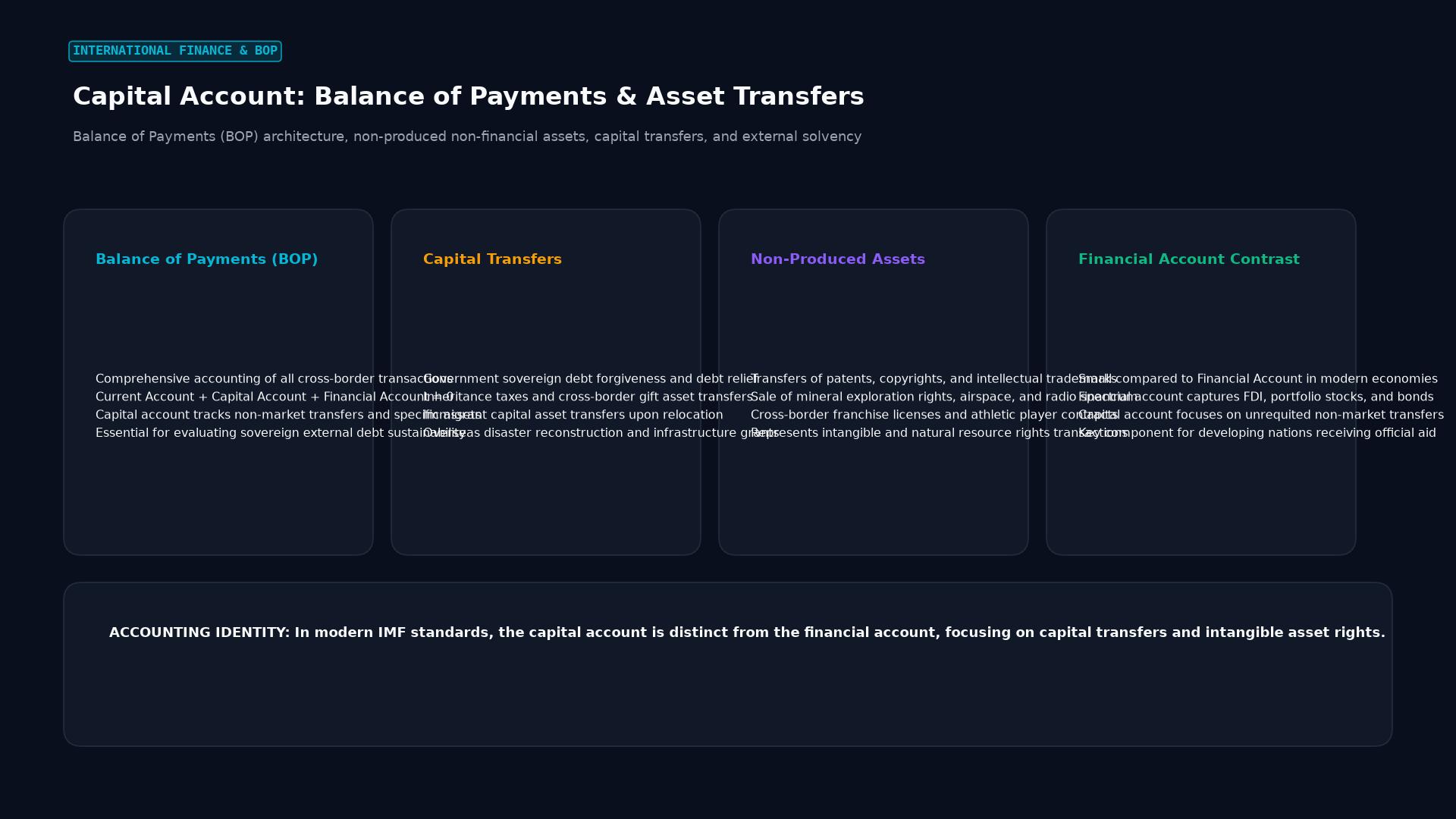 Figure: Balance of Payments (BOP) architecture, non-produced non-financial assets, capital transfers, and external solvency
The Modern IMF Classification: Capital Account vs. Financial Account
A frequent source of confusion among investors stems from how the terminology has evolved over recent decades:
The Traditional Definition
In classic 20th-century macroeconomic textbooks, the term “capital account” was used broadly to encompass all cross-border movements of investment funds, including foreign purchases of stocks, sovereign bonds, bank deposits, corporate takeovers, and factory construction.
The Modern IMF Standard (BPM6 Framework)
To bring precision to international financial statistics, the International Monetary Fund (IMF) revised its guidelines in the Balance of Payments and International Investment Position Manual (Sixth Edition, BPM6). Under this global standard, the traditional account was divided into two distinct components:
- The Capital Account (Narrow Definition): A relatively small account recording non-market capital transfers and the acquisition or disposal of non-produced, non-financial assets.
- Capital Transfers: Debt forgiveness by sovereign governments, international disaster relief grants for infrastructure, inheritance taxes, and assets brought into a country by migrating citizens.
- Non-Produced, Non-Financial Assets: Cross-border transactions in intellectual property, patents, copyrights, trademarks, franchise rights, carbon emission credits, mineral rights leases, and land transfers for foreign embassies.
- The Financial Account (The Primary Driver): The massive multi-trillion-dollar component tracking international investments, net purchases of foreign financial assets, and official reserve transactions.
Components of Cross-Border Financial Flows
Within the broader capital and financial ledger, economists track four distinct categories of capital movements:
1. Foreign Direct Investment (FDI)
FDI represents long-term, productive physical investments where a foreign entity acquires a lasting management interest (traditionally defined as owning 10% or more of voting equity). Examples include a German automaker constructing an assembly plant in the United States or a Japanese conglomerate acquiring an Australian mining company. FDI flows are sticky, stable, and reflect long-term confidence in the host country’s legal and economic environment.
2. Portfolio Investment (“Hot Money”)
Portfolio investment encompasses cross-border purchases of public corporate equities and sovereign bonds where foreign investors hold less than 10% control. Unlike physical FDI, portfolio capital is highly liquid: global hedge funds, mutual funds, and sovereign wealth funds can reallocate billions of dollars across sovereign bond markets with a single keystroke in response to interest rate shifts, creating sharp, immediate exchange rate volatility.
3. Other Investment
Covers commercial cross-border bank deposits, interbank loans, trade credits, and repurchase agreements. When international banks lend capital to foreign financial institutions, these transactions are captured here.
4. Reserve Assets
Transactions in official foreign exchange reserves, monetary gold, and Special Drawing Rights (SDR) executed by the national central bank to manage domestic currency stability or supply emergency liquidity.
The Fundamental Balance of Payments Identity
Under double-entry bookkeeping rules, an economy’s total external transactions must balance mathematically:
$$ \text{Current Account} + \text{Capital Account} + \text{Financial Account} = 0 $$ (Subject to statistical discrepancies, known as net errors and omissions).
This structural identity yields a profound macroeconomic reality: a nation cannot run a persistent current account deficit unless it runs an equivalent financial and capital account surplus.
Consider the United States:
- The US runs the largest persistent Current Account deficit in the world, consuming hundreds of billions of dollars more in foreign manufactured goods and imported oil each year than it exports.
- To finance this continuous consumption deficit, foreign entities must send capital back to the United States. Foreign investors and central banks purchase US Treasury bonds, American corporate equities, commercial real estate, and Silicon Valley venture capital assets.
- The resulting Financial and Capital Account surplus directly mirrors and finances the trade deficit, maintaining the US Dollar’s status as the global reserve currency.
The Trilemma and Capital Account Convertibility
A government’s policy regarding its capital account is governed by the Mundell-Fleming Trilemma (also known as the “Impossible Trinity”). A sovereign nation can select only two of the following three policy objectives:
- Free Capital Mobility (an open, fully convertible capital account).
- Fixed Exchange Rate (a stable or pegged currency).
- Independent Sovereign Monetary Policy (the ability to set domestic interest rates).
- Open Capital Accounts (e.g., US, Eurozone, UK, Japan): Capital enters and exits freely without regulatory restrictions. The exchange rate floats freely on global markets, allowing the central bank to set domestic interest rates independently.
- Closed or Managed Capital Accounts (e.g., China, India): Governments impose administrative capital controls to restrict domestic citizens from moving money abroad and limit speculative foreign hot-money inflows. This allows the nation to manage its currency peg while maintaining control over domestic monetary conditions.
Why Capital Flows Dominate Modern Forex Markets
In the early decades of the post-WWII era under the Bretton Woods system, foreign exchange rates were dictated primarily by the physical trade balance (the Current Account).
Today, daily global foreign exchange turnover exceeds $7.5 trillion, of which physical international merchandise trade represents less than 3%. The remaining 97% of daily currency transactions are driven entirely by financial and capital account activities—international sovereign debt purchases, equity portfolio rebalancing, cross-border corporate mergers, and currency hedging. When global real interest rates or investment returns tilt in favor of a specific country, capital inflows swamp trade deficits, triggering rapid currency appreciation.
Key Takeaways
- The capital account records international capital transfers and transactions in non-produced, non-financial assets.
- Under modern IMF BPM6 standards, market investment flows are classified under the companion Financial Account.
- The Balance of Payments identity requires that current account deficits be financed by capital and financial account surpluses.
- Cross-border capital flows (FDI and portfolio investment) drive over 95% of daily turnover in modern foreign exchange markets.
- The Impossible Trinity dictates that countries with open capital accounts must permit their exchange rates to float if they wish to set domestic interest rates independently.
FAQ
What is the difference between a current account surplus and a capital account surplus? A current account surplus means a nation exports more physical goods, services, and investment income than it imports, accumulating net foreign wealth. A capital/financial account surplus means a nation is receiving a net inflow of foreign investment capital, selling domestic assets or issuing debt to foreign investors.
What are “hot money” capital flows? “Hot money” refers to short-term, highly liquid portfolio investments in foreign sovereign bonds and money market deposits seeking quick returns on interest rate differentials. Hot money can flee a country overnight during a crisis, sparking severe currency depreciation.
Why do emerging economies sometimes restrict their capital accounts? Developing nations implement capital controls to prevent speculative international capital from triggering destabilizing asset bubbles during boom times, and to halt sudden capital flight and banking panics during economic downturns.
Ready to trade forex?
Open a free demo account with a regulated broker. Practice with virtual funds before risking real money.