Offshore Bank
An offshore bank is a licensed financial institution located in a foreign jurisdiction—typically an Offshore Financial Center (OFC)—operating outside the home country of its non-resident depositors to provide cross-border banking, multicurrency treasury management, tax-efficient structures, and international asset protection.
What Is an Offshore Bank?
In global finance, an offshore bank is a bank that conducts financial, custodial, and treasury business primarily with non-resident clients, corporations, and institutional entities. The institution is legally chartered and regulated in a jurisdiction distinct from the legal domicile or citizenship of its account holders.
Geographically, offshore financial centers (OFCs) are located in sovereign territories or crown dependencies that have established specialized legal frameworks to attract foreign capital—such as Switzerland, the Cayman Islands, Singapore, Luxembourg, Jersey, Guernsey, Mauritius, and the United Arab Emirates (UAE).
Historically celebrated for strict statutory bank secrecy (such as the Swiss Banking Act of 1934), the modern offshore banking landscape has transformed under international regulatory initiatives—including the OECD’s Common Reporting Standard (CRS) and the United States’ Foreign Account Tax Compliance Act (FATCA). Modern offshore banking emphasizes global currency mobility, cross-border corporate trade finance, international securities custody, and geopolitical diversification rather than opaque secrecy.
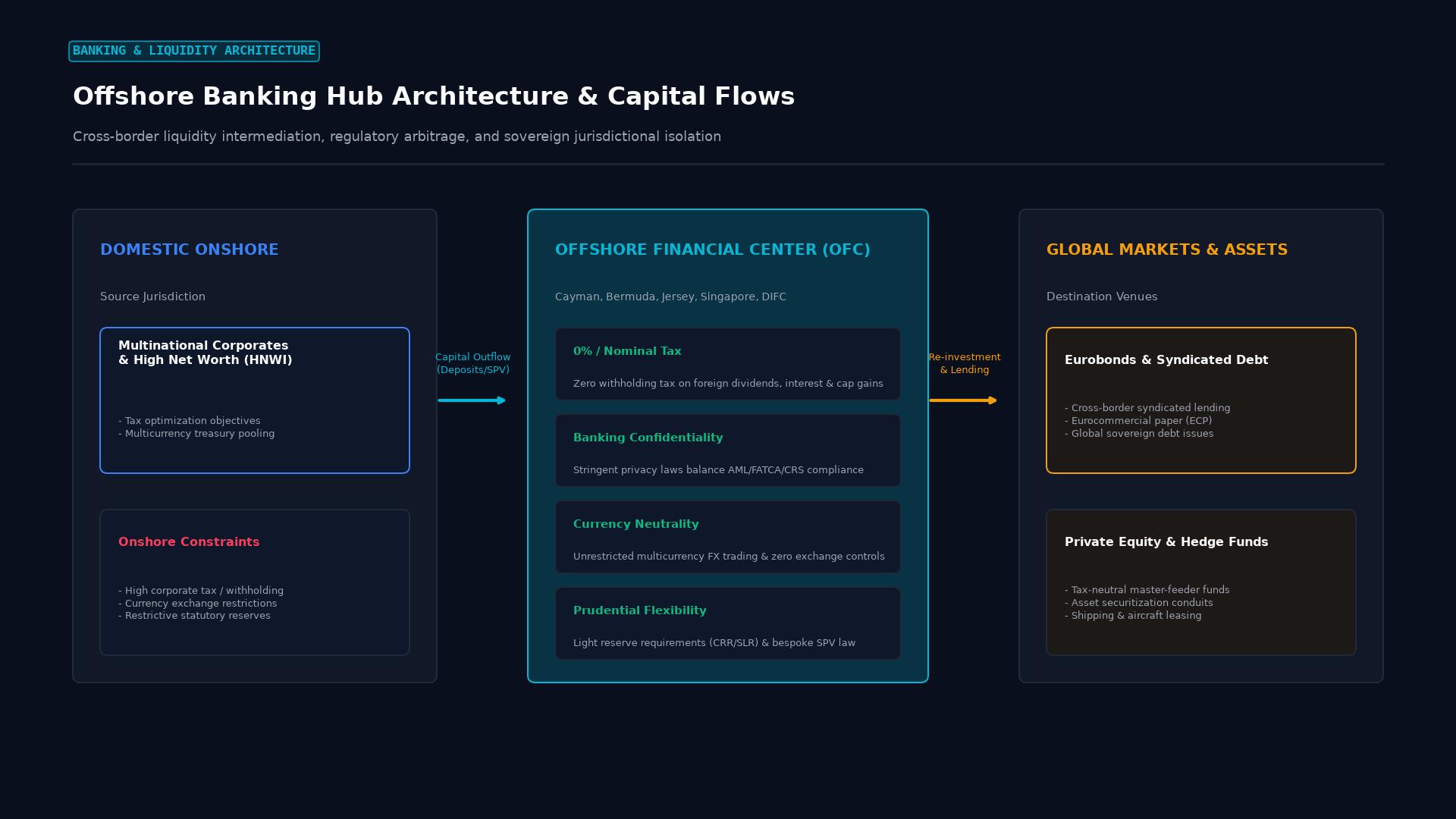 Figure: Cross-border financial intermediation through offshore centers: tax-neutral treasury pooling, international bond issuance, and regulatory arbitrage.
Strategic Functions of Modern Offshore Banking
Multinational corporations, international forex brokerages, and high-net-worth individuals (HNWIs) utilize offshore banking institutions for critical operational advantages:
1. Multicurrency Liquidity and Forex Flexibility
Domestic retail banks in many developing or exchange-controlled nations restrict the holding or conversion of foreign currencies. Offshore banks provide frictionless multicurrency treasury accounts, allowing international businesses to receive revenue in USD, clear expenses in EUR, and manage FX exposure without mandatory conversion to domestic soft currencies.
2. Geopolitical and Sovereign Risk Diversification
Investors residing in countries characterized by political instability, currency hyperinflation, sovereign capital controls, or judicial expropriation use offshore banks in stable jurisdictions (such as Switzerland or Singapore) to protect their liquid capital under well-established rule-of-law regimes.
3. Institutional Brokerage and Fund Domiciliation
A substantial portion of the global hedge fund and retail forex trading industry is domiciled offshore (e.g., Cayman Islands, British Virgin Islands, Seychelles, Bahamas). These entities maintain operational clearing and client fund segregation accounts at offshore commercial banks to access global prime brokerage networks with administrative efficiency.
Regulatory Transformation: The Transparency Revolution
Over the past two decades, international regulatory coalitions fundamentally restructured offshore banking compliance:
| Framework / Directive | Sponsoring Body | Core Mandate & Compliance Impact |
|---|---|---|
| FATCA (2010) | United States Congress / IRS | Compels Foreign Financial Institutions (FFIs) globally to report account balances and transactions of US persons directly to the IRS under penalty of a 30% withholding tax. |
| CRS (2014) | OECD / G20 | Implements the Automatic Exchange of Financial Account Information (AEOI) across 110+ participating sovereign jurisdictions, transmitting annual account balances to tax authorities. |
| FATF 40 Recommendations | Financial Action Task Force | Imposes rigorous Anti-Money Laundering (AML), Ultimate Beneficial Ownership (UBO) verification, and Know-Your-Customer (KYC) onboarding standards. |
| BEPS Framework | OECD | Curtails Base Erosion and Profit Shifting by requiring offshore corporate entities to demonstrate genuine “economic substance” (local premises, staff, expenditures). |
Domestic vs. Offshore Banking Comparison
The structural distinctions between traditional domestic commercial banking and offshore private banking include:
| Operational Feature | Domestic Retail Bank | Offshore Financial Center Bank |
|---|---|---|
| Target Clientele | Local residents, domestic businesses | Non-residents, multinational corporations, trusts |
| Currency Handling | Local national currency; limited foreign lines | Seamless multicurrency ledgers (15+ global currencies) |
| Minimum Balance | Low / Nominal ($50 to $1,000) | Moderate to High ($10,000 to $1,000,000+ depending on tier) |
| Deposit Insurance | State-backed guarantee (e.g., FDIC $250k, FSCS £85k) | Varies; many offshore centers enforce higher capital ratios instead |
| Regulatory Scrutiny | Standard domestic central bank oversight | Dual compliance (local monetary authority + FATCA/CRS/FATF) |
| Capital Control Risk | Direct exposure to national capital controls | Shielded from depositor’s domestic capital restrictions |
Real-World Case Study: The Transformation of Swiss Banking Secrecy
For nearly a century, Switzerland’s Article 47 of the 1934 Banking Act made it a criminal offense for Swiss bankers to reveal client identity or account details to third parties, including foreign governments.
- The Impasse: In 2008, the US Department of Justice (DOJ) launched an investigation into major Swiss institutions, ultimately resulting in UBS paying a $780 million fine and turning over records of thousands of undisclosed American accounts.
- The Transition: Recognizing the threat of exclusion from the US dollar clearing system (Fedwire and CHIPS), Switzerland formally signed the OECD Multilateral Competent Authority Agreement on Automatic Exchange of Financial Account Information.
- The Modern Era: In 2018, Switzerland began active automatic exchange of tax data (AEOI) under CRS with dozens of partner countries.
- The Strategic Shift: Swiss private banks pivoted away from secrecy to compete on balance sheet solvency (holding Tier-1 capital ratios above 18%), institutional wealth management expertise, fiduciary discretion, and political neutrality.
Frequently Asked Questions
Is it legal to have an offshore bank account?
Yes. Holding an offshore bank account is completely legal in virtually all democratic nations, provided the account holder complies with domestic tax laws by reporting account existence and paying taxes on income earned (e.g., filing US FBAR / FinCEN Form 114, or declaring foreign interest income to local tax authorities).
What is the OECD Common Reporting Standard (CRS)?
The Common Reporting Standard is an international information-exchange framework developed by the OECD. Under CRS, banks in participating countries automatically collect financial account information of foreign tax residents (including balances, interest, dividends, and gross proceeds) and transmit that data annually to the tax authority of the depositor’s home nation.
Why do retail forex brokers use offshore banking jurisdictions?
Many international retail forex and CFD brokers establish licensed entities in offshore jurisdictions (such as Belize, Bahamas, or Seychelles) to offer clients higher leverage ratios (e.g., 1:100 to 1:500) that are restricted in domestic jurisdictions (such as ESMA’s 1:30 cap or US CFTC’s 1:50 cap), while maintaining lower operational overhead costs.
Ready to trade forex?
Open a free demo account with a regulated broker. Practice with virtual funds before risking real money.