Option
An option is a binding derivative financial contract that grants the purchaser (holder) the right, but not the obligation, to buy (via a call) or sell (via a put) an underlying asset at a predetermined strike price on or before a designated expiration date, in exchange for paying an upfront cash premium to the seller (writer).
What Is an Option?
An option is one of the most versatile and widely utilized derivative instruments in modern capital markets. It derives its financial value from an underlying reference asset—such as a single stock, an exchange-traded fund (ETF), a sovereign bond, a physical commodity, or a foreign exchange currency pair.
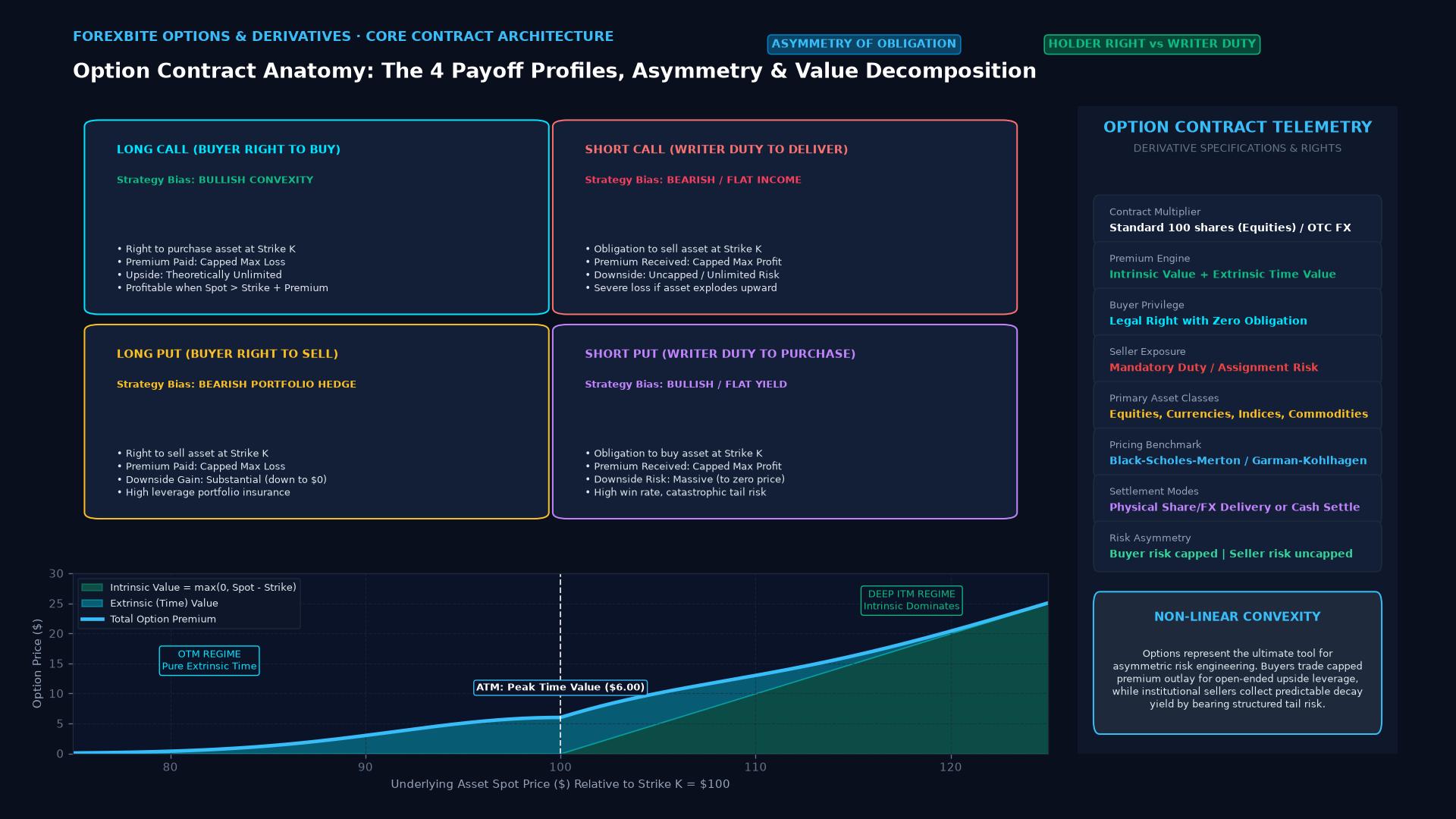
The core defining feature of an option is asymmetry of obligation:
- The Buyer (Holder): Pays an upfront cash amount known as the premium. In exchange, the buyer acquires a legal right with zero ongoing obligation. If the market moves unfavorably, the buyer can simply allow the contract to expire worthless, capping their maximum potential loss at the premium paid.
- The Seller (Writer): Collects the upfront cash premium. In exchange, the writer assumes a legal obligation to fulfill the terms of the trade if the holder chooses to exercise the contract. The writer faces potentially severe or unlimited market risk if the underlying asset moves sharply against their position.
The Two Foundational Types: Calls and Puts
Every options contract belongs to one of two fundamental types:
1. Call Options
A call option confers the right to buy the underlying asset at the agreed strike price ($K$).
- A trader purchases a call option if they anticipate that the market price of the underlying asset ($S$) will rise significantly above the strike price before expiration ($T$).
- Intrinsic Value at Expiration: $$\text{Value}_{\text{Call}} = \max(0, S - K)$$
2. Put Options
A put option confers the right to sell the underlying asset at the strike price ($K$).
- A trader purchases a put option if they anticipate that the market price of the underlying asset will fall below the strike price, or to insure an existing long equity or currency portfolio against a market crash.
- Intrinsic Value at Expiration: $$\text{Value}_{\text{Put}} = \max(0, K - S)$$
Option Moneyness and Pricing Structure
An option’s market price (the premium) consists of two distinct components: Intrinsic Value and Extrinsic Value (Time Value):
$$\text{Option Premium} = \text{Intrinsic Value} + \text{Extrinsic Value}$$
An option’s relationship to the prevailing market price of the underlying asset determines its moneyness:
| Moneyness Tier | Call Option Condition | Put Option Condition | Value Composition |
|---|---|---|---|
| In-the-Money (ITM) | Underlying Price $>$ Strike Price ($S > K$) | Underlying Price $<$ Strike Price ($S < K$) | Positive intrinsic value + remaining extrinsic time value. |
| At-the-Money (ATM) | Underlying Price $\approx$ Strike Price ($S \approx K$) | Underlying Price $\approx$ Strike Price ($S \approx K$) | Zero intrinsic value; maximum extrinsic time value. |
| Out-of-the-Money (OTM) | Underlying Price $<$ Strike Price ($S < K$) | Underlying Price $>$ Strike Price ($S > K$) | Zero intrinsic value; premium consists 100% of extrinsic value. |
Exercise Styles: American vs. European
Options are also classified by the contractual rules governing when the holder is permitted to exercise:
- American-Style Options: Can be exercised by the holder at any time on or before the official expiration date. Most single-stock equity options traded on US exchanges (e.g., Apple, Microsoft) are American-style.
- European-Style Options: Can only be exercised on the exact expiration date at the close of trading. Most broad-market index options (e.g., S&P 500 Index options - SPX) and interbank OTC foreign exchange options follow the European exercise convention.
- Bermudan-Style Options: Can be exercised only on specified predetermined calendar dates (e.g., the 15th of each month) prior to final expiration.
The Option Greeks: Risk Sensitivities
Institutional derivatives desks price and manage options portfolios using mathematical models (such as the Black-Scholes-Merton formula for European options or binomial trees for American options). The sensitivity of an option’s price to external market variables is quantified through the Greeks:
$$\begin{aligned} \text{Delta } (\Delta) &= \frac{\partial V}{\partial S} \quad \text{(Sensitivity to underlying asset price changes)} \ \text{Gamma } (\Gamma) &= \frac{\partial^2 V}{\partial S^2} \quad \text{(Rate of change of Delta per unit move in underlying)} \ \text{Theta } (\Theta) &= \frac{\partial V}{\partial t} \quad \text{(Rate of time decay; erosion of premium per day)} \ \text{Vega } (\nu) &= \frac{\partial V}{\partial \sigma} \quad \text{(Sensitivity to changes in Implied Volatility)} \ \text{Rho } (\rho) &= \frac{\partial V}{\partial r} \quad \text{(Sensitivity to changes in the risk-free interest rate)} \end{aligned}$$
Real-World Case Study: Hedging a Stock Portfolio with Protective Puts
In late 2021, an institutional portfolio manager held 10,000 shares of an index ETF trading at $400 per share ($4,000,000 portfolio value). Concerned about impending Federal Reserve interest rate hikes and market contraction in 2022, the manager wished to protect against a crash without liquidating the underlying shares.
- Strategy: Protective Put.
- Implementation: The manager bought 100 Put contracts (each controlling 100 shares) with a strike price of $380 expiring in 6 months, paying an upfront premium of $10 per share ($100,000 total premium, or 2.5% of portfolio value).
- The Downturn: Over the following 6 months, the market dropped 25%, and the ETF fell to $300 per share.
- Unhedged Outcome: The portfolio shares would have lost $1,000,000 in market value.
- Hedged Result: $$\text{Put Intrinsic Value at Expiry} = ($380 - $300) \times 10{,}000 \ \text{shares} = $800{,}000$$ $$\text{Net Loss on Portfolio} = (-$1{,}000{,}000 \ \text{stock drop}) + $800{,}000 \ \text{put payout} - $100{,}000 \ \text{premium} = -$300{,}000$$
- The put option established a hard floor at $380 per share, preventing $700,000 in catastrophic portfolio drawdown.
Frequently Asked Questions
Can retail traders trade foreign exchange options?
Yes. Currency options trade in two primary formats: exchange-traded currency options (such as FX futures options traded on the Chicago Mercantile Exchange, CME) and over-the-counter (OTC) vanilla and binary options offered by specialized retail and institutional brokers.
What happens if an option expires out-of-the-money?
If an option expires out-of-the-money (OTM), it possesses zero intrinsic value and ceases to exist. The buyer loses the entire premium paid to purchase the contract, while the seller (writer) retains 100% of the collected premium as maximum realized profit.
What is implied volatility (IV) and why is it important in options?
Implied Volatility (IV) is the market’s forward-looking estimate of the underlying asset’s price volatility over the life of the option, backed out mathematically from current market premiums. Higher implied volatility increases the likelihood that an option will finish deep in-the-money, causing option premiums (both calls and puts) to become significantly more expensive.
Ready to trade forex?
Open a free demo account with a regulated broker. Practice with virtual funds before risking real money.