Option Series
An option series is an individual, tradeable derivative contract defined by an exact combination of underlying asset, contract type (call or put), specific strike price, and unique expiration date within a broader option class.
What Is an Option Series?
In options market microstructure, an option series represents the most granular, discrete, and specific contract unit available for trading. While an option class encompasses all contracts of a single type (calls or puts) on an underlying asset across all strikes and maturities, an option series refers to the exact contracts within that class that share:
- The identical underlying security or index (e.g., Apple Inc. - AAPL).
- The identical option type (Call or Put).
- The identical strike price (e.g., $220.00).
- The identical expiration date (e.g., the third Friday of October 2024).
For example, all “AAPL Oct 18 2024 $220 Calls” belong to the same option series. Every market participant who buys or sells an AAPL Oct 18 2024 $220 Call is trading the identical fungible series, governed by the exact same clearing specifications administered by the Options Clearing Corporation (OCC).
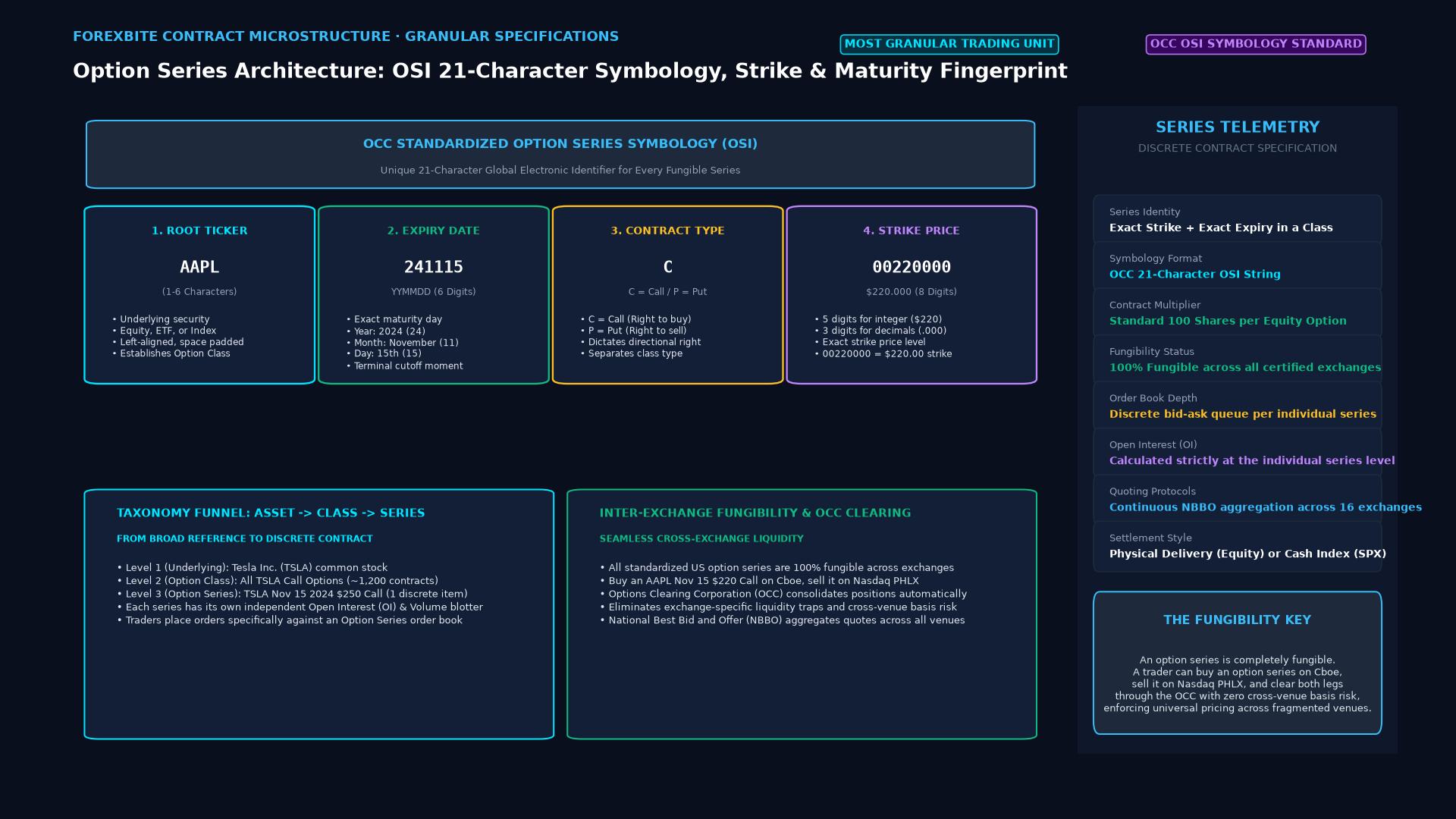
Technical Specifications and OCC Symbology
Standardized options exchanges utilize a precise alphanumeric identifier defined by the OCC Options Symbology Initiative (OSI) to represent each unique option series:
$$\text{OSI Format: } \underbrace{\text{ROOT}}{1-6 \text{ chars}} \ + \ \underbrace{\text{YYMMDD}}{\text{Expiration}} \ + \ \underbrace{\text{T}}{\text{Type (C/P)}} \ + \ \underbrace{\text{00000000}}{\text{Strike Price (in thousandths)}}$$
For example, a Tesla (TSLA) $250.00 Call expiring on November 15, 2024 is codified as: $$\text{TSLA241115C00250000}$$
| Symbology Component | Value in Example | Meaning |
|---|---|---|
| Root Symbol | TSLA |
Underlying reference stock |
| Expiration Date | 241115 |
Year 2024, Month 11 (November), Day 15 |
| Option Type | C |
Call option (conveys right to buy) |
| Strike Price | 00250000 |
$250.000 (divided by 1,000) |
Market Dynamics at the Series Level
Trading activity, liquidity, and risk metrics are tracked specifically at the series level:
1. Open Interest (OI) Accounting
The Options Clearing Corporation tracks open interest separately for each distinct option series. A single high-volume corporate announcement may cause open interest in the ATM (At-the-Money) series to surge to 80,000 contracts, while a distant OTM series on the same stock may register zero open interest.
2. Series-Specific Greeks
While the underlying asset has a single price and historical volatility, every option series possesses its own unique mathematical sensitivities:
- Delta: Varies from 0.00 to 1.00 (calls) or 0.00 to -1.00 (puts) across strikes.
- Gamma: Reaches its maximum peak in the series closest to the current market price (At-the-Money series with near-term expiration).
- Theta: Accelerates non-linearly as the series approaches its final 30 days before expiration.
Option Chain: Navigating Multiple Series
When traders view an Option Chain on an electronic terminal (such as Bloomberg, ThinkorSwim, or Interactive Brokers), they are viewing a matrix comparing multiple option series side-by-side:
               OPTION CHAIN MATRIX (Calls vs. Puts: Oct 2024 Expiry)

  CALL OPTION SERIES                           PUT OPTION SERIES
  Bid    Ask    Volume   OI   | Strike |   Bid    Ask    Volume   OI
  -------------------------------------------------------------------
  8.40   8.60    3,200  12.4k | $210   |  1.10   1.15      450   4.2k
  4.20   4.35    8,900  28.1k | $220   |  2.15   2.25    2,100  11.8k
  1.65   1.75   15,400  42.6k | $230   |  4.80   5.00    5,400  18.9k
Each horizontal line represents two distinct option series (the $220 Call series on the left, and the $220 Put series on the right).
Real-World Case Study: Pinning Risk in an Expiration Series
On third Friday options expiration in June 2023, an institutional market maker was short 5,000 contracts of the SPY Jun 16 2023 $440 Call series and long 5,000 contracts of the SPY Jun 16 2023 $440 Put series.
- The Underlying Price: SPY traded tightly between $439.85 and $440.15 during the final 30 minutes of the trading day.
- Pin Risk: If SPY closed at $440.01, the $440 Call series would automatically exercise via the OCC’s 1-cent rule, requiring the market maker to deliver 500,000 shares of SPY over the weekend. If it closed at $439.99, the calls would expire worthless, but the put holders might exercise.
- Delta Instability: At the exact strike of the expiring series, Delta fluctuated wildly between 0.0 and 1.0 on every 2-cent tick in the underlying ETF.
- Risk Resolution: To neutralize catastrophic weekend gap exposure, the market maker actively traded the underlying cash equity market into the 4:00 PM close, buying and selling stock to maintain delta neutrality until the series officially expired.
Frequently Asked Questions
Can an option series be adjusted after it has been listed?
Yes. If the underlying company executes a corporate stock split, reverse split, special cash dividend, or merger, the Options Clearing Corporation publishes an adjustment memo modifying the deliverable shares or strike prices for all active series in that stock (creating non-standard adjusted series).
What happens when an option series reaches its expiration date?
At 4:00 PM EST on the designated expiration date, trading in that series ceases permanently. Options that are in-the-money by $0.01 or more are automatically exercised by the OCC on behalf of holders, while out-of-the-money series expire worthless and are purged from exchange systems.
What is the difference between an option class and an option series?
An option class includes all options of the same type (all calls or all puts) on a specific underlying asset across every strike price and expiration date. An option series is a single contract line within that class sharing the exact same strike price and expiration date.
Ready to trade forex?
Open a free demo account with a regulated broker. Practice with virtual funds before risking real money.