Option Class
An option class consists of all option contracts of the exact same type (either all calls or all puts) listed on a specific underlying security or reference asset, encompassing all available strike prices and expiration dates.
What Is an Option Class?
In listed derivatives markets, an option class represents the collective group of all option contracts that share two identical fundamental attributes:
- The Same Underlying Security: The identical common stock, exchange-traded fund (ETF), commodity index, or currency pair (e.g., Apple Inc. - AAPL, or the Euro/US Dollar currency future).
- The Same Option Type: Either all Calls or all Puts.
An option class encompasses every strike price, expiration cycle, and settlement style available for that underlying asset within that directional type. For example:
- All Apple (AAPL) Call options listed across every strike price ($150 to $300) and every expiration date (weekly, monthly, LEAPS) form the AAPL Call Option Class.
- All Apple (AAPL) Put options listed across every strike price and expiration date form the AAPL Put Option Class.
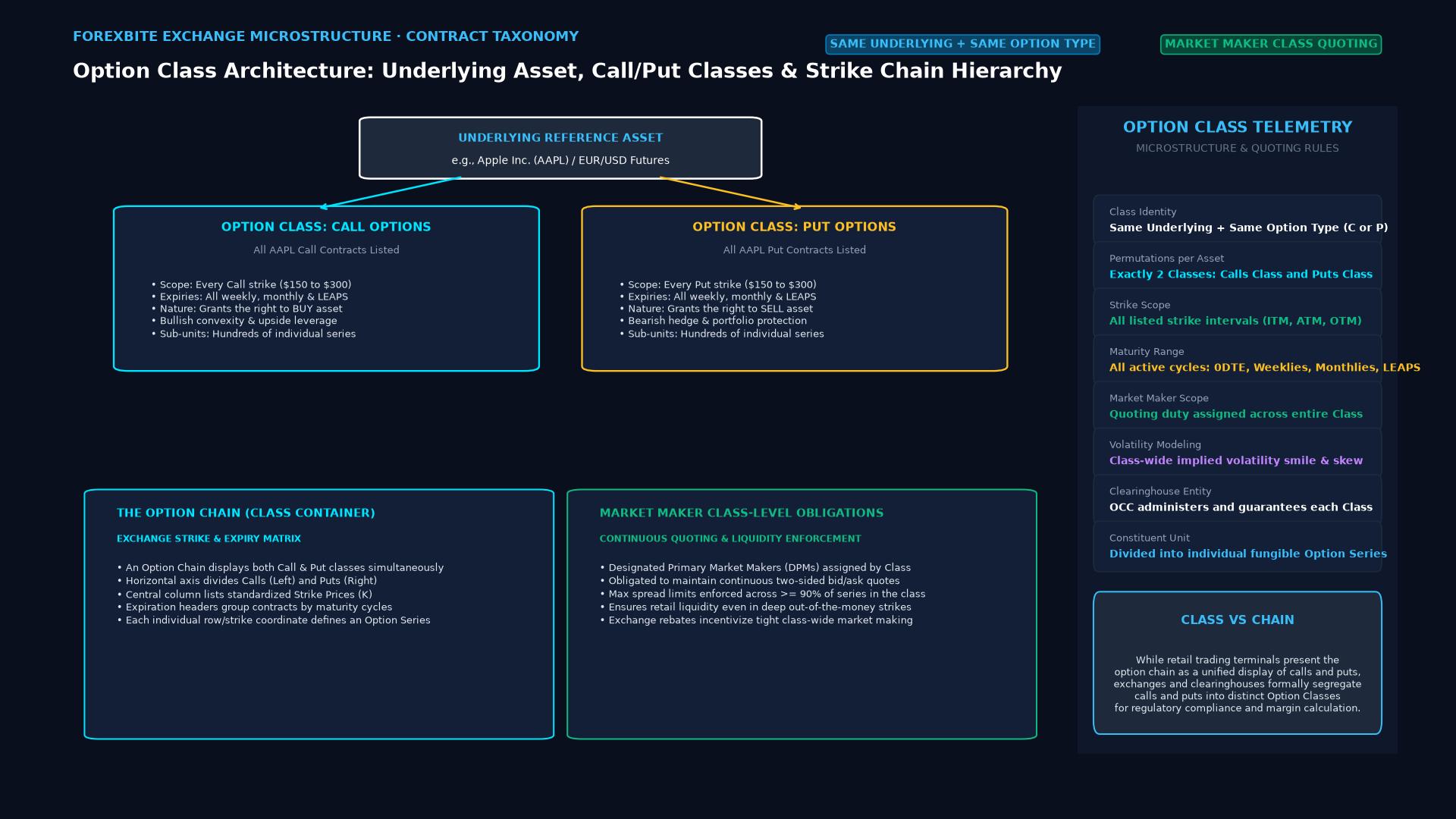
Hierarchy: Underlying Asset vs. Option Class vs. Option Series
Market participants navigate options chains by understanding the formal organizational taxonomy enforced by clearing institutions like the Options Clearing Corporation (OCC):
| Classification Level | Definition | Scope | Concrete Example |
|---|---|---|---|
| 1. Underlying Asset | The base financial instrument from which derivative value is derived. | The equity, currency, or commodity itself. | EUR/USD Spot Currency or Microsoft (MSFT) Stock |
| 2. Option Class | All options of the same type (Call or Put) on the identical underlying asset. | Spans all strike prices and all expiration dates. | MSFT Calls (All MSFT Call options) |
| 3. Option Series | The specific, discrete contract defined by a single strike price and expiration date. | The individual, tradeable contract line item. | MSFT Oct 18 $440 Call |
Market Maker Quoting and Class Volatility
On major options exchanges—such as the Chicago Board Options Exchange (CBOE) and the International Securities Exchange (ISE)—designated Primary Market Makers (PMMs) and Lead Market Makers (LMMs) are assigned responsibilities at the option class level:
1. Class-Level Continuous Quoting Obligations
A market maker assigned to the EUR/USD or Nvidia (NVDA) option class does not select individual strike prices at whim. Regulatory exchange rules obligate them to provide continuous two-way bid/ask quotations across a statutory percentage of the entire option class (including near-the-money and out-of-the-money strikes across active expiration months).
2. The Volatility Surface of an Option Class
Quantitative desks analyze an option class as a unified three-dimensional mathematical structure known as the Implied Volatility Surface. While every contract in a class has its own discrete premium, the implied volatility across strikes (the volatility smile/skew) and across expirations (the term structure of volatility) is modeled cohesively across the entire option class.
                  THE OPTION CLASS VOLATILITY SURFACE

   Implied
   Volatility (%)
        ^
     45 |           *                             *   (OTM Put Skew)
     35 |               *                     *
     25 |                   *      *      *           (ATM Baseline)
        +---------------------------------------------> Strike Price ($)
                           380    400    420
                              (Put Class)
Real-World Case Study: Institutional Class Sweeps
On a high-volume trading day ahead of a Federal Reserve FOMC interest rate decision, an institutional volatility arbitrage fund observed unusual call activity across the broad financial sector.
- Target Asset: Financial Select Sector SPDR Fund (XLF).
- Execution Behavior: Instead of buying a massive block of a single specific option series (which would rapidly deplete liquidity at that strike and cause substantial price slippage), the fund’s algorithmic smart router executed an Option Class Sweep.
- Order Slicing: The algorithm simultaneously bought:
- 2,500 contracts of XLF Oct 38 Calls
- 3,000 contracts of XLF Oct 39 Calls
- 2,000 contracts of XLF Nov 40 Calls
- Impact: By distributing buying pressure across multiple series within the XLF Call Option Class, the fund captured sector-wide upside convexity while minimizing market impact and avoiding triggering single-series circuit breakers.
Frequently Asked Questions
Can an option class contain both calls and puts?
No. In strict institutional and regulatory definitions, calls and puts on the same underlying asset represent two separate option classes (e.g., the Tesla Call class and the Tesla Put class). When both calls and puts on a single security are discussed collectively, market participants refer to them as all the options on that underlying.
How does corporate action (e.g., stock split) affect an option class?
When an underlying corporation executes a stock split, reverse split, or spin-off, the Options Clearing Corporation (OCC) issues an adjustment memo that alters the contract terms across the entire option class. For instance, in a 2-for-1 stock split, all strike prices in the class are halved, while the number of contracts held is doubled.
What is the difference between an option class and an option series?
An option class includes all contracts of the same type (all calls or all puts) across all strikes and expirations on a given asset. An option series is the specific, individual contract within that class that shares the exact same strike price and expiration date (e.g., Apple Jan 2025 $200 Call).
Ready to trade forex?
Open a free demo account with a regulated broker. Practice with virtual funds before risking real money.