Opening Purchase
An opening purchase (commonly designated as "Buy to Open" or BTO) is an options or futures transaction in which an investor purchases a contract to initiate a brand-new long market position, thereby becoming the holder of the contract rather than liquidating an existing commitment.
What Is an Opening Purchase?
In derivatives trading, an opening purchase—formally designated on institutional and retail order tickets as Buy to Open (BTO)—is a transaction executed by an investor to establish a new long derivative position. By executing an opening purchase, the market participant pays an upfront cash premium to acquire the contractual rights embodied in the contract (becoming the option holder or long futures trader), rather than offsetting or buying back a short obligation.
Because derivatives markets maintain open interest that expands or contracts with trading activity, clearinghouses like the Options Clearing Corporation (OCC) require order tickets to explicitly differentiate between orders that create new risk (opening transactions) and orders that extinguish existing risk (closing transactions).
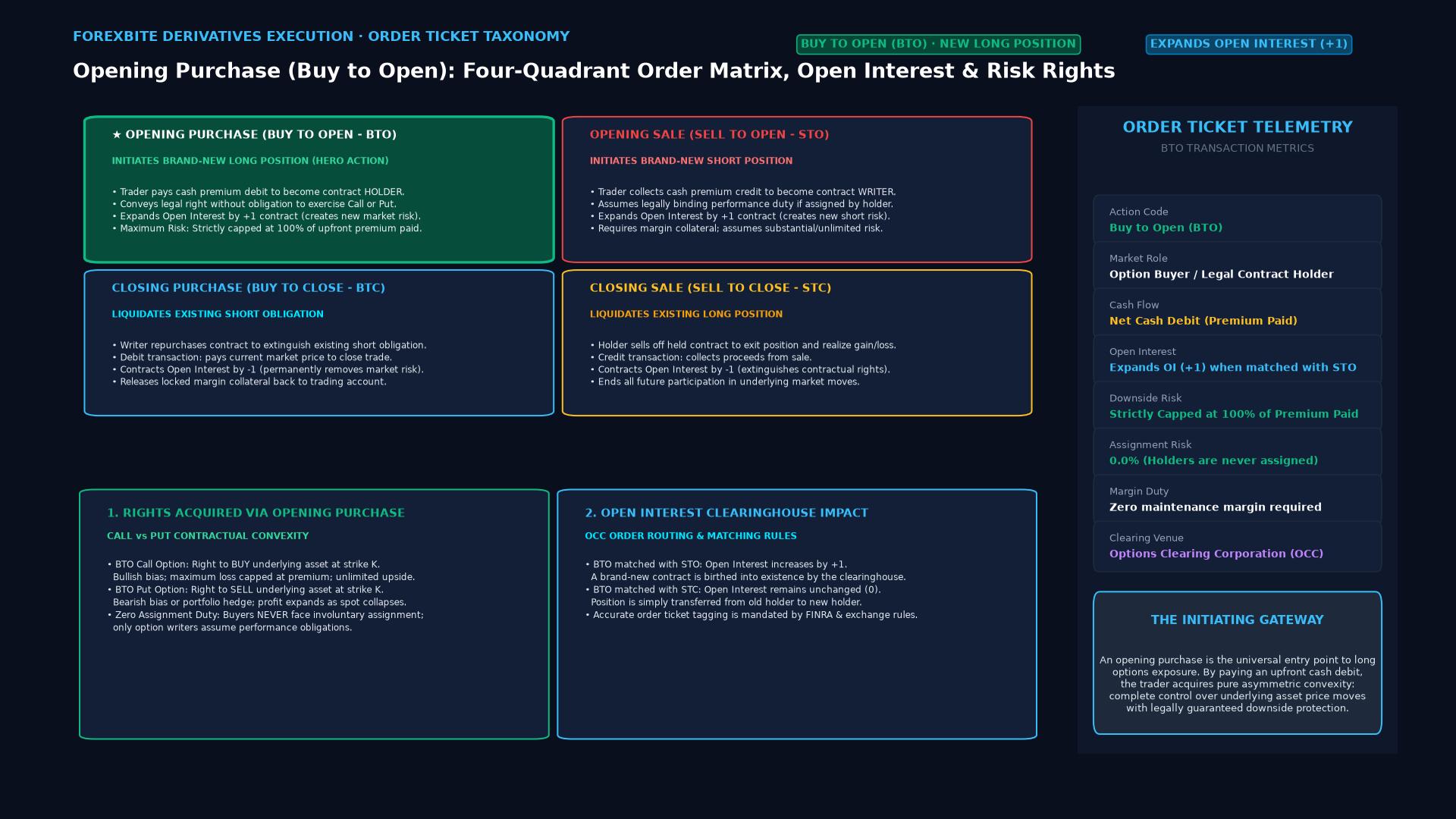 Figure: The four-quadrant derivative order matrix contrasting opening purchase (Buy to Open) with opening sale, closing purchase, and closing sale.
Rights Acquired via an Opening Purchase
When an investor executes an opening purchase, the rights conferred depend on whether the contract acquired is a Call or a Put:
1. Opening Purchase of a Call Option
- Contractual Right: The holder acquires the legal right—but not the obligation—to purchase 100 shares of the underlying asset (or specified currency notional) at the designated strike price on or before the expiration date.
- Investment Outlook: Strongly bullish on the underlying asset’s price, or seeking upside volatility expansion.
- Maximum Risk: Strictly capped at the total premium paid (plus transaction commissions).
- Maximum Potential Gain: Mathematically unlimited as the underlying asset price rises.
2. Opening Purchase of a Put Option
- Contractual Right: The holder acquires the legal right to sell 100 shares of the underlying asset at the strike price on or before expiration.
- Investment Outlook: Bearish on the underlying asset, or seeking an asymmetric downside hedge against an existing equity or currency portfolio.
- Maximum Risk: Strictly capped at the total premium paid.
- Maximum Potential Gain: Substantial, capped only if the underlying asset declines to zero.
Market Impact: Open Interest vs. Trading Volume
Every opening purchase alters market microstructure metrics depending on whether the counterparty is also opening or closing:
| Buyer Action | Seller Action | Impact on Trading Volume | Impact on Open Interest (OI) |
|---|---|---|---|
| Opening Purchase (BTO) | Opening Sale (STO) | Volume increases by 1 contract | Open Interest Increases (+1) (A brand-new contract is created by the OCC). |
| Opening Purchase (BTO) | Closing Sale (STC) | Volume increases by 1 contract | Open Interest Unchanged (0) (The contract is simply transferred from old holder to new holder). |
| Closing Purchase (BTC) | Closing Sale (STC) | Volume increases by 1 contract | Open Interest Decreases (-1) (The contract is permanently extinguished from the market). |
$$\Delta \text{Open Interest} = (\text{BTO} - \text{STC}) \quad \text{aggregated across market participants}$$
The Financial Cash Flows of an Opening Purchase
Unlike equity trading where capital can be borrowed on margin, an opening purchase of standard exchange-traded options requires 100% upfront cash payment:
- Debit Flow: The premium is immediately deducted from the trader’s cash purchasing power.
- No Margin Call Risk: Because the buyer’s risk is strictly limited to the premium paid, long options do not generate margin calls or maintenance margin requirements.
- Theta Decay (Time Value): As days pass toward contract expiration, the market value of the option decays due to time erosion (Theta), meaning the buyer needs sufficient directional movement or volatility spikes to overcome daily time decay.
Real-World Case Study: Hedging Currency Exposure with an Opening Purchase
In September 2023, a European manufacturing firm was scheduled to receive a payment of $10,000,000 USD from an American customer in December 2023. The prevailing spot rate was 1.0650 EUR/USD.
- The Exposure: If the Euro strengthened (EUR/USD rising to 1.1200), the firm’s $10M USD would convert into fewer Euros, severely reducing operational profit margins.
- The Execution (Opening Purchase): Instead of locking in a fixed forward, the corporate treasury executed an opening purchase (Buy to Open) of 100 EUR/USD Call option contracts (each covering €100,000, total notional €10,000,000) with a strike price of 1.0700 expiring in December, paying a premium of $0.0150 per Euro ($150,000 total debit).
- The Outcome: By December, macroeconomic rate cuts weakened the US dollar, pushing EUR/USD spot to 1.1000.
- Financial Payoff: $$\text{Gross Option Value at Expiry} = (1.1000 - 1.0700) \times €10{,}000{,}000 = $300{,}000$$ $$\text{Net Hedging Gain} = $300{,}000 - $150{,}000 \ \text{premium paid} = +$150{,}000$$
- The opening purchase successfully established a floor on their conversion rate while maintaining operational participation in favorable moves.
Frequently Asked Questions
What happens if I accidentally select “Buy to Close” instead of “Buy to Open”?
If you do not hold an existing short position in that exact option series, your brokerage trading platform will automatically reject the order with an error message stating “No existing short position to close.” You must select “Buy to Open” to initiate a new trade.
Does an opening purchase require a margin account?
No. An opening purchase of long calls or long puts can be executed in a standard cash account because the trader pays the full contract premium upfront and cannot lose more money than originally invested. Margin accounts are only mandatory when executing opening sales (writing uncovered options).
What is the difference between an opening purchase and an opening sale?
An opening purchase involves buying a contract to establish a long position, paying premium upfront with capped risk. An opening sale (Sell to Open) involves selling a contract you do not own to establish a short position (writing), collecting premium upfront while assuming contractual obligations that carry potentially substantial or unlimited risk.
Ready to trade forex?
Open a free demo account with a regulated broker. Practice with virtual funds before risking real money.