Package Deal
A package deal is a multi-leg financial transaction involving two or more distinct, interdependent orders or derivative contracts—such as options spreads, cross-currency swaps, or spot-deposit combinations—that are negotiated, priced, and executed simultaneously as a single atomic order at a net price.
What Is a Package Deal?
In financial market microstructure, institutional foreign exchange, and options trading, a package deal (often designated as a multi-leg order, complex order, or combo) is a transaction that bundles two or more distinct financial contracts into a single unified execution instruction. Rather than submitting separate individual orders for each leg—which introduces severe execution leg-risk (the risk that one leg fills while the other fails or slips)—a package deal is executed on an all-or-none, atomic basis at a single net price.
Package deals are ubiquitous across institutional treasury departments, hedge funds, and sophisticated retail derivatives platforms. They allow market participants to construct complex payoff profiles, hedge multiple correlated risks, and exploit volatility mispricings while locking in net spread economics.
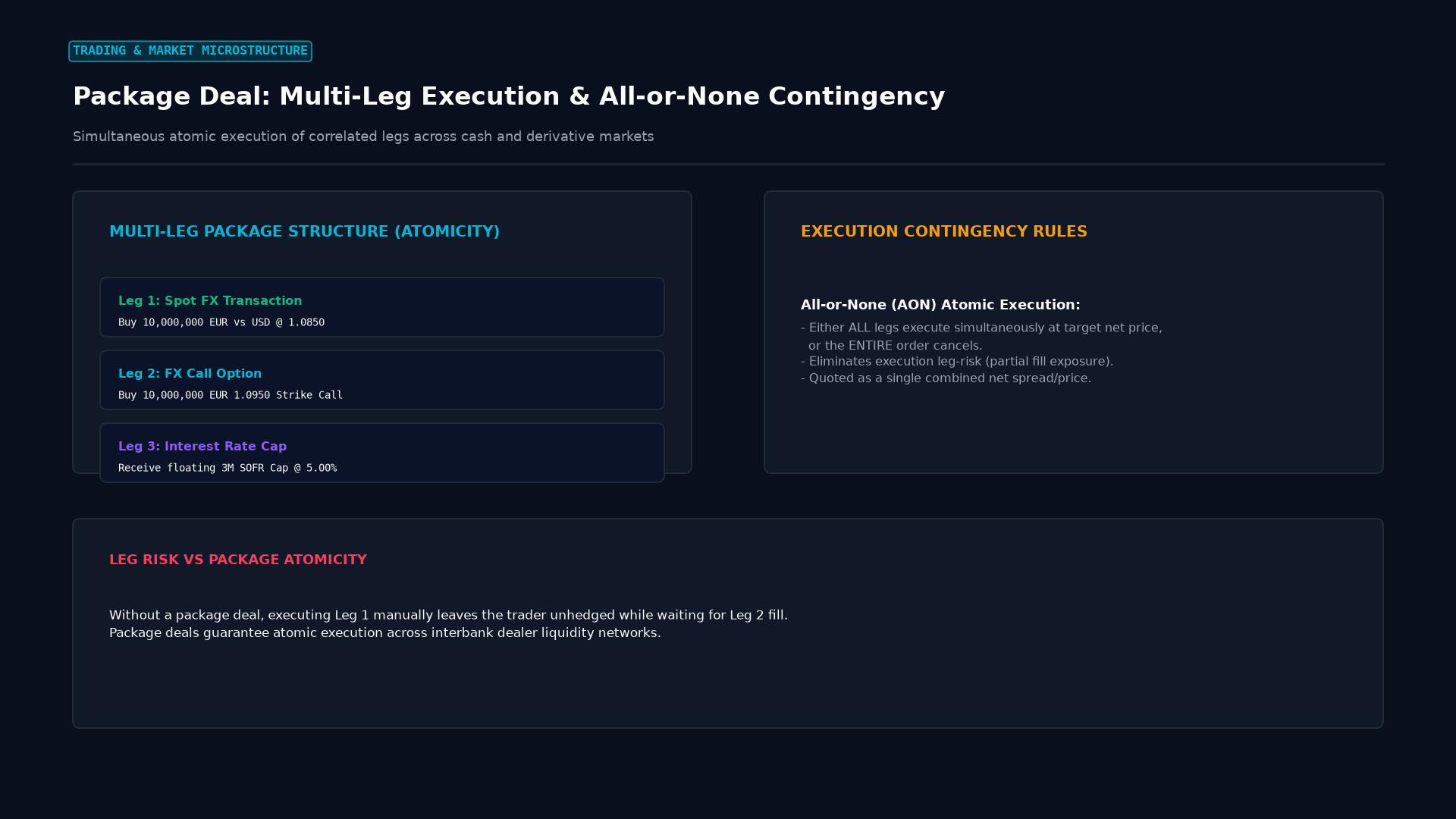 Figure: Multi-leg atomic order execution: bundling spot FX, currency options, and interest rate swaps into a single all-or-none transaction.
Common Institutional Package Deals
Financial institutions deploy package deals across various asset classes to accomplish structured risk objectives:
1. Complex Options Structures
On options exchanges (such as CBOE and ISE), electronic Complex Order Books (COBs) match multi-leg options packages without exposing the trader to legging risk:
- Straddles and Strangles: Simultaneously buying (or selling) a call and a put on the same underlying asset with the same expiration to trade pure volatility.
- Vertical and Calendar Spreads: Buying an option at one strike/expiration while selling an option at another strike/expiration to define capped risk and reward.
- Risk Reversals (Cylinder / Collar): In corporate FX hedging, simultaneously buying an out-of-the-money call and selling an out-of-the-money put to construct a zero-cost currency insurance collar.
2. Spot-Forward Combinations (FX Swaps)
In foreign exchange dealing, corporate treasurers frequently bundle an outright spot currency purchase with an opposing forward sale as a package deal to roll cash liquidity without exposing the firm to directional currency fluctuations.
3. Basis and Inter-Commodity Spreads
In futures markets (CME), agricultural and energy traders submit package deals to trade commodity price differentials—such as the Crack Spread (simultaneously buying crude oil futures while selling refined gasoline and heating oil futures) or the Spark Spread in power markets.
Complex Order Routing: The Net Price Concept
When submitting a package deal, the trader does not bid or offer on the individual prices of each component. Instead, the order specifies a Net Debit (amount paid) or Net Credit (amount received) for the entire combined structure:
$$\text{Net Package Price} = \sum \text{Debit Legs} - \sum \text{Credit Legs}$$
| Multi-Leg Package | Component Legs | Net Pricing Structure | Execution Objective |
|---|---|---|---|
| Bull Call Spread | Long Strike $A$ Call ($+$) + Short Strike $B$ Call ($-$) | Net Debit: Pays net difference between premiums. | Capped bullish upside with reduced upfront capital cost. |
| Iron Condor | Bull Put Spread ($+$) + Bear Call Spread ($+$) | Net Credit: Collects net premium. | Market-neutral volatility harvesting; profits if price stays range-bound. |
| FX Risk Reversal | Long OTM Call ($+$) + Short OTM Put ($-$) | Zero-Cost / Minor Net Debit: Premiums offset. | Asymmetric FX downside protection without net premium cash drain. |
| Box Spread | Bull Call Spread ($+$) + Bear Put Spread ($+$) | Net Debit: Fixed present value of strike distance. | Synthetic cash borrowing/lending; interest rate arbitrage. |
Regulatory and Margin Efficiencies
Regulators (including the US CFTC and SEC) and clearinghouses (such as OCC and CME Clearing) grant significant capital and margin relief to package deals compared to individual unlinked positions:
- Portfolio Margin Netting: Because the legs of a recognized package deal offset each other’s risk profile, the clearinghouse calculates margin based on the maximum net loss of the entire package, rather than summing the gross margin requirements of each leg.
- Execution Fairness: Under exchange rules, package deals resting on the complex order book cannot trade through the synthetic Net Best Bid and Offer (NBBO) derived from the individual leg markets, ensuring fair execution.
Real-World Case Study: Zero-Cost FX Collar for an Importer
In May 2023, a UK automotive distributor needed to purchase €50,000,000 worth of German vehicles with delivery and payment due in November 2023. Prevailing spot EUR/GBP was 0.8650.
- The Corporate Mandate: The CFO required hard insurance against the Euro surging above 0.8900, but had a strict budget permitting zero net cash expenditure on option premiums.
- The Package Execution: The treasury desk executed a Zero-Cost Risk Reversal Package Deal with an investment bank:
- Leg 1: Buy €50,000,000 EUR Call / GBP Put at strike 0.8900 (Cost: 1.25% premium).
- Leg 2: Sell €50,000,000 EUR Put / GBP Call at strike 0.8450 (Revenue: 1.25% premium).
- Net Package Price: Exactly 0.00% (Zero-Cost).
- The Outcome: The bank executed both legs simultaneously as a single atomic package deal. The company successfully guaranteed that its maximum purchase price for Euros would never exceed 0.8900, funding the protection entirely by agreeing to surrender gains if the Euro dropped below 0.8450—achieving complete budget certainty without cash outlay.
Frequently Asked Questions
What is “legging risk” and how does a package deal eliminate it?
Legging risk occurs when a trader attempts to enter a multi-leg strategy manually by submitting one order after another. If the first leg fills and the market moves sharply before the second leg can fill, the trader is left holding unhedged directional exposure. A package deal eliminates legging risk by executing all legs simultaneously or rejecting the entire bundle.
Can a package deal include different asset classes?
Yes. Multi-asset package deals (such as cross-market hedging or convertible bond arbitrage) bundle equities, bonds, and derivatives into a single synchronized trade, typically executed over-the-counter through institutional prime brokers.
Do package deals incur higher brokerage commissions?
Most retail and institutional brokers charge per-contract or per-ticket fees on each underlying leg executed within the package (e.g., paying for two legs in a vertical spread). However, the elimination of slippage and the margin relief granted to defined-risk packages generally far outweigh the incremental per-contract commission.
Ready to trade forex?
Open a free demo account with a regulated broker. Practice with virtual funds before risking real money.