Par Spread
In fixed income derivatives and credit markets, the par spread is the fixed annual interest rate or coupon spread (expressed in basis points) that equates the present value of a swap's or credit default swap's cash flows to par (zero net present value) at contract inception.
What Is a Par Spread?
In modern quantitative finance, interest rate swaps (IRS), and Credit Default Swaps (CDS), the par spread (often referred to as the par swap rate or CDS par spread) is the contractual fixed coupon or annual spread that prices a new derivative contract at fair value (par) at trade inception.
Under standard derivative pricing theory, when two institutional counterparties enter a swap contract, neither party pays an upfront cash exchange to the other ($\text{Net Present Value} = 0$). To achieve this equilibrium, the fixed rate or spread exchanged throughout the life of the contract must be mathematically calibrated such that the expected discounted present value of all fixed cash flows exactly equals the expected discounted present value of the floating cash flows:
$$\text{PV}(\text{Fixed Leg Cash Flows}) = \text{PV}(\text{Floating Leg Cash Flows}) \iff \text{NPV} = 0$$
The specific fixed rate that satisfies this mathematical equation is designated as the par spread.
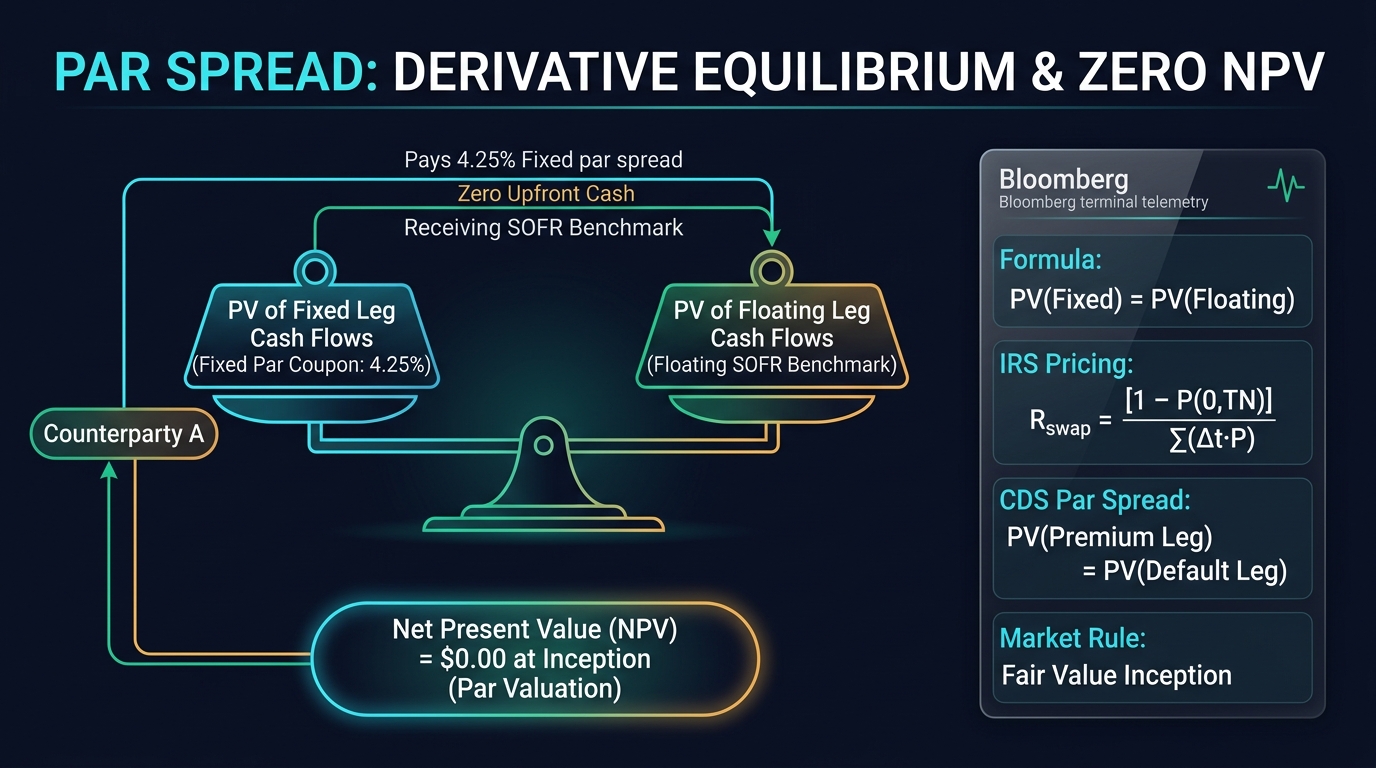
                   THE PAR SPREAD EQUILIBRIUM AT INCEPTION

  Fixed Rate Payer                             Floating Rate Payer
         |                                              |
         | ===== Pays Fixed PAR SPREAD (e.g., 4.25%) => |
         |                                              |
         | <==== Receives Floating SOFR Benchmark ===== |
         |                                              |
         +----------------------------------------------+
                                |
                   NPV OF CONTRACT = EXACTLY $0.00
            (Zero upfront cash required; contract trades at Par)
Par Spread Across Financial Derivatives
The par spread concept operates across two core sectors of institutional capital markets:
1. Interest Rate Swaps (IRS): The Par Swap Rate
In a plain-vanilla fixed-for-floating interest rate swap, Counterparty A pays a fixed interest rate, while Counterparty B pays a floating benchmark (such as SOFR in the US, €STR in Europe, or SONIA in the UK).
- The Par Swap Rate is the fixed coupon rate ($R_{\text{swap}}$) that makes the swap worth zero at inception.
- Mathematical Formula: $$R_{\text{swap}} = \frac{1 - P(0, T_N)}{\sum_{i=1}^N \Delta t_i \times P(0, T_i)}$$ Where $P(0, T_i)$ is the discount factor for maturity $T_i$, and $\Delta t_i$ is the year fraction for payment period $i$.
2. Credit Default Swaps (CDS): The CDS Par Spread
In credit derivatives, a Credit Default Swap acts as an insurance policy against the bankruptcy or default of a sovereign or corporate debt issuer.
- The protection buyer pays an ongoing premium (the CDS spread) to the protection seller.
- The CDS Par Spread (quoted in basis points per year, e.g., 85 bps) is the premium that equates the present value of the expected premium leg to the present value of the expected default protection leg (contingent on the issuer’s default probability and loss given default): $$\text{PV}(\text{Premium Leg}) = \text{PV}(\text{Default Leg})$$
Standardized Swaps vs. Par Spreads: The Role of Upfront Points
Historically, all swaps and CDS were traded directly at their par spread with zero upfront cash. However, following the 2008 financial crisis, global derivatives regulators (via the Dodd-Frank Act in the US and EMIR in Europe) mandated central clearing and standardization:
| Operational Dimension | Historical Par Spread Quoting | Modern Standardized Quoting |
|---|---|---|
| Fixed Coupon | Set to the exact, fractional Par Spread (e.g., 4.3182%). | Standardized fixed coupons: 100 bps (investment grade) or 500 bps (high yield). |
| Upfront Cash Exchange | Exactly $0.00 at contract inception. | Buyer or seller pays an Upfront Fee to reconcile difference with Par Spread. |
| Clearing & Fungibility | Contracts had bespoke coupons; hard to net and clear. | High liquidity; identical coupons enable seamless central counterparty (CCP) netting. |
| Pricing Quotation | Quoted in basis points (spread). | Traded via standardized points upfront, but still converted to Par Spread for analysis. |
$$\text{Upfront Payment} \approx (\text{Par Spread} - \text{Standardized Coupon}) \times \text{Risky PV01}$$
Curve Dynamics: The Par Spread Curve
By calculating the par spread across consecutive maturities (1 year, 2 years, 5 years, 10 years, and 30 years), quantitative dealers construct the Par Swap Curve.
This curve serves as the global benchmark for pricing corporate bonds, municipal debt, commercial mortgages, and structured products. When financial analysts state that “the 10-year swap rate rose 5 basis points,” they are referring to an increase in the par spread required for a 10-year interest rate swap.
                  THE BENCHMARK PAR SWAP CURVE

   Par Swap Rate (%)
        ^
    5.0 |                                 *-------------*  (30Y Par: 4.80%)
    4.5 |                     *----------*  (10Y Par: 4.50%)
    4.0 |         *----------*  (5Y Par: 4.10%)
    3.5 | *------*  (2Y Par: 3.65%)
        +----------------------------------------------------> Tenor (Years)
          2Y      5Y          10Y                       30Y
Real-World Case Study: Hedging Commercial Real Estate Debt
In early 2023, a real estate development firm secured a $100,000,000 floating-rate construction loan tied to 3-month SOFR + 200 basis points.
- The Risk: The developer could not tolerate the risk of Federal Reserve rate hikes driving 3-month SOFR above 5.00%, which would push total debt servicing costs beyond project cash flow.
- The Solution: The developer approached an investment bank to enter a 5-year fixed-for-floating interest rate swap.
- Determining the Par Spread: The bank’s quantitative analytics system modeled discount factors from the zero-coupon yield curve and calculated that the 5-Year Par Swap Rate was 3.85%.
- Contract Execution:
- Developer pays the bank the fixed 3.85% par spread.
- Bank pays the developer floating 3-month SOFR.
- Net upfront cash paid: $0.00 (traded at par).
- The Result: The developer converted their uncertain floating borrowing cost into a guaranteed fixed loan rate of $3.85% + 2.00% = 5.85%$ for the next five years, completely eliminating interest rate volatility.
Frequently Asked Questions
What happens to the value of a swap after inception if market interest rates change?
At inception, a swap trades at par with an NPV of zero. As soon as market interest rates shift, the fixed par spread agreed in the contract no longer matches current market rates. The swap develops a positive mark-to-market value (an asset) for one party and an equal negative value (a liability) for the counterparty, requiring daily variation margin collateral exchange.
How does credit risk affect the CDS par spread?
The worse a borrower’s creditworthiness, the higher its CDS par spread. If an investment-grade corporation experiences earnings distress or debt downgrades, the CDS par spread required to insure its debt might surge from 60 basis points ($6,000/year per $1M protected) to 450 basis points ($45,000/year per $1M protected).
What is the difference between a zero-coupon yield and a par spread?
A zero-coupon yield (spot rate) is the interest rate earned on an investment that makes a single payment at maturity with no intermediate cash flows. A par spread is the coupon rate for a multi-period bond or swap that pays periodic intermediate cash flows and trades at exactly 100% of face value.
Ready to trade forex?
Open a free demo account with a regulated broker. Practice with virtual funds before risking real money.