Par
Par (short for par value or face value) refers to the stated nominal value of a financial instrument—such as the principal amount of a bond repaid at maturity—or an official exchange rate where two currencies trade at an exact 1:1 equilibrium ratio.
What Does “Par” Mean in Finance?
The term par—derived from the Latin par, meaning “equal”—holds two foundational definitions in international capital and foreign exchange markets:
- Fixed Income and Debt Securities: Par refers to the par value (face value or nominal value) of a bond, note, or bill—typically standardized at $1,000 for corporate bonds or 100% of face value for sovereign government debt (e.g., US Treasuries, UK gilts). It represents the exact principal capital amount the bond issuer promises to return to the investor upon final maturity.
- Foreign Exchange Markets: Par (or parity) designates an exact 1:1 exchange rate between two distinct sovereign currencies (such as EUR/USD = 1.0000 or USD/CHF = 1.0000), representing an equality of purchasing exchange ratio.
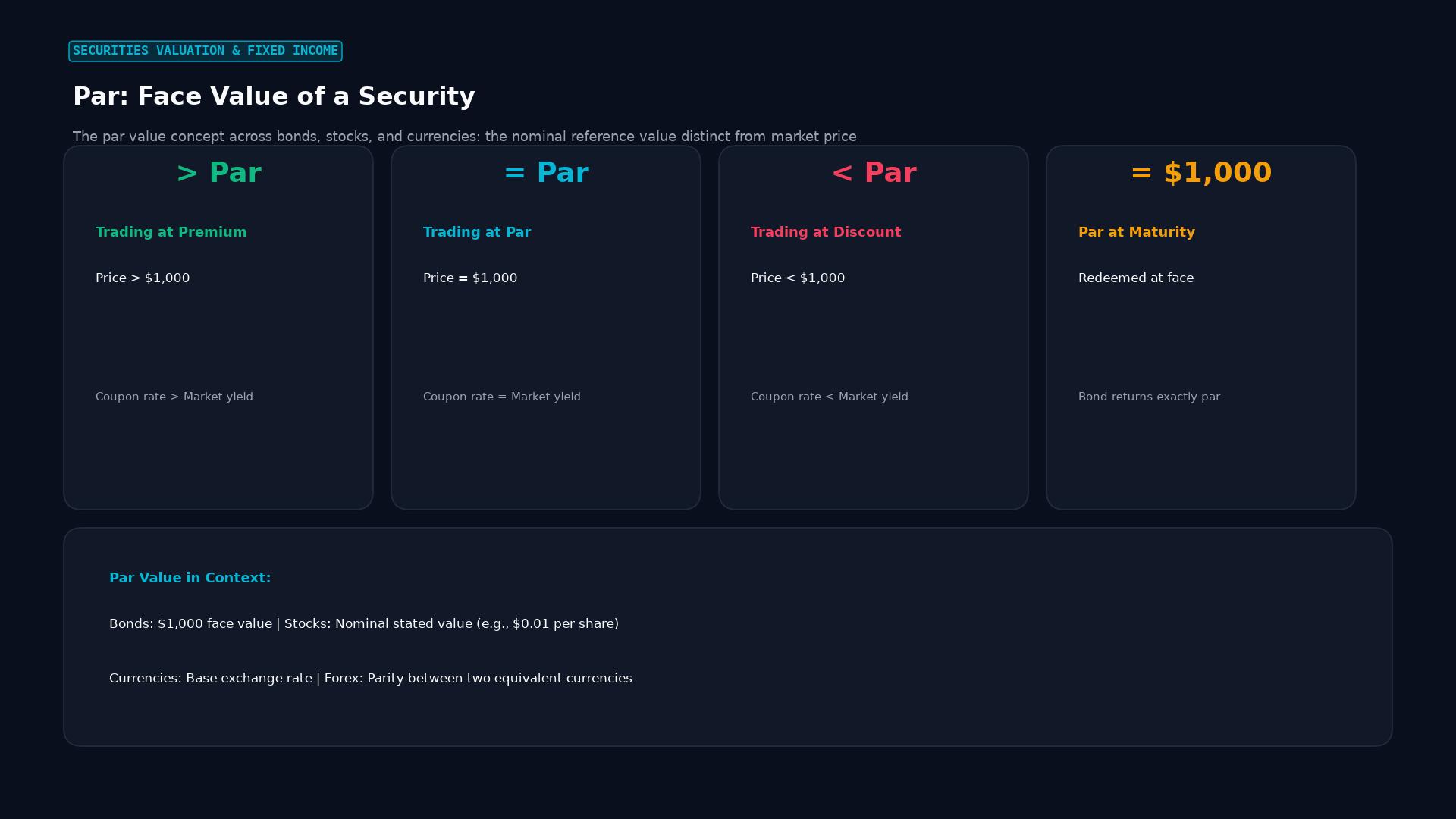 Figure: The par value concept across bonds, stocks, and currencies: the nominal reference value distinct from market price
Par in Fixed Income: Bonds and Debt Instruments
In bond markets, bond prices are expressed as a percentage of par value (where par equals 100.00):
1. Trading at Par (Price = 100.00)
A bond trades “at par” when its current secondary market trading price equals its original face value. Mathematically, a bond trades at par when the issuer’s contractual coupon rate exactly matches prevailing benchmark market interest rates for debt of identical maturity and credit risk. Under this condition:
$$\text{Yield to Maturity (YTM)} = \text{Current Yield} = \text{Coupon Rate}$$
2. Trading at a Discount (Price < 100.00)
If prevailing market interest rates rise above the bond’s contractual coupon rate, the bond’s secondary market price declines below par (e.g., trading at 94.50). The lower price compensates new buyers by boosting their total yield to maturity to competitive market levels.
3. Trading at a Premium (Price > 100.00)
If market interest rates fall below the bond’s coupon rate, existing bonds paying higher fixed interest become attractive. Investors bid the price up above par (e.g., trading at 106.20) until the effective yield drops to align with prevailing market rates.
Par in Foreign Exchange: The 1.0000 Parity Level
In foreign exchange trading, the term “par” refers to the psychological and macroeconomic threshold where one unit of the base currency equals exactly one unit of the quote currency:
$$\text{Currency Parity} \implies \text{Base Currency} = \text{Quote Currency} \quad (\text{Exchange Rate} = 1.0000)$$
| Currency Pair | Historical Parity Instances | Macroeconomic Context |
|---|---|---|
| EUR/USD Parity | 2000–2002 & July–November 2022 | European sovereign launch teething followed by the 2022 Russian energy supply crisis. |
| USD/CHF Parity | Frequent oscillator (2010–2023) | Natural historical equilibrium between the US Dollar and Swiss Franc safe-haven. |
| AUD/USD Parity | 2010–2013 Commodity Supercycle | Surging Chinese demand for Australian iron ore and coal drove the Aussie dollar above $1.00 USD. |
| USD/CAD Parity | 2007 & 2011–2012 | High global crude oil prices ($100+/barrel) propelled the Canadian “Loonie” to par with the US Dollar. |
In spot forex, par represents the ultimate psychological round number. Institutional market makers, sovereign wealth funds, and corporate treasuries place massive clusters of options barriers, stop-loss orders, and resting limit orders around 1.0000 parity levels.
Real-World Case Study: The 2022 EUR/USD Return to Parity
In July 2022, for the first time in two decades, the Euro fell to par (1.0000) against the US Dollar.
- Macro Catalysts:
- The European natural gas crisis following the escalation of the Russia-Ukraine war threatened severe industrial rationing in Germany.
- The US Federal Reserve initiated rapid 75-basis-point interest rate hikes, while the European Central Bank (ECB) lagged with negative deposit rates (-0.50%).
- The Psychological Battle at Par: As EUR/USD approached 1.0000, market microstructure on EBS and Reuters Matching saw unprecedented volume. Over $5 billion in Digital Barrier Options were tied to the 1.0000 strike:
- Option writers aggressively defended par by buying Euros at 1.0020.
- Trend-following CTAs and macro hedge funds flooded the market with sell orders to trigger the barrier.
- The Break: On July 13, 2022, EUR/USD cracked through 1.0000, falling to an intraday low of 0.9998. The barrier triggered, forcing automated knock-out liquidations that eventually propelled the pair down to 0.9535 by September before stabilizing.
       EUR/USD 2022 DESCENT THROUGH 1.0000 PARITY

 [1.0800: May 2022] ---> European Energy Crisis Accelerates
                                    |
 [1.0400: June 2022] --> Fed Delivers Jumbo 75 bps Rate Hikes
                                    |
 [1.0000: July 2022] --> BATTLE AT PARITY: Massive Options Barrier Defense
                                    |
 [0.9998: July 13] ----> Parity Breaks! Knock-Out Triggers Cascading Sells
                                    |
 [0.9535: Sept 2022] --> Cycle Trough Reached Before Eventual Recovery
Frequently Asked Questions
What is the par value of common stock?
In equity corporate finance, par value is an arbitrary nominal accounting figure printed on stock certificates (often $0.01 or $0.001 per share), required by corporate state statutes (like Delaware corporate law) for legal capital accounting. It bears zero correlation to the actual market value of the stock.
Does a bond always mature at par?
Yes. Unless the issuing company or government defaults or enters debt restructuring, the bondholder will receive exactly 100% of the bond’s par value ($1,000 per bond) upon the designated maturity date, regardless of whether they bought the bond at a premium ($1,050) or at a discount ($920).
What happens when an exchange rate crosses par?
When a major currency pair crosses 1.0000 par, it shifts market psychology and media headlines worldwide. In retail trading, it alters quoting perception because the base currency becomes cheaper than the quote currency, often triggering large-scale algorithmic execution flows and rebalancing in global sovereign reserve portfolios.
Ready to trade forex?
Open a free demo account with a regulated broker. Practice with virtual funds before risking real money.