Parity
Parity denotes a state of price, rate, or value equality in financial markets—specifically referring to an option trading at its exact intrinsic value with zero time premium, a currency exchange rate trading at an exact 1:1 ratio, or the no-arbitrage equilibrium established by Put-Call Parity.
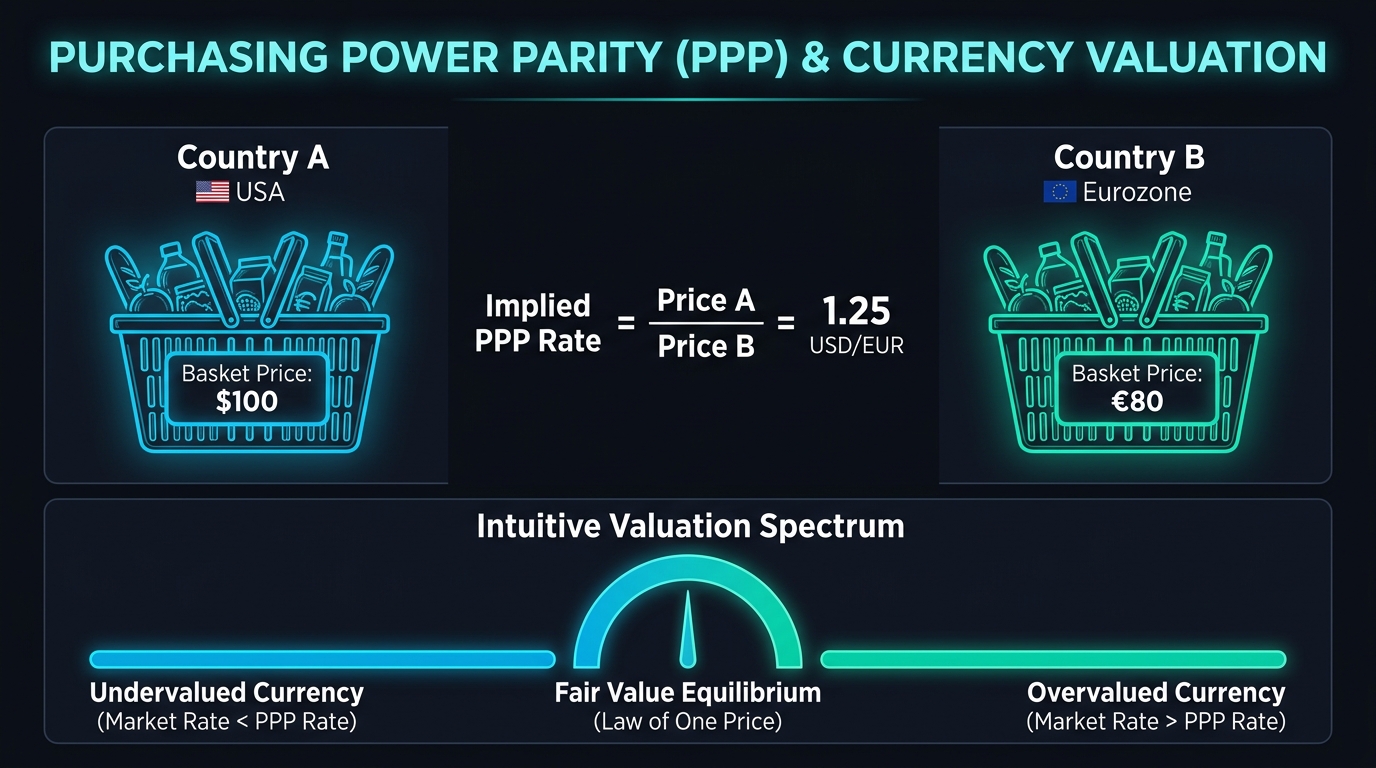
What Is Parity in Financial Markets?
The term parity—derived from the Latin paritas, signifying absolute equality—is a multi-dimensional concept utilized across derivatives pricing, foreign exchange markets, and macroeconomic theory:
- Options Market Parity (Zero Time Value): An option contract trades “at parity” when its total market price (premium) is identical to its intrinsic value, containing zero remaining extrinsic value (time premium). In this state, buying and immediately exercising the option yields the exact same financial payoff as buying or selling the underlying asset directly on the cash exchange.
- Put-Call Parity: The foundational mathematical law of options arbitrage that equates the price of a European call option and a European put option of identical strike and expiration to the underlying asset price and risk-free interest rate.
- Foreign Exchange Parity: The milestone state where two currencies trade at an exact 1:1 exchange rate (e.g., EUR/USD = 1.0000 or USD/CHF = 1.0000).
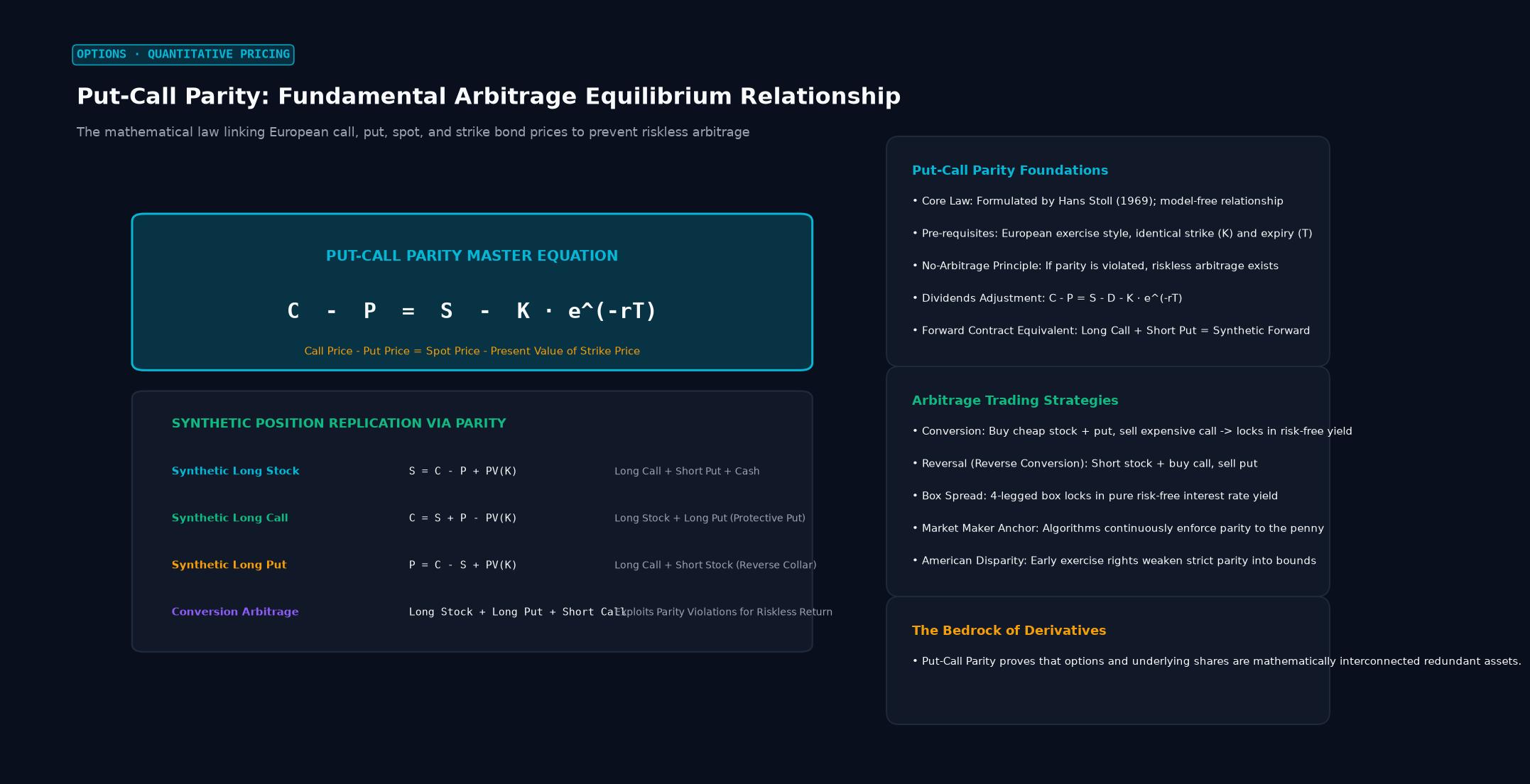 Figure: The mathematical law linking European call, put, spot, and strike bond prices to prevent riskless arbitrage
Options Trading at Parity
In derivatives microstructure, when an option trades “at parity,” the writer of the option receives zero premium compensation for bearing time decay or volatility risk:
$$\text{Option Premium} = \text{Intrinsic Value} \implies \text{Extrinsic Value} = 0$$
Why Options Trade at Parity
- Expiration Day (Zero Days to Expiration - 0DTE): As the clock runs down to the final minutes of trading on expiration Friday, time value completely evaporates ($\Theta \to 0$). In-the-money options trade at pure parity.
- Deep In-the-Money Options: When an option is deep in-the-money (e.g., holding a Delta of 0.99), market makers price the contract with virtually zero time value because the probability of the contract finishing out-of-the-money is near zero.
- Cost of Carry and Early Exercise: For American-style call options on dividend-paying stocks, deep ITM calls often trade at parity immediately prior to the ex-dividend date, prompting institutional holders to exercise early to capture the cash dividend.
The Put-Call Parity Theorem
Formulated by Hans Stoll in 1969, Put-Call Parity defines the static no-arbitrage relationship between European call and put options having the same strike price ($K$) and expiration date ($T$) on an underlying asset ($S$):
$$C + K \cdot e^{-rT} = P + S$$
Where:
- $C$ = Price of the European Call Option.
- $P$ = Price of the European Put Option.
- $S$ = Current Spot Price of the Underlying Asset.
- $K \cdot e^{-rT}$ = Present value of the strike price discounted at risk-free rate $r$.
                       PUT-CALL PARITY ARBITRAGE BALANCE

          FIDUCIARY CALL                        PROTECTIVE PUT
      [Long Call + Zero-Coupon Bond]       [Long Put + Long Stock]
                 C + K*e^(-rT)         =          P + S
                       |                            |
                       +============================+
                                      |
                      If Fiduciary Call > Protective Put:
                      Sell Call + Borrow, Buy Put + Stock
                              (Synthetic Arbitrage)
If market prices deviate from this strict mathematical equality, institutional quantitative desks execute riskless reversal or conversion arbitrage trades, buying the undervalued synthetic combination and shorting the overvalued side until parity is restored.
Foreign Exchange Parity (1:1 Ratio)
In foreign exchange dealing rooms, parity denotes an exchange rate of exactly 1.0000:
| Currency Pair | Significance of Parity | Historical Market Impact |
|---|---|---|
| EUR/USD (Euro Parity) | Historical parity milestone. Reached during launch (2000–2002) and European energy shock (July–November 2022). | Triggers multi-billion-dollar barrier options knock-outs; shifts international corporate purchasing budgets. |
| USD/CHF (Swiss Parity) | Frequent equilibrium benchmark between US Dollar and Swiss Franc. | Serves as psychological anchor for Swiss National Bank (SNB) export competitiveness. |
| AUD/USD (Aussie Parity) | Reached during the 2010–2013 mining boom. | Boosted Australian consumer import power while challenging domestic manufacturing. |
Real-World Case Study: Put-Call Parity Arbitrage in Hard-to-Borrow Stocks
In early 2021 during the retail meme-stock phenomenon, heavily shorted equities (such as GameStop - GME and AMC Entertainment) experienced severe share shortages in the securities lending market:
- The Market Distortion: Short-borrow borrow fees surged above 100% annualized, making physical shorting nearly impossible for hedge funds.
- The Put-Call Disparity: Retail traders flooded the market with out-of-the-money call purchases. Under standard Put-Call Parity: $$S = C - P + K \cdot e^{-rT}$$ Because call premiums exploded relative to puts, synthetic short positions constructed via options traded at a steep discount to the cash stock price on the NYSE.
- The Arbitrage Execution: Proprietary algorithmic market makers who held inventory of hard-to-borrow shares sold expensive physical stock at $300, simultaneously bought synthetic long stock (Long Call + Short Put) at an effective price of $275, and locked in a riskless $25.00 per share arbitrage spread while holding the position until options expiration.
Frequently Asked Questions
Can an option trade below parity?
In theoretical European options models, an option should never trade below parity (which would imply negative time value). However, in real-world American-style options on hard-to-borrow stocks with massive short-borrow fees, deep in-the-money puts occasionally trade slightly below parity because the cost of financing or shorting the underlying shares exceeds the theoretical premium.
What is the difference between Par and Parity?
While derived from the same root:
- Par typically refers to the nominal face value of a debt security (e.g., a $1,000 bond trading at 100% of face value).
- Parity refers to an ongoing condition of equality—either an option trading at its intrinsic value, two currencies trading at 1:1, or the balance between puts and calls.
Does Put-Call Parity apply to American-style options?
Strict Put-Call Parity applies mathematically to European-style options (which can only be exercised at expiration). For American-style options—which can be exercised early—Put-Call Parity is expressed as an inequality band rather than an exact equality, due to the added economic value of early exercise rights.
Ready to trade forex?
Open a free demo account with a regulated broker. Practice with virtual funds before risking real money.