Dirty Float (Managed Float)
A dirty float, or managed float, is an exchange rate regime where a national currency's market value is primarily determined by open market supply and demand, but the central bank periodically intervenes to mitigate extreme volatility or defend strategic economic boundaries.
What Is a Dirty Float (Managed Float)?
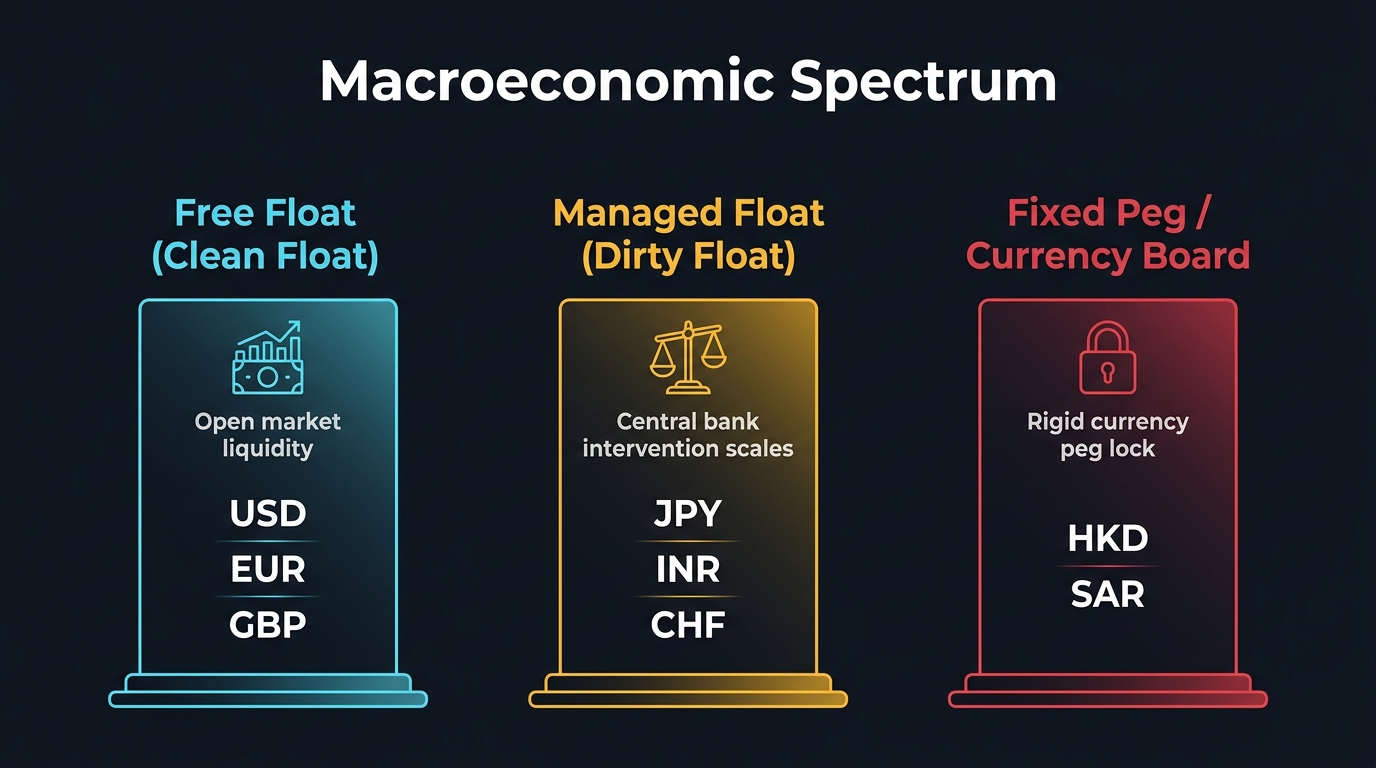
A dirty float—officially known in macroeconomic literature as a managed floating exchange rate regime—is a hybrid monetary framework situated between a purely flexible (clean) float and a rigid currency peg. Under a dirty float, the exchange rate fluctuates continuously in response to private capital flows, export-import balances, and international investment sentiment. However, the domestic monetary authority or central bank reserves the right to intervene directly in foreign exchange markets when price swings threaten economic stability.
Unlike a fixed exchange rate regime, a managed float does not establish a publicly announced, immutable peg against another currency or a basket of commodities. Instead, monetary policymakers maintain discretionary boundaries or undisclosed target corridors. When market speculation pushes the national currency outside these comfort zones, the central bank enters the interbank market as an active buyer or seller.
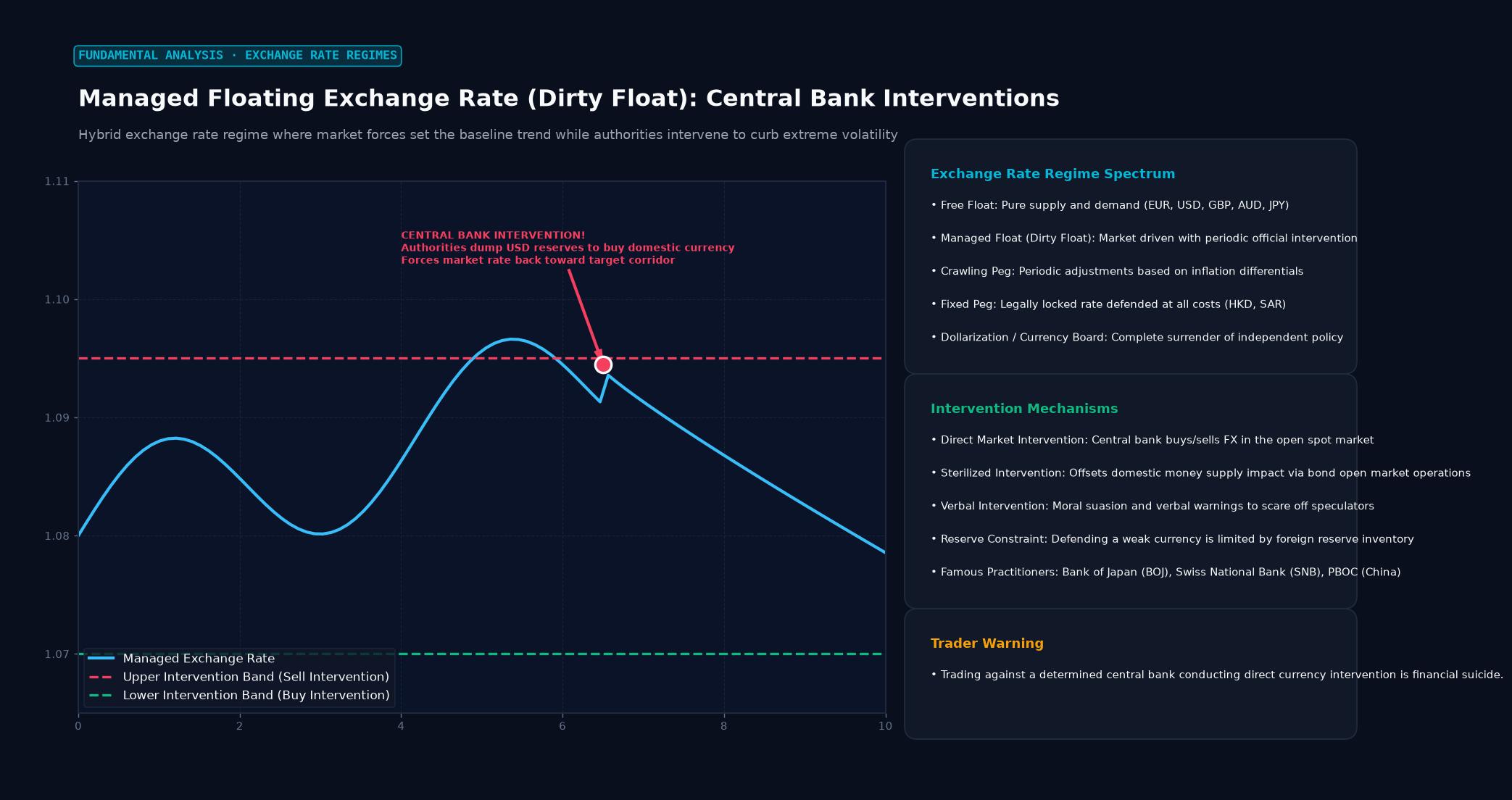 Figure: Hybrid exchange rate regime where market forces set the baseline trend while authorities intervene to curb extreme volatility
How Central Banks Intervene Under a Managed Float
Monetary authorities execute foreign exchange management through three primary operational mechanisms:
1. Direct Reserve Operations
When a central bank deems its currency excessively weak, it deploys foreign currency reserves (typically US Treasury bonds or Eurobonds), liquidates them, and uses the foreign currency proceeds to buy its own domestic currency on the spot market. This creates immediate, non-commercial buying pressure. Conversely, if the currency is appreciating too rapidly and threatening export competitiveness, the bank prints domestic currency to purchase foreign currencies, expanding its official foreign exchange reserves.
2. Sterilized vs. Unsterilized Interventions
- Sterilized Intervention: To prevent FX interventions from destabilizing domestic liquidity and inflation, the central bank conducts offsetting open market operations. If the bank buys domestic currency with foreign reserves, it concurrently purchases domestic government securities to inject liquidity back into commercial banking reserves. The net domestic money supply remains unchanged.
- Unsterilized Intervention: The central bank allows the FX transaction to directly impact the monetary base. Selling foreign reserves to buy domestic currency without sterilization contracts the money supply, pushing short-term interest rates higher and reinforcing currency strength.
3. Oral Intervention (“Jawboning”)
Direct market interventions cost billions of dollars in foreign currency reserves. Central bank governors and finance ministers often rely on coordinated rhetorical warnings to induce caution among currency speculators before deploying capital. Statements declaring that policymakers are “closely monitoring rapid one-sided moves” or “ready to take decisive action against speculative excess” frequently trigger short-term market reversals without spending a single dollar.
Comparison of Exchange Rate Systems
| Feature | Clean Floating Rate | Managed (Dirty) Float | Fixed (Pegged) Exchange Rate |
|---|---|---|---|
| Price Determination | 100% Market supply and demand | Market forces guided by policy thresholds | Centrally mandated parity |
| Central Bank Role | Passive spectator; sets domestic interest rates | Occasional intervention to smooth volatility | Constant intervention to defend the peg |
| Reserve Depletion Risk | Minimal | Moderate (limited to episodic interventions) | Extreme (susceptible to speculative currency runs) |
| Monetary Independence | Full autonomy | Substantial autonomy | Constrained by foreign anchor interest rates |
| Examples | USD, EUR, GBP, AUD | JPY, INR, BRL, CHF | HKD, SAR, AED, BHD |
Real-World Case Study: The Bank of Japan (2022–2024)
The Japanese Yen (JPY) offers the clearest contemporary illustration of a managed floating currency. While officially designated by the IMF as a free float, the Ministry of Finance (MOF) and the Bank of Japan (BOJ) actively intervene when rapid yen depreciation endangers domestic purchasing power.
In September and October 2022, as aggressive Federal Reserve rate hikes widened the US-Japan interest rate differential, USD/JPY surged past 145 and subsequently touched 151.94. In response, Japanese authorities executed direct dollar-selling interventions totaling over $60 billion USD, driving USD/JPY down by more than 500 pips within hours.
A similar dynamic occurred in April and May 2024 when USD/JPY briefly eclipsed 160.00. The BOJ intervened with an estimated $62 billion USD injection over several days, reminding global hedge funds that excessive one-sided speculative bets carry catastrophic tail risk.
USD/JPY 160.00 +------------------------------------------+ (BOJ Intervenes)
               |                                         \
               |                                          \ -500 pips drop
USD/JPY 155.00 +                     /\                    \
               |                    /  \                    +--------------
               |       /\          /    \
USD/JPY 150.00 +------/--\--------/------\---------------------------------
               |     /    \      /
USD/JPY 145.00 +----+      \----+ (Speculative Carry Trade Expansion)
Trading Managed Float Currencies: Risk Considerations
- Intervention Reversal Risk: Trading carry trades (long USD/JPY or long EUR/JPY) near multi-decade highs carries severe tail risk. Central bank interventions occur without warning, typically during thin liquidity windows (such as the end of the New York trading session or early Tokyo morning), triggering massive slippage and stop-loss hunting.
- Asymmetric Volatility: In a dirty float regime, price action often drifts steadily in the direction of macro fundamentals, followed by violent, counter-trend spikes engineered by central bank desk orders.
- Reserve Depletion Constraints: Central banks have unlimited capacity to weaken their currency (they can print domestic currency indefinitely), but limited capacity to defend a weakening currency (they are constrained by the size of their foreign exchange reserves).
Key Takeaways
- A dirty float regime allows market supply and demand to establish currency prices while central banks intervene periodically to curb disorderly volatility.
- Central banks defend export competitiveness by capping currency appreciation and defend import inflation by halting rapid currency depreciation.
- Direct FX interventions can be sterilized (offsetting open market operations) or unsterilized (altering the domestic money supply).
- Japan, Switzerland, and India operate prominent managed float models to safeguard their domestic economic interests.
- Forex traders must exercise extreme caution near historical intervention thresholds, as central bank liquidity injections can cause sudden 300 to 500 pip reversals.
Frequently Asked Questions
Why is it called a “dirty” float?
The term originated in the 1970s following the collapse of the Bretton Woods system. Economists dubbed it “dirty” because pure free-market theorists considered central bank manipulation a distortion of clean price discovery.
How can a trader anticipate a central bank intervention?
Traders monitor official statements from monetary authorities. As language escalates from “monitoring exchange rates” to “deeply concerned about disorderly, one-sided moves” and finally to “conducting rate checks” with commercial banks, direct intervention is imminent.
What happens to a retail trader’s position during an intervention?
Retail positions held on the wrong side of an intervention often experience catastrophic losses. Because central bank orders consume all available counterparty liquidity in milliseconds, stop-loss orders are subject to severe slippage well beyond the specified trigger price.
Ready to trade forex?
Open a free demo account with a regulated broker. Practice with virtual funds before risking real money.