Permitted Currency
A permitted currency (also designated as an eligible currency) is a national sovereign currency officially authorized by a central clearinghouse, prime broker, or regulatory body as acceptable collateral for initial and variation margin, trade settlement, or cross-border payment netting.
What Is a Permitted Currency?
In institutional capital markets, multi-asset clearinghouses, and global prime brokerage, a permitted currency (interchangeably referred to as an eligible currency) is any fiat currency that meets the rigorous legal, liquidity, and operational criteria required to be accepted as financial collateral or settlement tender.
Central counterparties (CCPs) such as CME Clearing, LCH (London Clearing House), and Eurex Clearing—as well as the Continuous Linked Settlement (CLS Bank) network—handle trillions of dollars in daily derivative trades and currency swaps. To ensure that the failure of a major member bank does not trigger systemic insolvency, clearinghouses enforce strict collateral eligibility schedules. Only sovereign currencies that are freely convertible, supported by deep money markets, and backed by creditworthy central banks qualify as permitted currencies.
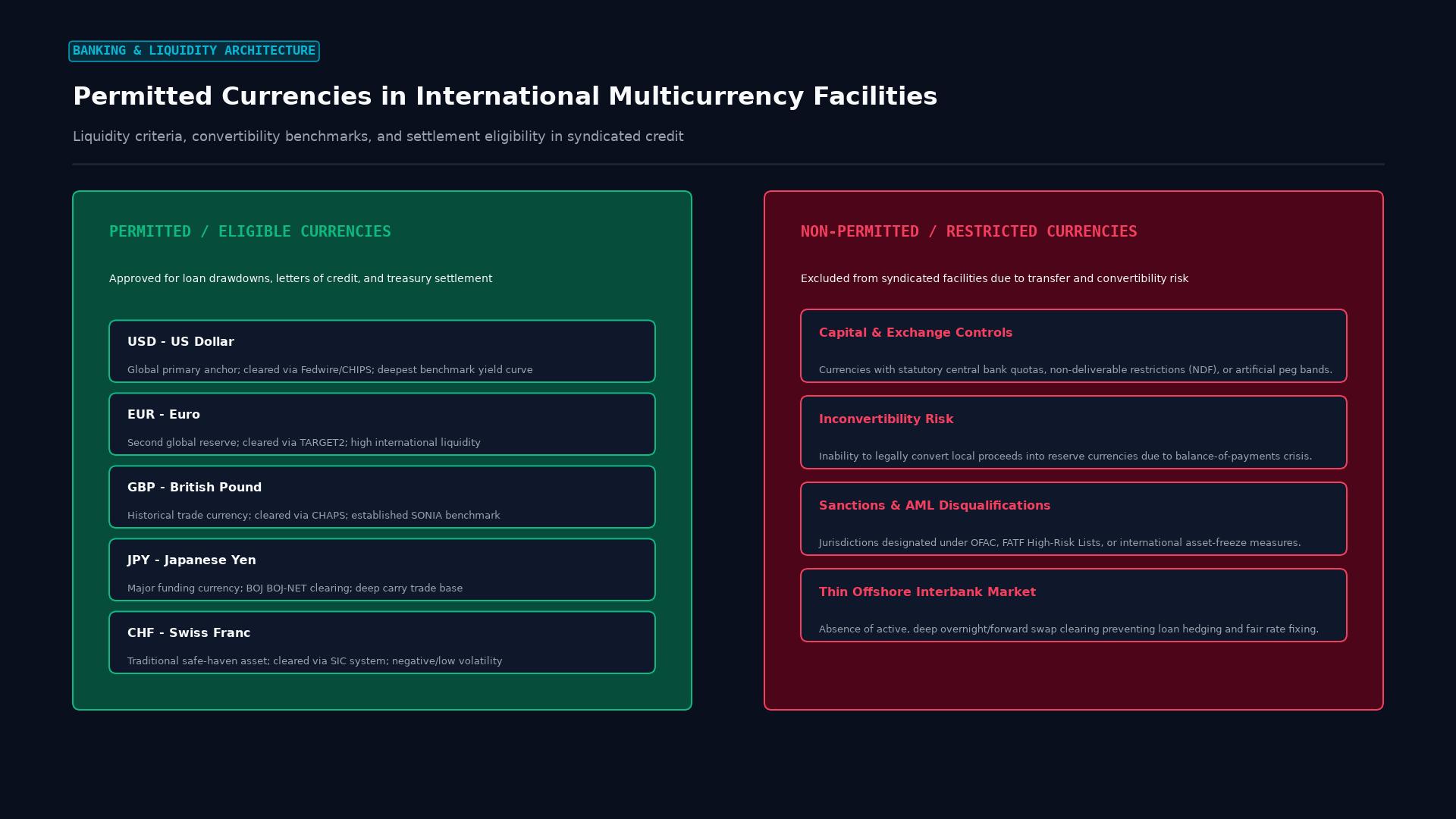 Figure: Sovereign currency eligibility standards in international credit agreements: reserve liquidity, unrestricted convertibility, and absence of exchange controls.
Core Criteria for Permitted Currency Status
For a clearing institution or prime broker to designate a currency as a permitted currency, the sovereign currency must satisfy four mandatory financial requirements:
1. Unrestricted Capital Account Convertibility
The issuing nation must maintain full convertibility on both current and capital accounts. Currencies subject to government capital controls, mandatory repatriation orders, or central bank foreign exchange rationing (such as the Chinese Offshore Renminbi under certain domestic conduits, or the Argentine Peso) are restricted or completely excluded from permitted collateral schedules.
2. Deep Overnight and Repo Money Markets
The currency must possess deep, resilient interbank lending and repurchase (repo) markets. If a clearing member defaults, the clearinghouse must be able to convert the deposited currency collateral into liquid base currency (typically USD or EUR) within minutes without suffering market impact or wide spread friction.
3. Central Bank Standing Swap Lines
Major clearing institutions prioritize currencies issued by central banks that participate in the standing bilateral liquidity swap network coordinated by the Federal Reserve, ECB, Bank of Japan, Bank of England, Swiss National Bank, and Bank of Canada. These swap lines guarantee emergency access to foreign currency liquidity during systemic panics.
4. Continuous Settlement Infrastructure (CLS Eligibility)
Participation in the Continuous Linked Settlement (CLS) system—which eliminates settlement (Herstatt) risk through Payment-versus-Payment (PvP) settlement—is a primary benchmark for international permitted currency status. Currently, only 18 global currencies hold full CLS settlement eligibility.
Collateral Haircuts on Permitted Currencies
When a clearinghouse accepts a permitted currency that differs from the base currency of the derivative contract (e.g., depositing Euros to satisfy margin requirements on US Treasury futures denominated in USD), the clearinghouse applies a Foreign Exchange Collateral Haircut:
$$\text{Usable Collateral Value} = \text{Market Value of Currency} \times (1 - \text{Haircut})$$
Haircuts protect the clearinghouse against adverse exchange rate swings that may occur between the time a clearing member defaults and the time the clearinghouse liquidates the deposited foreign currency.
| Permitted Currency | CME Clearing Haircut (Illustrative) | Primary Use Case | Central Bank Swap Line Status |
|---|---|---|---|
| US Dollar (USD) | 0.0% (Benchmark base) | Universal margin, futures settlement, cleared swaps. | Fed Issuer |
| Euro (EUR) | 2.5% to 3.5% | Cross-border derivative collateral, European debt. | Standing Core Swap Line |
| British Pound (GBP) | 3.0% to 4.0% | Gilt futures clearing, London interbank swaps. | Standing Core Swap Line |
| Japanese Yen (JPY) | 4.5% to 6.0% | Asian session derivatives, JGB repo clearing. | Standing Core Swap Line |
| Swiss Franc (CHF) | 4.0% to 5.0% | Safe-haven banking collateral, Eurex clearing. | Standing Core Swap Line |
| Canadian Dollar (CAD) | 3.5% to 4.5% | North American energy futures, cross-border banking. | Standing Core Swap Line |
| Australian Dollar (AUD) | 5.0% to 6.5% | Commodity derivative margin, Asia-Pacific desks. | Regional Swap Network |
Real-World Case Study: Collateral Management During the 2022 Gilt Shock
During the UK “Mini-Budget” crisis in late September 2022, long-dated UK government gilt yields surged by over 100 basis points in days, and the British Pound plunged to an all-time low of 1.0350 against the US Dollar.
- The Problem: Global pension funds and clearing firms who had deposited British Pounds (a permitted currency) as performance bond collateral at US and European clearinghouses faced dual collateral stress:
- Derivative positions incurred massive variation margin losses.
- The collateral value of their deposited GBP plunged in US Dollar terms.
- The Clearinghouse Response: On September 27, major clearinghouses (including CME Clearing and LCH) issued emergency risk notices:
- GBP was retained as a permitted currency, but its cross-currency haircut was immediately escalated from 3.5% to 8.5%.
- The Liquidity Demand: Clearing members were required to deposit an additional $1.8 billion in US Dollar cash or eligible Treasuries within hours to cover the reduced collateral value of their Sterling balances, illustrating how haircut adjustments on permitted currencies serve as systemic circuit breakers.
Frequently Asked Questions
Can cryptocurrency be considered a permitted currency by institutional clearinghouses?
Currently, no major regulated central counterparty (such as CME, LCH, or Eurex) accepts unpegged cryptocurrencies (like Bitcoin or Ethereum) as permitted margin collateral for traditional cleared contracts, due to extreme intraday volatility and regulatory capital constraints under Basel rules.
What is the difference between a convertible currency and a permitted currency?
A convertible currency is any national currency that can be legally exchanged for other currencies without government restrictions. A permitted currency is a much stricter institutional classification; it is a convertible currency that has been formally vetted, approved, and assigned specific haircut schedules by a central clearinghouse or prime broker for use as financial collateral.
What happens if a permitted currency is downgraded or restricted?
If a nation imposes capital controls, undergoes sovereign default, or suffers hyperinflation, clearinghouses immediately issue risk notices revoking the currency’s permitted status. Clearing members holding that currency are given a mandatory window (typically 24 to 48 hours) to substitute the restricted currency with cash USD, EUR, or approved sovereign government debt.
Ready to trade forex?
Open a free demo account with a regulated broker. Practice with virtual funds before risking real money.