PHP
PHP (Philippine Peso or Piso) is the official currency of the Philippines, subdivided into 100 sentimos and regulated by the Bangko Sentral ng Pilipinas (BSP).
What is the Philippine Peso (PHP)?
The Philippine Peso (ISO code: PHP, Filipino: piso, symbol: ₱) is the official currency of the Republic of the Philippines. Issued, monitored, and defended by the country’s central monetary authority, the Bangko Sentral ng Pilipinas (BSP), the currency is subdivided into 100 sentimos (cents).
Under the International Organization for Standardization (ISO 4217), the three-letter code is PHP. In domestic commerce, the peso is denoted using the unique currency symbol ₱, which is an uppercase letter “P” crossed by two horizontal parallel bars (or occasionally a single bar).
The Philippine Peso is a prominent emerging market Southeast Asian currency. In global foreign exchange trading, the PHP operates under a market-determined floating exchange rate system. The value of the peso is anchored by two massive macroeconomic lifelines: tens of billions of dollars in annual remittances sent home by Overseas Filipino Workers (OFWs), and substantial foreign currency revenues generated by the nation’s Business Process Outsourcing (BPO) sector.
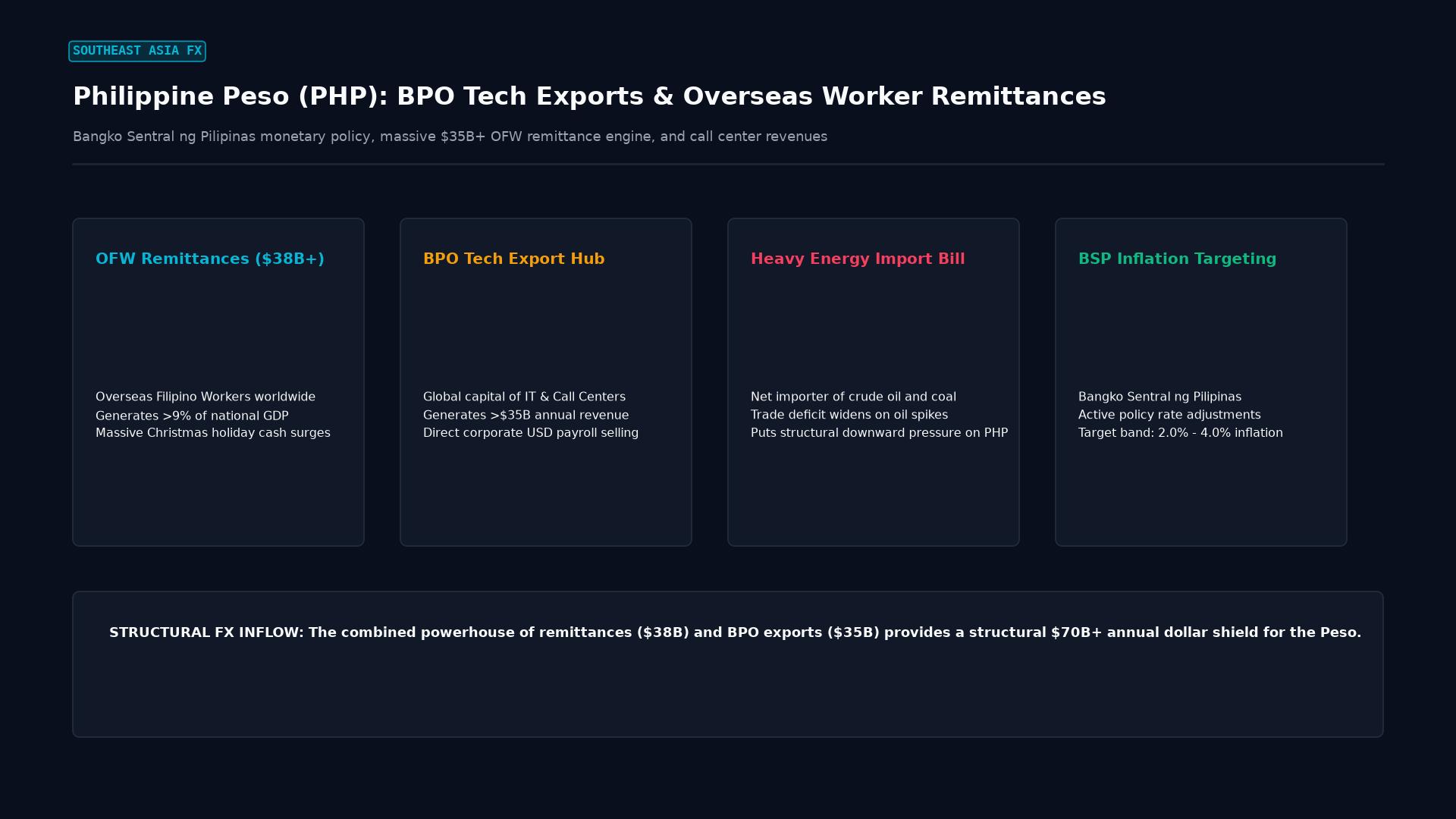 Figure: Bangko Sentral ng Pilipinas monetary policy, massive $35B+ OFW remittance engine, and call center revenues
Historical Evolution of the Philippine Currency
The Philippine currency system evolved through colonial eras, monetary realignments, and central banking reorganizations.
Spanish Colonial Era and the Real de a Ocho
Prior to Spanish colonization, trade across the Philippine archipelago was conducted via barter and localized gold tokens (piloncitos). During the Spanish colonial administration (1565 to 1898), the Philippines became an Asian hub for the Manila-Acapulco Galleon trade. Silver coins minted in Mexico and Peru, famously known as the Real de a Ocho (Spanish dollar or piece of eight), circulated as primary legal tender.
In 1852, the Spanish crown established the archipelago’s first commercial bank, El Banco Español Filipino de Isabel II (now the Bank of the Philippine Islands), which issued the first paper banknotes denominated in Pesos Fuertes (strong pesos).
Spanish Colonial Era (1565-1898)
Silver Pieces of Eight & Pesos Fuertes
                    │
                    ▼
American Colonial Period (1898-1946)
Philippine Coinage Act of 1903
Pegged to Gold and Fixed at 2:1 with US Dollar ($1 = ₱2)
                    │
                    ▼
Post-WWII & Central Bank Act of 1949
Establishment of the Central Bank of the Philippines (CBP)
Bretton Woods Fixed Exchange System
                    │
                    ▼
1970 Floating Transition & 1997 Asian Financial Crisis
Abolition of rigid parity; transition to market float;
Regional contagion pushes USD/PHP from ₱26 to ₱40+
                    │
                    ▼
1993 / 2019: Bangko Sentral ng Pilipinas (BSP) Modernization
Republic Act 7653 and RA 11211 establish independent central bank;
Implementation of Inflation-Targeting Framework (2002)
The American Administration and the 2:1 Dollar Peg
Following the Treaty of Paris in 1898 and the onset of American colonial administration, the United States Congress enacted the Philippine Coinage Act of 1903. This legislation established the Philippine peso on a gold exchange standard, fixing the currency at an exact ratio of two Philippine pesos to one United States dollar:
$$\text{Fixed Exchange Parity (1903)}: 1 \text{ USD} = 2.00 \text{ PHP}$$
This rigid 2:1 exchange rate persisted through the establishment of the Philippine Commonwealth in 1935, surviving until the Japanese occupation during World War II, when hyperinflated military fiat notes (known colloquially as “Mickey Mouse money”) flooded the islands.
The Modern Central Bank: From CBP to BSP
In 1949, the newly sovereign Republic of the Philippines enacted Republic Act No. 265, establishing the Central Bank of the Philippines (CBP) to manage the post-war monetary system.
Over the subsequent decades, high external debt and balance-of-payments pressures forced the government to abandon the fixed parity, letting the peso devalue in stages through the 1960s and 1970s.
In 1993, following the restructuring of the old central bank’s liabilities, Congress passed Republic Act No. 7653 (The New Central Bank Act), reconstituting the monetary authority as the Bangko Sentral ng Pilipinas (BSP). The BSP was endowed with administrative and fiscal autonomy, later reinforced by Republic Act No. 11211 in 2019, which expanded the central bank’s regulatory capitalization and surveillance powers.
Macroeconomic Drivers of the Philippine Peso
The value of the Philippine Peso against the US dollar (USD/PHP) and major trading partners is governed by specific macroeconomic factors.
1. Overseas Filipino Worker (OFW) Remittances
One of the most defining characteristics of the Philippine macro economy is its vast global diaspora. Over 10 million Filipinos live and work abroad, concentrated across the Middle East, North America, Europe, and maritime shipping fleets.
+------------------------------------------------------------------------------------+
|                      OFW CASH REMITTANCE FLOW DYNAMICS                             |
+------------------------------------------------------------------------------------+
|  ANNUAL INFLOW VOLUME |  Exceeds $35 Billion USD annually (>8% of national GDP)    |
|  SEASONAL PEAK        |  Fourth Quarter (November-December) for Holiday Spending   |
|  ECONOMIC FUNCTION    |  Countercyclical stabilizer; direct support to consumption |
|  FX MARKET IMPACT     |  Consistent structural selling of USD to purchase PHP      |
+------------------------------------------------------------------------------------+
Remittance inflows represent a consistent, non-debt-creating supply of foreign exchange. Because remittances are converted into pesos through domestic banks, money transfer operators, and electronic wallets to fund household consumption, education, and real estate, they provide structural support for the currency.
During the fourth quarter of each calendar year, seasonal remittance surges historically create appreciation pressure on the PHP.
2. Business Process Outsourcing (BPO) and Services Exports
The Philippine IT-BPO industry is a global leader in customer service, healthcare claims administration, financial back-office operations, and software development.
- Generating over $32 to $38 billion USD in annual revenues, the sector mirrors the scale of worker remittances.
- BPO enterprises receive foreign client billings in US dollars and convert these earnings into pesos to cover local commercial leases, telecommunications infrastructure, and monthly employee payrolls.
       Global Enterprise Outsourcing
       Contract Revenue Paid in USD
                     │
                     ▼
       BPO Centers in Manila, Cebu, Davao
       Must Meet Domestic Operational Costs
                     │
                     ▼
       Bi-Monthly Interbank Currency Sales
       USD Sold / PHP Purchased for Local Payroll
                     │
                     ▼
       Structural Support for Peso Liquidity
3. The Trade Deficit and Energy Import Sensitivity
While remittances and BPO services generate massive current account inflows, the Philippines runs a persistent merchandise trade deficit.
The country is a net importer of:
- Refined Petroleum and Crude Oil: The Philippines imports almost 100% of its domestic fossil fuel consumption. High global oil prices expand the country’s import bill, requiring massive dollar purchases that depreciate the peso.
- Capital Goods and Infrastructure Equipment: National infrastructure programs require imported construction equipment, structural steel, and specialized machinery.
- Electronics Raw Materials: The manufacturing export sector is concentrated in semiconductors and electronic subassemblies, which require large initial imports of raw silicon and components before re-export.
Surging Global Crude Oil Prices (Brent)
                 │
                 ▼
Expanding Philippine Merchandise Trade Deficit
                 │
                 ▼
Heavy Corporate Demand to Buy USD to Settle Fuel Invoices
                 │
                 ▼
Depreciation Pressure on PHP (USD/PHP Moves Upward)
Monetary Policy Framework: The BSP Interest Rate Corridor
Since January 2002, the Bangko Sentral ng Pilipinas has conducted monetary policy under an explicit Inflation-Targeting Framework, moving away from targeting monetary aggregates.
The national government, through the Development Budget Coordination Committee (DBCC), sets the medium-term headline inflation target, typically defined as:
$$\text{Inflation Target} = 3.0% \pm 1.0% \quad (2.0% \text{ to } 4.0%)$$
To achieve this target, the BSP operates an Interest Rate Corridor (IRC) system:
+------------------------------------------------------------------------------------+
|                         BSP INTEREST RATE CORRIDOR (IRC)                           |
+-----------------------------------+------------------------------------------------+
| FACILITY                          | ROLE & LIQUIDITY FUNCTION                      |
+-----------------------------------+------------------------------------------------+
| Overnight Lending Facility (OLF)  | Ceiling of the corridor; provides standing     |
|                                   | collateralized overnight liquidity to banks.   |
+-----------------------------------+------------------------------------------------+
| Target Reverse Repurchase (RRP)   | Key policy benchmark rate; primary tool for    |
| Facility                          | signaling monetary stance and managing demand. |
+-----------------------------------+------------------------------------------------+
| Overnight Deposit Facility (ODF)  | Floor of the corridor; absorbs excess interbank|
|                                   | liquidity deposited overnight by banks.        |
+-----------------------------------+------------------------------------------------+
When inflationary pressures mount or aggressive US Federal Reserve interest rate hikes narrow the interest rate differential between the US dollar and the peso, the BSP raises its policy rate. This maintains attractive carry returns for holding peso assets and prevents capital flight.
BSP Foreign Exchange Intervention Mechanisms
The BSP does not target a specific nominal exchange rate for USD/PHP. However, the central bank maintains an active presence in foreign exchange markets to maintain order and limit extreme intraday volatility.
1. Direct Interbank Spot Smoothing
The BSP participates in the domestic spot market via the electronic trading platform of the Philippine Dealing System (PDS). When sudden external shocks trigger disorderly currency depreciation, the central bank sells US dollars from its Gross International Reserves (GIR) to provide liquidity. When capital inflows surge, the BSP accumulates reserves by purchasing excess dollars.
2. The Non-Deliverable Forward (NDF) Market
To provide commercial banks and institutional corporate treasuries with currency hedging without depleting physical spot reserves, the BSP participates in the domestic Non-Deliverable Forward (NDF) market.
3. Currency Rate Risk Protection Program (CRRP)
The BSP operates the CRRP, a non-deliverable forward facility offered to commercial banks. Under this program, eligible corporate importers with unhedged foreign exchange obligations can hedge their foreign currency exposure directly with the central bank, mitigating speculative front-running in the spot market.
Trading the PHP: Spot and Derivative Market Conventions
In global financial markets, the peso is quoted directly against the US dollar as USD/PHP, representing the number of pesos required to purchase one US dollar.
Direct Quotation:
USD/PHP = 56.500

Interpretation:
1 US Dollar = 56.500 Philippine Pesos
An increase to 58.000 indicates Peso depreciation (USD strength).
A decrease to 55.000 indicates Peso appreciation (USD weakness).
Market Structure: Onshore Spot vs. Offshore NDF
Trading in the Philippine Peso is bifurcated between local cash markets and offshore forward derivatives:
-
Onshore Interbank Spot (PDS/FIT):
- Regulated under the Bankers Association of the Philippines (BAP) and BSP rules.
- Traded on electronic matching platforms between accredited universal and commercial banks.
- Settle on a $T+1$ or $T+2$ basis through the Philippine Payment and Settlement System (PhilPaSSplus).
- Strict documentary requirements apply: corporations purchasing foreign exchange exceeding regulatory thresholds must submit underlying commercial invoices, letters of credit, or loan contracts.
-
Offshore Non-Deliverable Forward (NDF) Market:
- Centered in major financial hubs (Singapore, Hong Kong, London, New York).
- Utilized by global hedge funds, sovereign wealth managers, and foreign institutional portfolio investors who lack domestic Philippine settlement capabilities.
- Contracts are cash-settled in US dollars at maturity based on the official PHP fixing rate (the BAP USD/PHP closing or reference rate).
NDF Net Cash Settlement Formula:
USD Payout = Notional Amount x [(Fixing Spot Rate - Agreed NDF Rate) / Fixing Spot Rate]
Key Takeaways
- Official Currency of the Philippines: The Philippine Peso (PHP, symbol: ₱) is administered by the constitutionally independent Bangko Sentral ng Pilipinas (BSP).
- Core Inflow Engines: The currency is anchored by over $35 billion in annual Overseas Filipino Worker (OFW) remittances and over $30 billion from the IT-BPO export sector.
- Structural Energy Vulnerability: As an oil-importing economy, high global crude oil prices widen the Philippine trade deficit, creating depreciation pressure on the peso.
- Inflation-Targeting Regime: The BSP uses an Interest Rate Corridor (RRP, OLF, ODF) to maintain domestic price stability within a target band of 2% to 4%.
- Strategic FX Interventions: While the peso operates under a floating exchange rate, the BSP actively intervenes in spot and derivative markets to curb speculative volatility and protect foreign exchange stability.
- Two-Tier Market Infrastructure: Onshore spot trading requires documentation under BAP/BSP guidelines, while international macro investors manage peso exposure via offshore USD-settled Non-Deliverable Forwards (NDFs).
Frequently Asked Questions (FAQ)
What causes seasonal strength in the Philippine Peso during December?
The Philippine Peso experiences seasonal strength in November and December due to holiday remittances sent home by Overseas Filipino Workers (OFWs). Millions of Filipinos working abroad send money to their families for Christmas celebrations, year-end tuition, and retail purchases. Domestic remittance agents and commercial banks convert billions of US dollars into pesos over a compressed period, creating concentrated local currency demand that appreciates the PHP.
How does the price of crude oil impact the USD/PHP exchange rate?
The Philippines imports nearly all of its petroleum products. When world crude oil prices rise, Philippine oil refiners and fuel distributors must acquire more US dollars to pay overseas suppliers. This surge in foreign currency demand widens the merchandise trade deficit and increases selling pressure on the peso, causing the USD/PHP exchange rate to rise (depreciating the peso).
Can foreign investors buy Philippine Pesos freely on international retail platforms?
Direct physical delivery of Philippine Pesos is subject to central bank cross-border cash limits (under BSP regulations, individuals cannot bring more than ₱50,000 in physical cash into or out of the country without prior authorization). However, foreign investors can access financial exposure to the peso through international brokerages offering Non-Deliverable Forwards (NDFs), currency derivatives, or by opening local custody accounts with Philippine commercial banks to trade peso-denominated equities and sovereign treasury bonds (Bonds and Treasury Bills).
Ready to trade forex?
Open a free demo account with a regulated broker. Practice with virtual funds before risking real money.