THB
THB (Thai Baht) is the official currency of the Kingdom of Thailand, subdivided into 100 satang and issued by the Bank of Thailand (BOT).
What is the Thai Baht (THB)?
The Thai Baht (ISO code: THB, symbol: ฿) is the official currency of the Kingdom of Thailand. Issued, managed, and regulated by the nation’s central monetary authority, the Bank of Thailand (BOT) (Thanakhan haeng Prathet Thai), the baht is subdivided into 100 satang.
In global currency markets, the Thai Baht is a prominent, liquid emerging Asian currency. Historically, the baht holds a central place in modern economic history: the forced devaluation of the Thai Baht on July 2, 1997, served as the catalyst that ignited the 1997 Asian Financial Crisis.
Following that regional crisis, Thailand dismantled its rigid fixed peg and adopted a managed floating exchange rate regime governed by a flexible inflation-targeting framework. Supported by an industrial manufacturing base, international tourism revenues, and defensive foreign exchange reserve buffers, the modern Thai Baht has evolved into an established regional currency.
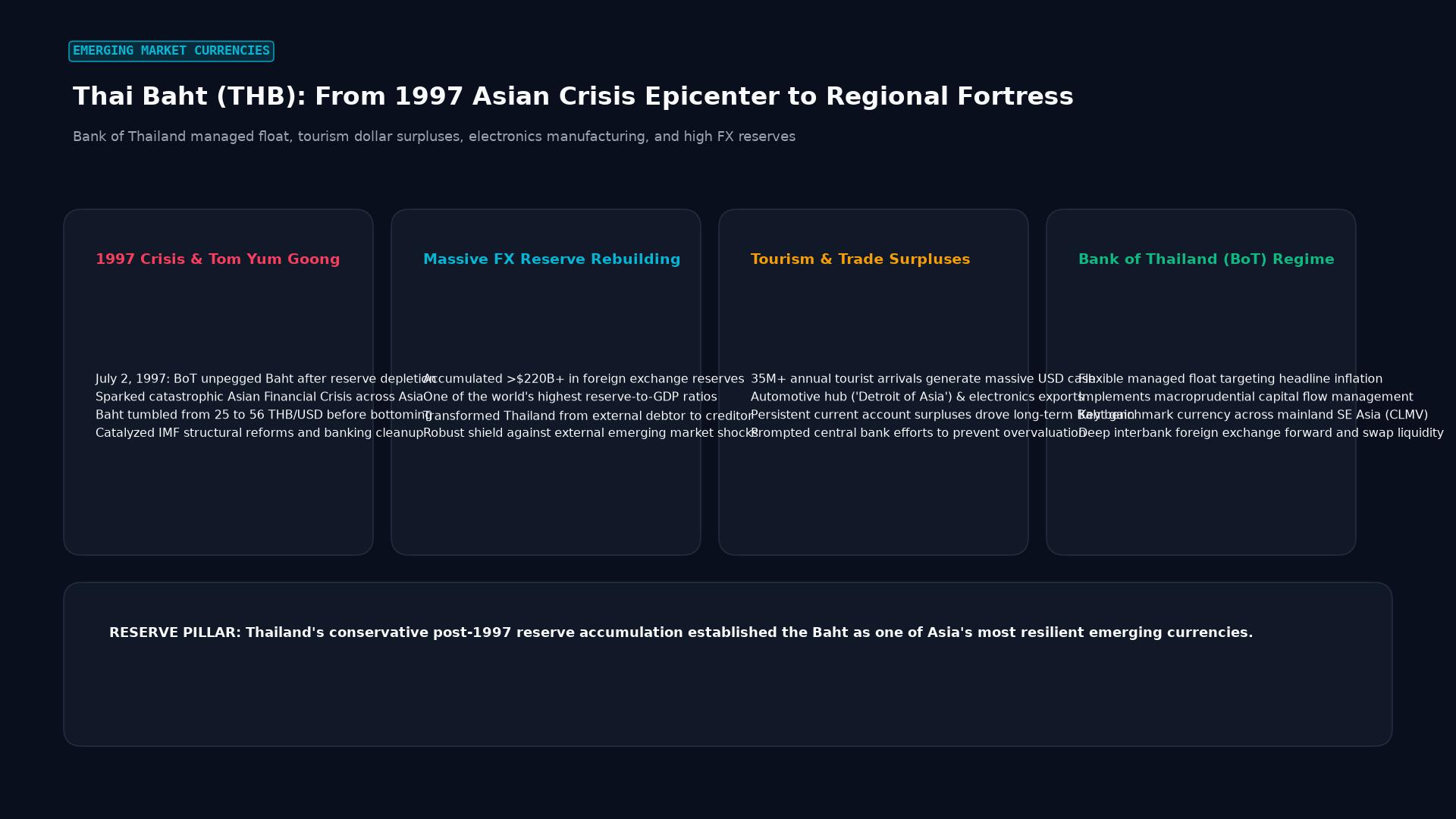 Figure: Bank of Thailand managed float, tourism dollar surpluses, electronics manufacturing, and high FX reserves
Historical Origins and Currency Modernization
The monetary evolution of Thailand (historically known as Siam until 1939) transitioned from traditional indigenous silver tokens to industrialized paper fiat.
From Bullet Money (Phot Duang) to Modern Coins
For centuries under the Sukhothai and Ayutthaya kingdoms, commerce in Siam was transacted using Phot Duang (colloquially called “bullet money”):
- Pieces of high-purity silver bars were bent into small rounded balls and stamped with royal dynastic marks.
- In the mid-19th century, expanding maritime trade with Western powers under the Bowring Treaty overwhelmed the production capacity of handmade bullet money.
- Under King Rama IV (King Mongkut) and his son King Rama V (King Chulalongkorn), Siam modernized its monetary system: mechanical minting presses were imported from Europe, decimalization was established (1 Baht = 100 Satang), and the first modern paper currency (Ngoen Kradat) was introduced.
13th Century - 1860: Traditional "Bullet Money" (Phot Duang)
Silver ingots folded into stamped spheres
                      │
                      ▼
1897-1902: Decimalization under King Rama V
Abolition of ancient cowrie shells; introduction of modern Baht & Satang
                      │
                      ▼
December 1942: Creation of the Bank of Thailand (BOT)
Wartime monetary authority established to manage currency circulation
                      │
                      ▼
1984-1997: The Fixed Currency Basket Era
Baht pegged heavily to the US Dollar (~25 THB/USD);
Drives foreign capital inflows and domestic real estate bubble
                      │
                      ▼
July 2, 1997: The "Tom Yam Kung" Currency Crisis
BOT depletes reserves defending the peg; forced float;
Baht crashes to historic low of ~56 THB/USD; sparks Asian Crisis
                      │
                      ▼
2000-Present: Managed Float & Reserve Accumulation
Shift to inflation targeting; BOT accumulates >$200B in FX reserves;
Re-emergence of Baht as an industrial export currency
The Founding of the Bank of Thailand (1942)
On December 10, 1942, during World War II, the government established the Bank of Thailand (BOT) to manage sovereign banknote issuance and stabilize the wartime financial system. In the post-war decades, the central bank operated conservative monetary policies, maintaining high gold backing ratios to defend domestic currency purchasing power.
The 1997 Asian Financial Crisis: The “Tom Yam Kung” Crash
The Thai Baht is synonymous with the start of the 1997 Asian Financial Crisis (known locally in Thailand as the Tom Yam Kung Crisis, named after the spicy Thai soup).
1990-1996: Fixed Basket Peg (~25 THB per 1 USD)
Bangkok International Banking Facilities (BIBF) allows local firms
to borrow cheaply in US Dollars at 4-6% interest
                      │
                      ▼
Domestic Credit Bubble & Over-Investment
Unhedged dollar loans poured into speculative real estate & golf courses;
Current account deficit widens to an unsustainable 8% of GDP
                      │
                      ▼
Early 1997: Speculative Hedge Fund Attacks
Macro funds (Quantum, Tiger) short the Baht, expecting devaluation
                      │
                      ▼
May-June 1997: BOT Forward Book Depletion
Central bank burns tens of billions in foreign exchange reserves
using off-balance-sheet forward swap contracts to defend 25 THB/USD
                      │
                      ▼
JULY 2, 1997: THE PEG COLLAPSES
BOT runs out of usable net foreign reserves and announces a free float;
Baht plunges by 50%, crashing to an all-time low of 56 THB per USD;
Contagion spreads instantly to Indonesia, South Korea, & Malaysia
Root Causes of the Devaluation
- The Currency Mismatch Trap: Thailand maintained a de facto fixed peg of roughly 25 Baht per 1 US Dollar. Believing the exchange rate was guaranteed by the central bank, Thai property developers, industrial conglomerates, and finance companies borrowed billions in US dollars at low Western interest rates without purchasing currency hedges.
- The Current Account Deficit: By 1996, rising wages and a strong US dollar (to which the baht was pegged) eroded Thai export competitiveness. The current account deficit expanded to 8% of GDP.
- Speculative Attacks and Depleted Reserves: Global macro hedge funds recognized that Thailand’s foreign exchange reserves could not support the peg. The Bank of Thailand committed billions in spot reserves and signed tens of billions of dollars in off-balance-sheet forward swap contracts to buy baht.
When net usable foreign reserves dropped toward zero, the central bank conceded defeat: on July 2, 1997, it unpegged the baht, triggering an immediate currency collapse and an IMF emergency bailout of $17.2 billion USD.
Macroeconomic Drivers of the Modern Thai Baht
Following the 1997 crisis, Thailand transformed its economic architecture. Today, the valuation of the baht is shaped by manufacturing exports, international tourism, oil imports, and regional trade.
1. The “Detroit of Southeast Asia”: Automotive and Electronics Exports
Thailand restructured its industrial sector into an advanced export manufacturing hub:
- Automotive Assembly: Thailand is Southeast Asia’s leading automotive production base. Major Japanese automakers (Toyota, Isuzu, Honda, Nissan, Mitsubishi), alongside emerging electric vehicle manufacturers, operate major assembly complexes in the Eastern Economic Corridor (Rayong, Chonburi), exporting pickup trucks and SUVs worldwide.
- Electronics & Hard Disk Drives: The country is a leading global exporter of computer hard disk drives (Western Digital, Seagate), electronic integrated circuits, and air conditioning systems.
+------------------------------------------------------------------------------------+
|                         THAI MERCHANDISE EXPORT PILLARS                            |
+-------------------+----------------------------------------------------------------+
| INDUSTRIAL SECTOR | ECONOMIC CONTRIBUTION & EXPORT PROFILE                         |
+-------------------+----------------------------------------------------------------+
| Automotive &      | World's second-largest producer of 1-ton pickup trucks;        |
| Auto Components   | major global production center for commercial vehicles.        |
+-------------------+----------------------------------------------------------------+
| Computers, HDDs,  | Global hub for data storage hardware assembly, printed         |
| & Electronics     | circuit boards (PCBs), and consumer electronic appliances.     |
+-------------------+----------------------------------------------------------------+
| Agribusiness &    | World leader in natural rubber, canned pineapple, processed    |
| Food Processing   | tuna, cassava starch, and premium Jasmine rice.                |
+-------------------+----------------------------------------------------------------+
When global automotive and tech demand expands, corporate export revenues generate foreign currency inflows that appreciate the baht against the dollar.
2. The Tourism Engine and Seasonal Current Account Swings
International tourism is a primary economic driver in Thailand, contributing between 12% and 20% of national GDP (including indirect hospitality, transport, and retail employment).
The tourism industry creates distinct seasonal current account cycles that foreign exchange traders actively track:
                  THE THAI BAHT ANNUAL TOURISM LIQUIDITY CYCLE

       HIGH TOURISM SEASON (Q4 - Q1: November to March)
       - Millions of European, Asian, & American tourists arrive for winter holidays
       - Massive inflows of foreign exchange spent on hotels, dining, and internal travel
       - Heavy conversion of USD/EUR into Baht creates structural appreciation pressure
                              │
                              ▼
       LOW TOURISM / MONSOON SEASON (Q2 - Q3: May to September)
       - Tourist arrivals drop significantly
       - Corporate dividend repatriation season (foreign firms repatriate earnings)
       - Current account balance narrows or turns negative; Baht softens
3. Energy Import Vulnerability
Thailand is a net importer of crude oil and natural gas. When world petroleum prices surge, Thailand’s energy import bill expands rapidly, worsening the trade balance and placing downward pressure on the THB.
Bank of Thailand Monetary Framework
The Bank of Thailand operates under a Flexible Inflation-Targeting Framework established in May 2000.
+------------------------------------------------------------------------------------+
|                         BOT MONETARY POLICY FRAMEWORK                              |
+-------------------+----------------------------------------------------------------+
| TARGET VARIABLE   | Headline Consumer Price Index (CPI) Inflation                  |
| INFLATION TARGET  | 1.0% to 3.0% (Medium-term target range)                        |
| GOVERNING BODY    | Monetary Policy Committee (MPC) - 7-member statutory board     |
| BENCHMARK RATE    | 1-day Bilateral Repurchase Rate (Policy Repo Rate)             |
| INTERVENTION TOOL | Spot foreign exchange smoothing & USD/THB forward swaps        |
+-------------------+----------------------------------------------------------------+
The Fortress Reserve Strategy
Determined never to repeat the crisis of 1997, the Bank of Thailand pursued a multi-decade strategy of foreign exchange reserve accumulation:
- Thailand’s gross official foreign exchange reserves regularly exceed $210 billion to $250 billion USD, ranking among the highest in the world relative to gross domestic product.
- This reserve fortress provides the central bank with liquidity to smooth out speculative exchange rate volatility without endangering national solvency.
Market Microstructure: Onshore vs. Offshore (Two-Tier Market)
To curb speculative offshore currency attacks, the Bank of Thailand maintains structural boundaries between domestic and offshore foreign exchange trading.
+------------------------------------------------------------------------------------+
|                         ONSHORE VS. OFFSHORE THB REGIME                            |
+---------------------+-------------------------------+------------------------------+
| ATTRIBUTE           | ONSHORE BAHT (DOMESTIC)       | OFFSHORE BAHT (INTERNATIONAL)|
+---------------------+-------------------------------+------------------------------+
| Primary Quote       | USD/THB (e.g., 36.50)         | USD/THB NDF                  |
| Market Participants | Domestic banks, corporations, | Global hedge funds, foreign  |
|                     | licensed foreign dealers      | portfolio asset managers     |
| Regulatory Limit    | NRBA cash balance caps        | Cash-settled in US Dollars   |
|                     | (Non-Resident Baht Accounts)  | with zero physical delivery  |
| Clearing Rail       | BOT BAHTNET (RTGS System)     | International clearing banks |
+---------------------+-------------------------------+------------------------------+
Non-Resident Baht Account (NRBA) Rules
Under BOT foreign exchange regulations:
- Financial institutions are restricted from providing unconditional local currency credit lines to non-residents without underlying trade or investment documentation.
- The BOT enforces strict caps on outstanding daily balances in Non-Resident Baht Accounts (NRBA and NRBS), limiting the ability of foreign speculative funds to borrow domestic currency to execute speculative short attacks.
- International institutional investors access financial exposure to the baht primarily via Non-Deliverable Forwards (NDFs) traded in Singapore, London, and New York.
Key Takeaways
- Official Currency of Thailand: The Thai Baht (THB, symbol: ฿) is issued and managed by the Bank of Thailand (BOT).
- 1997 Crisis Catalyst: The forced float of the pegged Baht on July 2, 1997, triggered the catastrophic Asian Financial Crisis, leading to an overhaul of regional monetary policy.
- Export Powerhouse: Reflects an industrial manufacturing hub specializing in automotive assembly (the “Detroit of Southeast Asia”), computer electronics, and agricultural commodities.
- Tourism Liquidity Seasonality: International tourism receipts generate high seasonal currency inflows during the winter high season (Q4–Q1), supporting the exchange rate.
- Defensive Reserve Fortress: The BOT maintains over $200 billion USD in foreign exchange reserves, providing insulation against emerging market capital flight.
- Two-Tier Market Architecture: Foreign exchange trading is divided between documented onshore deliverable markets and offshore USD-settled Non-Deliverable Forwards (NDFs).
Frequently Asked Questions (FAQ)
What caused the Thai Baht to collapse on July 2, 1997?
The Thai Baht collapsed on July 2, 1997, because the government attempted to defend an unsustainable fixed peg of ~25 Baht per US Dollar while domestic banks and real estate firms accumulated billions in unhedged foreign debt. As Thailand’s trade deficit widened and real estate loans soured, global macro hedge funds recognized that the Baht was overvalued and began shorting the currency. The Bank of Thailand exhausted its foreign exchange reserves through off-balance-sheet forward contracts trying to defend the peg. When usable reserves were depleted, the central bank was forced to float the Baht, causing it to lose 50% of its value and sparking the Asian Financial Crisis.
Why does the Thai Baht tend to strengthen between November and February?
The Thai Baht exhibits seasonal strength between November and February due to Thailand’s peak international tourism season. During the Northern Hemisphere winter, millions of international travelers visit Thailand for holidays, injecting billions of dollars, euros, and pounds into the economy. Domestic banks, currency exchange booths, and hospitality businesses convert these foreign currencies into Thai Baht to pay local suppliers, hotel staff, and taxes, creating concentrated commercial demand that appreciates the THB.
What is the difference between Onshore Baht and Offshore Baht?
The difference lies in convertibility restrictions enforced by the Bank of Thailand to deter foreign currency speculation. Onshore Baht is the physical currency traded inside Thailand through domestic commercial banks, requiring underlying commercial documentation (such as import bills or verified investments) for large conversions. Offshore Baht refers to financial derivatives traded outside Thailand (primarily in Singapore and London) by foreign funds and institutional investors. Offshore contracts are settled as Non-Deliverable Forwards (NDFs) in US dollars, meaning no physical Thai Baht leave the country.
Ready to trade forex?
Open a free demo account with a regulated broker. Practice with virtual funds before risking real money.