PLN
PLN (Polish Zloty) is the official currency of Poland, subdivided into 100 groszy and issued by Narodowy Bank Polski (NBP).
What is the Polish Zloty (PLN)?
The Polish Zloty (ISO code: PLN, symbol: zł) is the official currency of the Republic of Poland. Issued, regulated, and defended by the nation’s central bank, Narodowy Bank Polski (NBP), the zloty is subdivided into 100 groszy (singular: grosz, symbol: gr).
The word złoty translates literally to “golden” in the Polish language, tracing its roots to historic gold ducats that circulated across Central Europe during the Middle Ages.
In modern international financial markets, the Polish Zloty is the benchmark liquid currency of Central and Eastern Europe (CEE). Poland is the largest economy among the European Union member states that have not yet adopted the single European currency (the Euro). The zloty trades under a free-floating exchange rate regime, reflecting deep commercial links to the German industrial supply chain, domestic monetary policy set by the NBP’s Monetary Policy Council, and shifting global risk appetite.
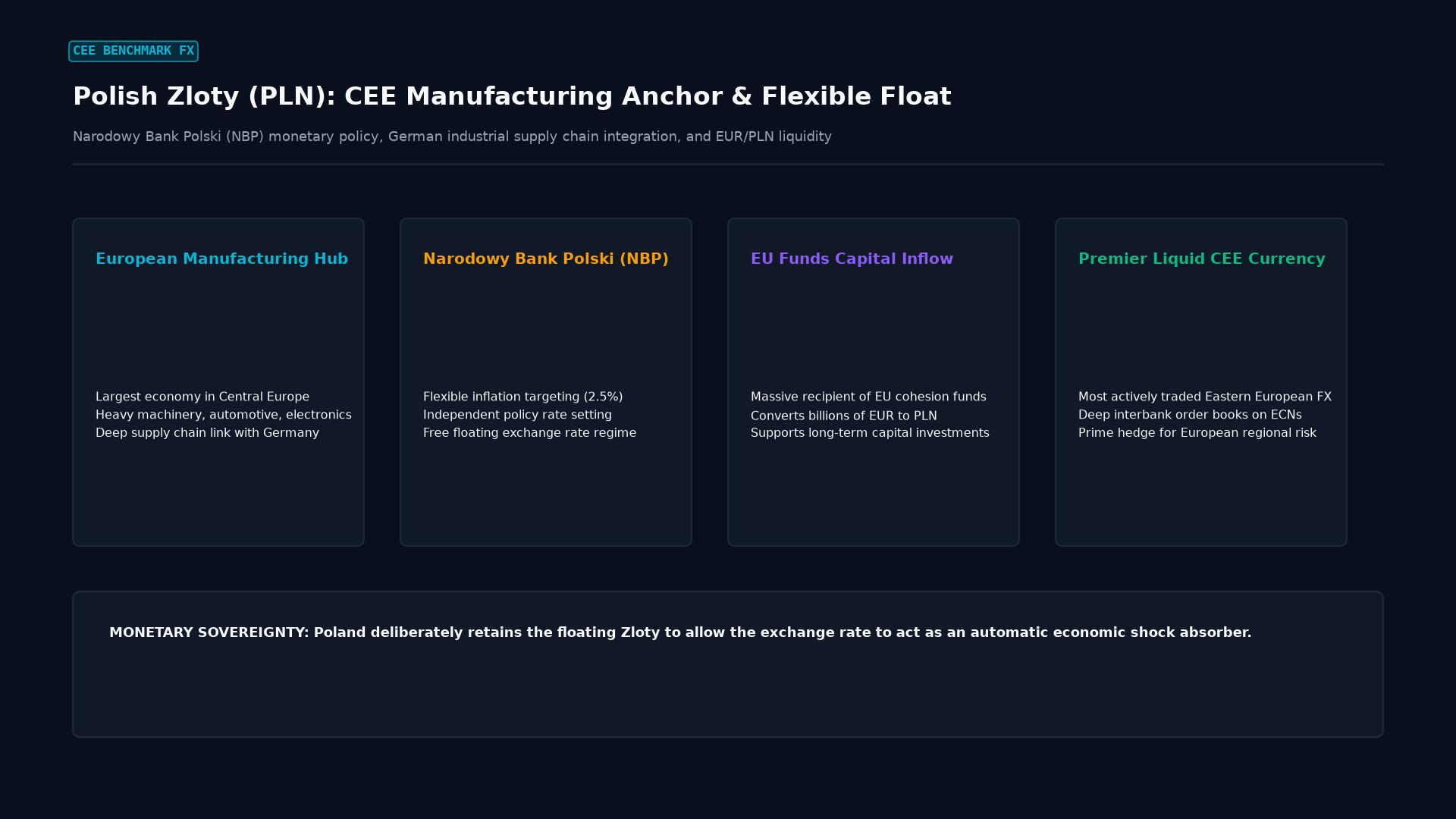 Figure: Narodowy Bank Polski (NBP) monetary policy, German industrial supply chain integration, and EUR/PLN liquidity
Historical Evolution of the Polish Currency
The monetary history of the zloty mirrors Poland’s turbulent geopolitical transformations, transitions across partitions, wars, socialist central planning, and post-communist market integration.
The Grabski Monetary Reform of 1924
Following the re-emergence of an independent Polish state after World War I, the country suffered hyperinflation driven by the collapse of the wartime Polish Mark (Marka Polska). In 1924, Prime Minister and Finance Minister Władysław Grabski enacted a landmark monetary reform:
- Created the modern central bank, Bank Polski SA.
- Introduced the Złoty as legal tender, replacing the Mark at a conversion rate of $1\text{ Złoty} = 1,800,000\text{ Marks}$.
- Anchored the currency to gold parity ($1\text{ Złoty} = 0.29\text{ grams of pure gold}$).
Post-WWI Hyperinflation (Polish Mark Collapses)
                    │
                    ▼
April 1924: Grabski Monetary Reform
Introduction of Modern Zloty (1 Złoty = 1.8M Marks)
                    │
                    ▼
Socialist Era (1945-1989): Inconvertible Fiat
Fixed administrative pricing; black market USD trade;
1950 Redenomination (100:1 wages, 100:3 savings confiscation)
                    │
                    ▼
1989-1990: The Balcerowicz "Shock Therapy" Plan
Price liberalization, elimination of hyperinflation,
Establishment of the modern Narodowy Bank Polski (NBP)
                    │
                    ▼
January 1, 1995: Redenomination (PLZ to PLN)
"Dropping Four Zeros": 10,000 Old Zlotys (PLZ) = 1 New Zloty (PLN)
                    │
                    ▼
April 2000: Full Free Float
Abolition of crawling peg and bands; adoption of direct inflation targeting
The Post-Communist Transition and the 1995 Redenomination
During the late 1980s, the communist economic system collapsed into another severe bout of triple-digit inflation. Under the Balcerowicz Plan (“Shock Therapy”) of 1990, Poland removed price controls, opened international trade, and restored macroeconomic discipline.
By 1994, inflation had stabilized, but consumer prices remained unwieldy, with prices quoted in millions of zlotys. On January 1, 1995, Poland executed a successful redenomination:
- The old ISO code PLZ was retired, and the new ISO code PLN was introduced.
- Four zeros were eliminated from the currency:
$$\text{1 PLN (New Złoty)} = 10,000 \text{ PLZ (Old Złotys)}$$
New banknotes designed by Andrzej Heidrich, depicting historical Polish rulers (from Mieszko I to Sigismund I the Old), entered circulation alongside newly minted grosz coins.
The Transition to a Free Float
During the 1990s, Poland managed its foreign exchange rate through a succession of structured regimes:
- Initial Dollar Peg (1990): The zloty was initially pegged to the US dollar to anchor expectations.
- Crawling Peg (1991 to 1995): To maintain export competitiveness amid lingering domestic inflation, the NBP transitioned to a crawling peg against a trade-weighted currency basket, devaluing the central rate by a fixed monthly percentage.
- Crawling Band (1995 to 2000): Fluctuation bands were gradually widened around the central parity from $\pm 7%$ up to $\pm 15%$.
On April 12, 2000, the Monetary Policy Council eliminated the crawling band and official trading fixings, allowing the Polish Zloty to become a freely floating currency. Since that date, the exchange rate has been determined by market supply and demand, with the NBP intervening only during exceptional periods of systemic disruption.
Macroeconomic Drivers of the Polish Zloty
The valuation of the zloty in global currency markets is shaped by regional economic integration, interest rate policy, trade balances, and geopolitical dynamics.
1. The German Industrial Engine and EU Trade Integration
Poland is integrated into the European Union single market. The European Union accounts for nearly 75% of Poland’s total merchandise exports, with Germany alone absorbing approximately 27% to 28% of Polish exports.
+------------------------------------------------------------------------------------+
|                         POLISH EXPORT SUPPLY CHAIN NEXUS                           |
+------------------------------------------------------------------------------------+
|  CORE SECTORS         |  Automotive parts, electrical machinery, consumer appliance|
|                       |  assembly, furniture, aerospace subassemblies, agri-food  |
|  SUPPLY CHAIN ROLE    |  Primary Tier-1 and Tier-2 supplier to German OEMs         |
|  ECONOMIC SENSITIVITY |  High beta to German IFO Business Climate & Eurozone PMIs  |
|  MARKET EFFECT        |  Slowing Eurozone manufacturing dampens demand for PLN    |
+------------------------------------------------------------------------------------+
Because Polish factories supply specialized components for German automotive manufacturers, strong industrial output in Germany generates export revenues that support the zloty. Conversely, an economic slowdown in Western Europe dampens Polish manufacturing activity, putting downward pressure on the currency.
2. NBP Monetary Policy and the Interest Rate Corridor
Monetary policy is governed by the Monetary Policy Council (Rada Polityki Pieniężnej - RPP), a ten-member statutory body within the NBP.
The RPP operates an Inflation-Targeting Framework with a continuous medium-term target:
$$\text{CPI Inflation Target} = 2.5% \pm 1.0% \quad (1.5% \text{ to } 3.5%)$$
The RPP conducts open market operations using its key reference rate (Stopa referencyjna):
+------------------------------------------------------------------------------------+
|                         NBP POLICY RATE ARCHITECTURE                               |
+-------------------+----------------------------------------------------------------+
| POLICY RATE       | MONETARY FUNCTION                                              |
+-------------------+----------------------------------------------------------------+
| Reference Rate    | Minimum yield on 7-day NBP money market bills (primary policy  |
| (Referencyjna)    | operational target).                                           |
+-------------------+----------------------------------------------------------------+
| Lombard Rate      | Ceiling of the corridor; provides overnight secured emergency   |
| (Lombardowa)      | collateralized liquidity to commercial banks.                  |
+-------------------+----------------------------------------------------------------+
| Deposit Rate      | Floor of the corridor; interest paid on commercial bank excess |
| (Depozytowa)      | liquidity parked overnight at the NBP.                         |
+-------------------+----------------------------------------------------------------+
When the RPP maintains an aggressive interest rate differential over the European Central Bank (ECB) deposit facility rate, foreign capital flows into Polish sovereign bonds (Treasury Bonds / Obligacje Skarbowe), driving carry-trade demand that appreciates the zloty against the Euro.
High NBP Policy Rate vs. Low ECB Rate
                 │
                 ▼
Expanding Interest Rate Spread (PLN Yield Advantage)
                 │
                 ▼
International Portfolio Funds Buy Polish Local Debt (Treasury Bills & Bonds)
                 │
                 ▼
Inflow of Capital Appreciates PLN (EUR/PLN Moves Downward)
3. European Union Structural and Recovery Funds
Poland has been the largest net recipient of European Union structural, cohesion, and resilience funds since its EU accession in 2004.
- Inflows of capital from the EU Multi-annual Financial Framework (MFF) and the Recovery and Resilience Facility (RRF / KPO) amount to tens of billions of euros.
- When the Polish government converts these euro-denominated transfers through the open interbank market or via the NBP’s FX reserves desk, it generates structural buying of zlotys, bolstering domestic infrastructure liquidity and strengthening the PLN exchange rate.
The Swiss Franc Mortgage Crisis (“Frankowicze”)
One of the most consequential financial challenges in modern Polish banking history is the Swiss Franc mortgage portfolio problem (kredyty frankowe).
2004-2008: Low Swiss Interest Rates (LIBOR)
Polish Homebuyers Borrow in CHF (Lower Monthly Payments)
                      │
                      ▼
January 2015: SNB Scraps EUR/CHF 1.20 Floor
CHF Surges from 3.50 PLN to >5.00 PLN
                      │
                      ▼
Homeowners' Monthly Debt Service & Principal Balance Double in Zloty Terms
                      │
                      ▼
Decade of Litigation in Polish Courts & European Court of Justice (CJEU)
                      │
                      ▼
CJEU Rulings Invalidate Abusive FX Conversion Clauses
Polish Commercial Banks Forced to Provision Tens of Billions of Zlotys
Background and Origins
Between 2004 and 2008, Polish commercial banks issued hundreds of thousands of residential mortgage loans denominated in or indexed to the Swiss Franc (CHF).
Because Swiss franc interest rates were dramatically lower than Polish zloty interest rates, borrowers could access larger loans with lower initial monthly installments. However, while borrowers earned their salaries in Polish zlotys, their debt service obligations were indexed to the value of the Swiss franc.
The Shock and Court Decisions
When the Swiss National Bank (SNB) unexpectedly abandoned its 1.20 exchange rate cap on the EUR/CHF in January 2015, the Swiss franc soared against global currencies. The CHF/PLN rate rose from approximately 2.00–2.50 PLN in the mid-2000s to over 4.00, and later above 5.00 PLN.
This currency shock doubled the outstanding principal balances and monthly installments for Polish homeowners in zloty terms.
The ensuing legal battles reached the Court of Justice of the European Union (CJEU) (notably the landmark Dziubak v. Raiffeisen case in 2019 and subsequent 2023 rulings). The courts ruled that unfair, unilateral foreign exchange conversion clauses drafted by banks were abusive under EU consumer protection law, allowing borrowers to nullify their loan contracts.
To absorb these cancellations and settle out of court, Polish commercial banks were forced to allocate tens of billions of zlotys in legal risk provisions, influencing bank balance sheets and creating periods of hedging demand for foreign currency.
Trading the PLN: FX Market Microstructure
In global foreign exchange trading, the primary benchmark pair is EUR/PLN, expressing how many zlotys are required to purchase one euro. The second most active pair is USD/PLN.
Direct Quotation:
EUR/PLN = 4.3250

Interpretation:
1 Euro = 4.3250 Polish Zlotys
A rise from 4.3250 to 4.4000 indicates Zloty depreciation.
A fall from 4.3250 to 4.2500 indicates Zloty appreciation.
+------------------------------------------------------------------------------------+
| TRADING ATTRIBUTES OF THE POLISH ZLOTY |
+-------------------+----------------------------------------------------------------+
| ATTRIBUTE | SPECIFICATION & MARKET CONVENTION |
+-------------------+----------------------------------------------------------------+
| Primary Pair | EUR/PLN (Standard liquid quote convention). |
| Secondary Pair | USD/PLN (Sensitive to global risk and energy pricing). |
| Quotation Decimals| Four decimal places (e.g., 4.3250; 1 pip = 0.0001 PLN). |
| Settlement Rail | Continuous Linked Settlement (CLS) participant currency; |
| | full physical gross settlement on a standard T+2 basis. |
| Trading Hours | Maximum interbank liquidity during Warsaw & London market |
| | overlap (08:00 to 17:00 Central European Time). |
| Derivative Depth | Liquid FX swaps, cross-currency basis swaps, and options. |
+-------------------+----------------------------------------------------------------+Because Poland is a member of Continuous Linked Settlement (CLS), international institutional counterparties settle physical zloty trades with zero principal Herstatt risk. This status gives the PLN higher institutional liquidity and lower settlement friction than non-CLS emerging market currencies.
Key Takeaways
- Official Currency of Poland: The Polish Zloty (PLN, symbol: zł), divided into 100 groszy, is issued and regulated by Narodowy Bank Polski (NBP).
- Post-Communist Stabilization: Following the 1924 Grabski reform and post-war communist controls, the currency underwent a 10,000:1 redenomination in 1995, transitioning from PLZ to PLN.
- Free Floating Exchange Rate: Since April 2000, the zloty has operated under a free float, with exchange rates determined by market forces without administrative bands.
- European Industrial Integration: The currency’s economic fundamentals are tied to the European Union and the German manufacturing supply chain, making the PLN sensitive to Eurozone industrial sentiment.
- Inflation-Targeting Regime: The NBP’s Monetary Policy Council sets reference interest rates to target an annual consumer inflation rate of 2.5% ± 1.0%.
- The “Frankowicze” Legacy: Widespread Swiss franc-indexed mortgages issued in the 2000s triggered systemic litigation, resulting in CJEU consumer rulings and large provisioning across the Polish banking sector.
- CLS Settlement Security: Unlike many emerging currencies, the PLN settles via the Continuous Linked Settlement (CLS) system, reducing settlement risk and enhancing institutional market liquidity.
Frequently Asked Questions (FAQ)
Is Poland required to adopt the Euro, and what is the status of Euro adoption?
Under the terms of its 2004 Treaty of Accession to the European Union, Poland is treaty-bound to adopt the Euro once it meets the nominal Maastricht convergence criteria (inflation, fiscal deficit, public debt, long-term interest rates, and two years of exchange rate stability inside the ERM II mechanism). However, the treaty does not establish a specific deadline for adoption. Poland has not joined the ERM II mechanism, and broad domestic political consensus has favored retaining an independent monetary policy and a floating currency to cushion the economy against external economic shocks.
Why is EUR/PLN more actively traded than USD/PLN?
EUR/PLN is the dominant currency pair because the European Union accounts for three-quarters of Poland’s international trade, with Germany alone representing over a quarter of total exports and imports. Polish corporations price commercial contracts, cross-border leasing arrangements, and supply chain invoices primarily in euros. Consequently, commercial hedging, interbank foreign exchange operations, and regional asset allocation center on EUR/PLN. USD/PLN is traded primarily for energy imports (such as crude oil and LNG) and broad global risk-sentiment hedging.
How did the Swiss Franc mortgage crisis affect the Polish banking system?
During the mid-2000s, hundreds of thousands of Polish households took out mortgages indexed to the Swiss Franc to benefit from low Swiss interest rates. When the Swiss franc surged following the 2015 removal of the EUR/CHF floor, the borrowers’ loan balances and monthly payments doubled in zloty terms. In response, borrowers sued commercial banks in domestic and EU courts. A series of landmark rulings by the Court of Justice of the European Union (CJEU) determined that the banks’ FX conversion clauses were abusive, enabling borrowers to annul the contracts. As a result, Polish banks have set aside tens of billions of zlotys in legal provisions to cover settlements and balance sheet losses.
Ready to trade forex?
Open a free demo account with a regulated broker. Practice with virtual funds before risking real money.