Political Risk
Political risk is the financial and operational risk that actions, regulatory shifts, instability, or legislative decisions enacted by a sovereign government—including expropriation, capital controls, sudden tax hikes, election shocks, or civil unrest—will significantly impair investment returns, corporate profitability, or national currency stability.
What Is Political Risk?
In international macroeconomics, foreign exchange trading, and global portfolio allocation, political risk represents the probability that political decisions, institutional fragility, or geopolitical events within a country will directly undermine economic performance, disrupt commercial operations, or cause sudden capital flight.
While market risk stems from natural fluctuations in supply, demand, and interest rates, political risk arises from the sovereignty of the state—its statutory power to rewrite tax codes, nationalize private property, repudiate sovereign debt, enforce currency exchange controls, or engage in international trade conflicts. Consequently, international credit rating agencies, multinational corporations, and currency desks continuously price a political risk premium into sovereign debt yields and spot exchange rates.
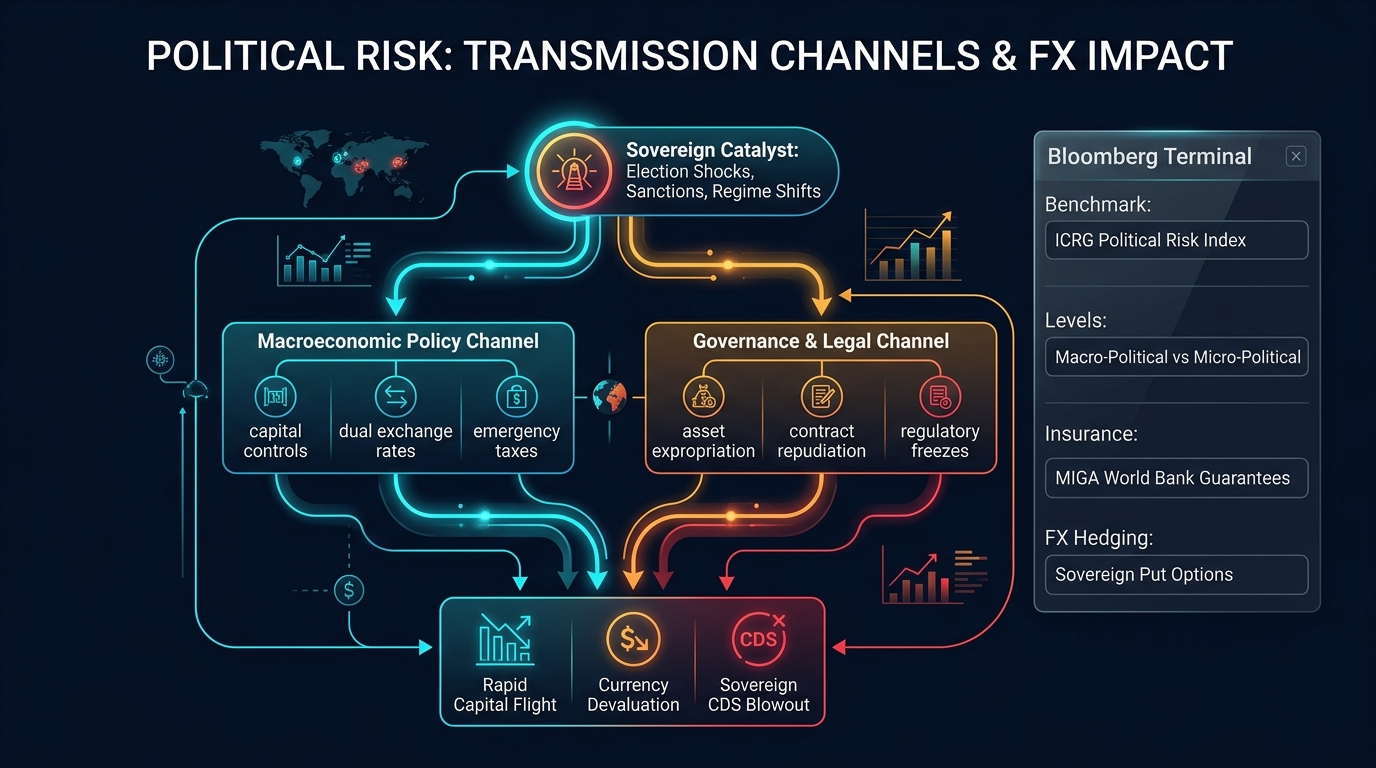
                    POLITICAL RISK TRANSMISSION CHANNELS

                      SOVEREIGN POLITICAL CATALYST
             (Election Shock, Regime Change, Sanctions, Coup)
                                     |
         +---------------------------+---------------------------+
         |                                                       |
         v                                                       v
  MACROECONOMIC POLICY                               GOVERNANCE & LEGAL
  - Currency Capital Controls                         - Asset Nationalization / Seizure
  - Confiscatory Tax Increases                        - Contract Repudiation
  - Debt Restructuring / Default                      - Civil Unrest / Supply Halts
         |                                                       |
         +---------------------------+---------------------------+
                                     |
                                     v
                       [FINANCIAL MARKET IMPACT]
           - Rapid Capital Outflows & Reserve Depletion
           - Sharp Currency Depreciation (FX Devaluation)
           - Sovereign Credit Rating Downgrades
           - Spike in Sovereign Bond Spreads (CDS Blowout)
The Spectrum of Political Risks
Political risk operates across two structural levels: Macro-political risk (affecting all enterprises in a country) and Micro-political risk (targeted toward specific foreign industries or assets):
1. Capital and Foreign Exchange Controls
When a government faces severe balance-of-payments crises or hyperinflation, it often imposes emergency capital controls—prohibiting non-residents from converting local currency back into USD or EUR, freezing international wire transfers, and introducing artificial dual exchange rates.
2. Expropriation and Nationalization
The direct seizure of privately owned foreign corporate assets, mines, oil wells, or factories by the state, either with inadequate compensation or zero restitution (as seen historically in Venezuela, Zimbabwe, and Cuba).
3. Geopolitical Conflict and Economic Sanctions
The imposition of multilateral financial embargoes, asset freezes, and expulsion from global messaging systems (such as the SWIFT network), which instantly isolates a nation’s financial institutions from global capital markets.
4. Regulatory and Fiscal Shifts
Unpredictable revisions to corporate tax rates, royalty structures, environmental permits, or labor laws that impair the discounted cash flows of multinational investments.
Macro-Risk Taxonomy: Developed vs. Emerging Markets
Political risk manifests across all sovereign jurisdictions, but its characteristics differ dramatically between developed and emerging economies:
| Risk Dimension | Developed Economies (G10) | Emerging & Frontier Markets |
|---|---|---|
| Primary Catalysts | Democratic election policy shifts, regulatory antitrust, protectionist tariffs. | Military coups, constitutional overhauls, nationalization, sovereign debt defaults. |
| Rule of Law & Courts | Independent judiciary; contracts legally enforceable through domestic courts. | Vulnerable to executive decree, judicial corruption, or retroactive legislation. |
| Currency Convertibility | Free-floating convertible currencies; zero capital controls. | Risk of sudden FX rationing, mandatory export revenue surrender, parallel black markets. |
| Capital Flight Mechanics | Rotational flows between equities, Treasuries, and cash. | Massive abrupt capital flight; collapse of domestic banking deposits into USD cash. |
| Pricing Instrument | Yield curve steepening, currency volatility surfaces. | Sovereign Credit Default Swaps (CDS), EMBI+ spreads, sovereign rating downgrades. |
Quantitative Measurement of Political Risk
Institutional investors and quantitative macro funds rely on standardized risk indices and market-implied pricing to quantify political risk:
1. Sovereign Credit Default Swap (CDS) Spreads
The market price of a sovereign CDS reflects the annual premium required to insure against a government’s debt default. A widening CDS spread indicates escalating market-perceived political or default risk.
2. Institutional Risk Indices
- World Bank Worldwide Governance Indicators (WGI): Evaluates voice and accountability, political stability, government effectiveness, regulatory quality, rule of law, and control of corruption.
- Political Risk Services (PRS) Group / ICRG: Produces the International Country Risk Guide, assigning monthly numerical ratings (0 to 100) across 22 political, financial, and economic variables.
Real-World Case Study: Brexit and the British Pound (2016)
On June 23, 2016, the United Kingdom held a nationwide referendum on its membership in the European Union.
- The Market Pricing: Ahead of the vote, financial markets priced in an 85% probability that the UK would vote to “Remain,” with spot GBP/USD trading near 1.5000.
- The Political Shock: In the early morning hours of June 24, vote counts confirmed an unexpected 51.9% victory for the “Leave” campaign (Brexit), triggering the immediate resignation of Prime Minister David Cameron and ushering in years of legislative and trade uncertainty.
- The Currency Reaction:
- In the fastest single-day collapse in modern foreign exchange history, the British Pound plummeted over 1,700 pips within six hours, dropping from 1.5000 to an intraday low of 1.3230 (an 11% single-day decline).
- Implied volatility on 1-month GBP/USD options surged to historical highs exceeding 28%.
- The Lesson: Political risk is not confined to developing nations; major democratic votes in reserve-currency jurisdictions can generate monumental repricing events overnight.
Frequently Asked Questions
Can investors insure against political risk?
Yes. Multilateral agencies like the World Bank’s Multilateral Investment Guarantee Agency (MIGA) and sovereign export credit agencies (such as the US DFC or UK Export Finance) provide Political Risk Insurance (PRI) to corporations. These policies cover losses resulting from currency inconvertibility, expropriation, war, terrorism, and sovereign breach of contract.
How do forex traders hedge political election risk?
Traders hedge election risk by reducing position size, buying out-of-the-money put options to establish a protective floor, utilizing guaranteed stop-loss orders (GSLOs), or temporarily shifting capital into recognized safe-haven currencies (such as the US Dollar, Swiss Franc, or Japanese Yen).
What is the difference between sovereign risk and political risk?
- Political Risk encompasses any political, social, or governmental action that impacts businesses or investments (including private sector companies).
- Sovereign Risk specifically refers to the risk that a foreign central government will default on its own sovereign debt obligations or fail to fulfill its official guarantees.
Ready to trade forex?
Open a free demo account with a regulated broker. Practice with virtual funds before risking real money.