Prime Rate
The prime rate (also known as the prime lending rate) is the benchmark interest rate that commercial banks charge their most creditworthy corporate and institutional borrowers, serving as the foundational reference index for pricing commercial loans, credit cards, and variable-rate mortgages.
What Is the Prime Rate?
In commercial banking and consumer credit markets, the prime rate (frequently designated as the Wall Street Journal Prime Rate in the United States) is the foundational interest rate index used by banking institutions to price revolving credit lines, floating-rate business loans, home equity lines of credit (HELOCs), and credit cards.
While the central bank sets the policy rate (such as the Federal Funds Target Rate in the US or the Bank of England Base Rate in the UK), the prime rate is determined by commercial banks themselves. However, because commercial banks fund their daily liquidity reserves through interbank money markets, changes in the central bank’s target rate transmit directly and immediately into the prime rate.
In the United States, commercial banks follow an established convention:
$$\text{US Prime Rate} = \text{Federal Funds Target Rate (Upper Bound)} + 3.00% \ (300 \ \text{bps})$$
If the Federal Reserve sets the Federal Funds target range at 5.25%–5.50%, major commercial banks (such as JPMorgan Chase, Bank of America, and Wells Fargo) universally adjust their statutory prime lending rate to 8.50% within hours of the FOMC policy announcement.
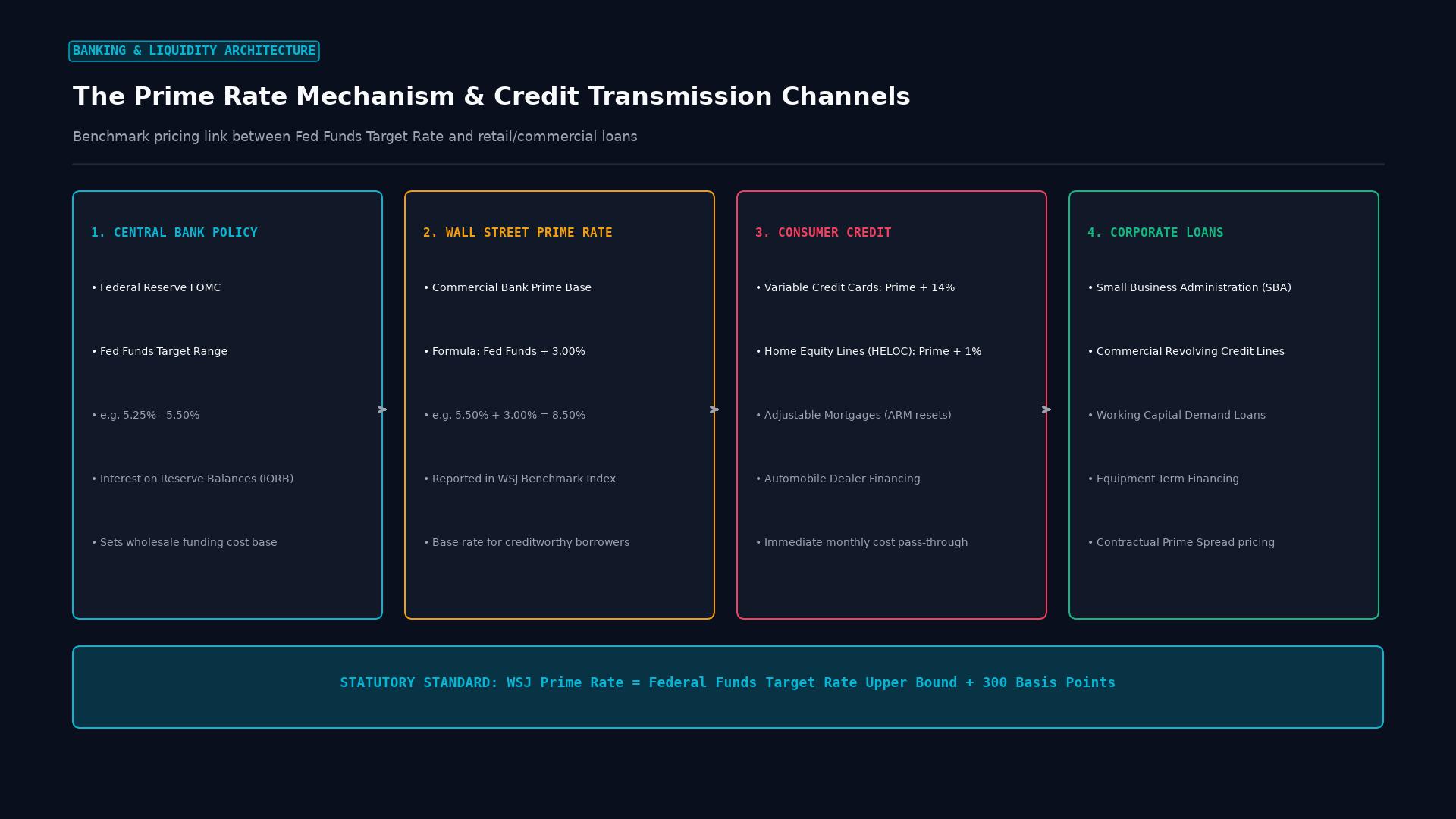 Figure: Benchmark lending engine: transmission from Federal Reserve policy rates through the commercial bank Prime Rate to consumer and small business debt.
How the Prime Rate Affects Consumer and Business Borrowing
The prime rate serves as an index upon which banks add an underwriting risk spread (margin) based on the borrower’s credit profile:
$$\text{Borrower Loan Rate} = \text{Prime Rate} + \text{Margin (Spread)}$$
| Credit Product | Typical Pricing Formula | Effective Rate (Prime = 8.50%) | Rate Sensitivity |
|---|---|---|---|
| Prime Corporate Revolver | Prime $+ 0.00%$ to $+ 1.50%$ | 8.50% to 10.00% | Adjusts on the first day of each calendar month. |
| Small Business Loan (SBA 7a) | Prime $+ 2.25%$ to $+ 4.75%$ | 10.75% to 13.25% | Direct quarterly or monthly floating resets. |
| Home Equity Line of Credit (HELOC) | Prime $+ 0.50%$ to $+ 2.00%$ | 9.00% to 10.50% | Resets within 1 to 2 billing cycles following Fed rate hikes. |
| Variable-Rate Credit Card | Prime $+ 11.99%$ to $+ 18.99%$ | 20.49% to 27.49% | Resets automatically; increases minimum monthly debt service. |
| Fixed-Rate 30Y Mortgage | Indirectly tied to 10-Year Treasury yield | 6.50% to 7.50% | Not tied directly to Prime, but correlated via macro yield curves. |
The WSJ Prime Rate: Consensus Mechanism
The most universally recognized standard in the United States is the Wall Street Journal (WSJ) Prime Rate:
- The Wall Street Journal polls the 30 largest commercial banks in the United States.
- When at least 23 of the 30 banks (approximately 75%) alter their prime lending rates, the WSJ officially updates its published consensus benchmark.
- Because interbank competition is intense, almost all major commercial banks adjust their prime rate simultaneously within minutes of an FOMC rate decision, ensuring seamless national credit uniformity.
Prime Rate vs. Central Bank Rate vs. SOFR
Market participants must distinguish between the key benchmark interest rates that steer global financial architecture:
| Benchmark Rate | Determining Entity | Counterparty / Market | Primary Structural Function |
|---|---|---|---|
| Federal Funds Rate | Central Bank (FOMC Target) | Depository institutions borrowing overnight reserves uncollateralized. | Core anchor of national monetary policy stance. |
| SOFR | Market-determined (Calculated by NY Fed) | Institutional banks & dealers in US Treasury repurchase (repo) market. | Replacement for USD LIBOR; benchmark for institutional derivatives & syndicated debt. |
| Prime Rate | Commercial Banks (JPMorgan, BofA, etc.) | Commercial banks lending to creditworthy corporations and consumers. | Benchmark index for consumer loans, HELOCs, and small business credit lines. |
Real-World Case Study: The 2022–2023 Rapid Tightening Shock
Between March 2022 and July 2023, the US Federal Reserve enacted the fastest monetary tightening campaign in four decades to combat 40-year-high inflation:
- The Rate Shock: The Fed hiked the Federal Funds target range from 0.00%–0.25% to 5.25%–5.50% (+525 basis points).
- The Prime Rate Expansion: In lockstep, the WSJ Prime Rate surged from 3.25% to 8.50%.
- Impact on Small Business Lending: A small manufacturing business with a $2,000,000 floating-rate SBA credit line priced at Prime + 2.00% saw its interest rate jump from 5.25% to 10.50%: $$\text{Initial Annual Interest Expense} = $2{,}000{,}000 \times 5.25% = $105{,}000$$ $$\text{New Annual Interest Expense} = $2{,}000{,}000 \times 10.50% = $210{,}000$$
- Corporate Transmission: The doubling of annual debt service expenses ($+$105,000) forced corporate borrowers nationwide to curtail capital expenditures and reduce hiring, successfully cooling aggregate demand as intended by central bank policy.
Frequently Asked Questions
Can an individual borrower borrow at the prime rate?
Generally, only the largest, most creditworthy multinational corporations with pristine credit ratings borrow directly at the prime rate (Prime + 0%). Individual retail borrowers almost always pay the prime rate plus an added margin (e.g., Prime + 1% for a HELOC, or Prime + 15% for a credit card) to compensate the bank for credit default risk.
What is the difference between the Prime Rate and the Discount Rate?
- The Prime Rate is the interest rate commercial banks charge their private clients.
- The Discount Rate (Primary Credit Rate) is the interest rate the Federal Reserve charges commercial banks when they borrow short-term emergency funds directly from the Fed’s Discount Window.
How quickly does a credit card interest rate change when the Prime Rate moves?
Under the Credit CARD Act of 2009 in the United States, credit card issuers are permitted to adjust variable APRs automatically in accordance with changes in a published index (such as the WSJ Prime Rate) without providing a 45-day advance notice. The change typically reflects on the cardholder’s statement within one to two billing cycles.
Ready to trade forex?
Open a free demo account with a regulated broker. Practice with virtual funds before risking real money.