Open Market Operations
Open Market Operations (OMOs) are the principal monetary policy tools by which a central bank buys or sells government securities, repurchase agreements, and eligible debt instruments in the open market to regulate the supply of commercial bank reserves and guide benchmark interest rates.
What Are Open Market Operations (OMOs)?
Open Market Operations (OMOs) constitute the most flexible and frequently utilized tool of modern central banking. By buying or selling marketable government debt securities (such as US Treasury bills and bonds, UK gilts, or German Bunds) in the open financial market, a central bank directly expands or contracts the monetary base and controls the volume of liquid reserves held by commercial banking institutions.
In the United States, open market operations are formulated and directed by the Federal Open Market Committee (FOMC) and executed on trading desks by the Open Market Trading Desk (the “Desk”) at the Federal Reserve Bank of New York, dealing exclusively with authorized primary dealers.
The core mechanics of OMOs operate on a direct reserve transmission model:
- Expansionary OMO (Purchases): When the central bank buys securities from primary dealers, it credits the reserve accounts of those dealers’ clearing banks with newly created central bank funds. This increases aggregate bank reserves, expanding system liquidity and placing downward pressure on short-term interbank lending rates (such as the Federal Funds Rate or SOFR).
- Contractionary OMO (Sales): When the central bank sells securities, it debits the reserve accounts of commercial banks, absorbing cash from the banking system. The reduction in available loanable funds increases competition for reserves, driving short-term interest rates upward.
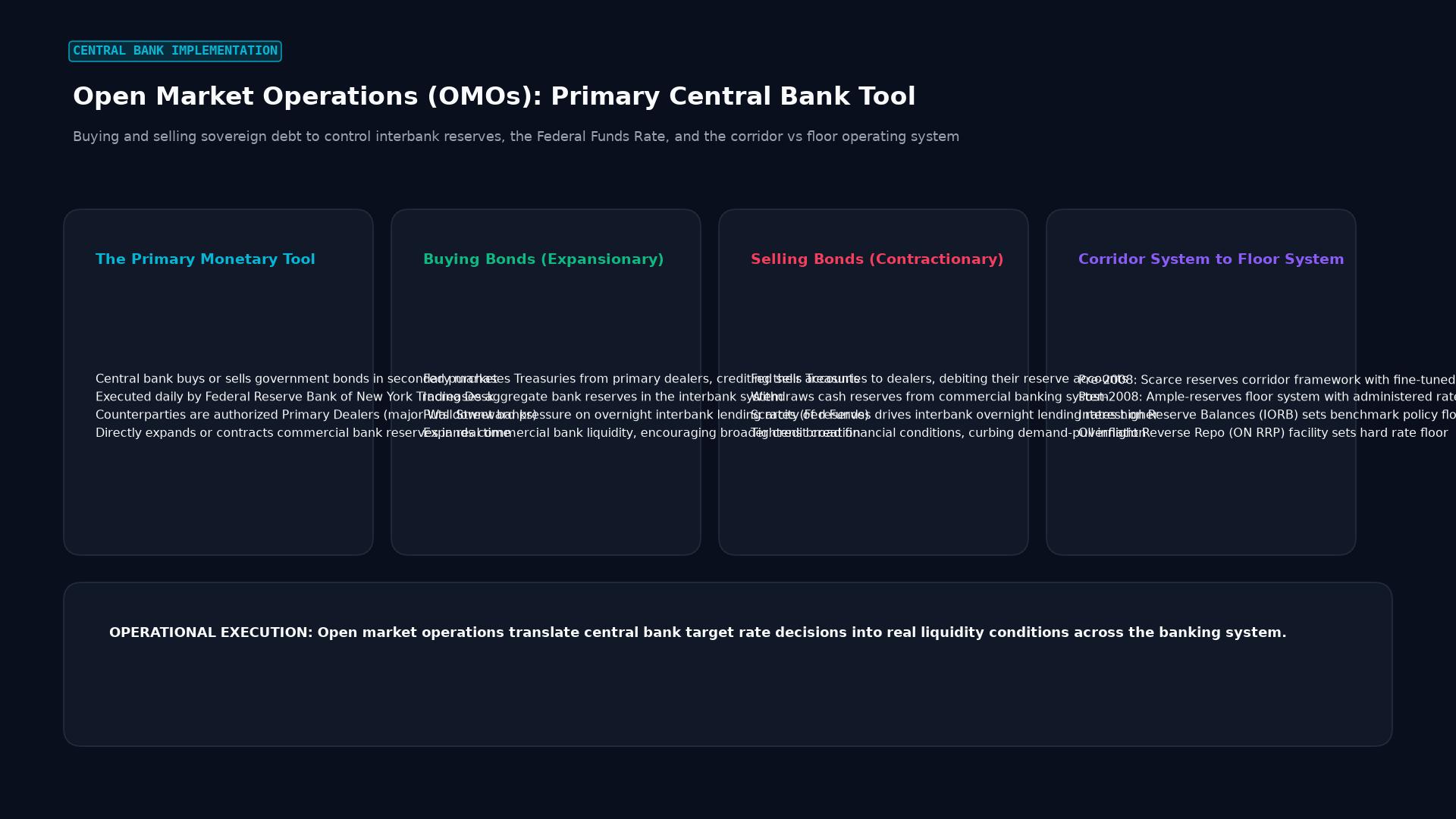 Figure: Buying and selling sovereign debt to control interbank reserves, the Federal Funds Rate, and the corridor vs floor operating system
Permanent vs. Temporary Open Market Operations
Central banks utilize two distinct structural categories of open market operations depending on their policy horizon:
1. Permanent Open Market Operations (POMO)
Permanent OMOs involve the outright outright purchase or sale of securities for the central bank’s System Open Market Account (SOMA) portfolio. These transactions are designed to accommodate long-term economic growth, replace maturing debt holdings, or execute structural balance sheet expansions—such as Quantitative Easing (QE) or Quantitative Tightening (QT). Outright purchases create a permanent increase in the monetary base until the central bank actively sells or lets the securities mature without reinvestment.
2. Temporary Open Market Operations (TOMO)
Temporary OMOs address transient, day-to-day liquidity imbalances in the banking system caused by corporate tax payment dates, seasonal currency demand, or Treasury General Account (TGA) fluctuations. Temporary operations utilize short-term collateralized lending agreements:
- Repurchase Agreements (Repos): The central bank buys securities from dealers today with an agreement to sell them back at a specified future date (typically overnight or up to 14 days), injecting temporary reserves.
- Reverse Repurchase Agreements (Reverse Repos / RRP): The central bank sells securities to eligible financial counterparties (including money market funds and government-sponsored enterprises) today with an agreement to buy them back tomorrow, draining excess cash and establishing a firm floor under overnight interest rates.
Evolution of the Operating Framework: Corridor vs. Floor System
Following the 2008 Global Financial Crisis, the operational execution of OMOs underwent a monumental structural shift:
| Operational Feature | Scarce Reserves Era (Pre-2008 Corridor) | Ample Reserves Era (Post-2008 Floor System) |
|---|---|---|
| Systemic Reserve Supply | Reserves were intentionally kept scarce (~$10 billion total). | Massive excess reserves created via QE ($3+ trillion). |
| Primary OMO Mechanism | Daily fine-tuning repos to adjust reserve supply to the exact inelastic demand curve. | Administered rates set policy; temporary reverse repos (ON RRP) drain excess cash. |
| Policy Rate Control | Trading desk adjusted marginal reserve quantities to hit the target Fed Funds rate. | Central bank sets IORB (Interest on Reserve Balances) as the benchmark floor rate. |
| FX Market Transmission | Direct adjustments to daily liquidity expectations moved spot rates immediately. | Shifts in forward rate expectations, terminal rate dot-plots, and balance sheet runoff runoff pace. |
Real-World Case Study: The September 2019 US Repo Market Spike
In mid-September 2019, a sharp collision of two calendar events drained liquid reserves from the US banking system:
- Corporate tax deadlines caused $35 billion to be transferred from commercial bank deposits into the Treasury’s account.
- A large US Treasury bond settlement absorbed another $78 billion in private cash.
Because commercial bank reserves had drifted down toward the regulatory minimum threshold during the Fed’s balance sheet runoff, the repo market experienced a severe liquidity squeeze. On September 17, 2019, the Secured Overnight Financing Rate (SOFR) surged from 2.42% to an intraday high of 10.00%, pulling the effective Federal Funds rate outside its target corridor.
       SEPTEMBER 2019 REPO SPIKE & EMERGENCY OMO INTERVENTION

 Tax Outflows + Treasury Auctions ---> Reserves Plummet Near Minimum Threshold
                                                  |
 Overnight Repo Rate Surges to 10% <-------------+
                                                  |
 NY Fed Launches Emergency Overnight Repo OMO ($75B/day)
                                                  |
 Reserves Injected Instantly ---> Overnight Rates Normalize Back to 2.00%
To re-establish rate control, the NY Fed Desk immediately initiated emergency daily temporary OMOs, injecting up to $75 billion per day through overnight repurchase operations. Shortly thereafter, the FOMC announced a permanent program to purchase $60 billion in Treasury bills per month to restore ample reserve buffers permanently.
Frequently Asked Questions
How do Open Market Operations impact spot forex rates?
When a central bank conducts contractionary OMOs (or raises its policy rate), domestic interest yields rise relative to foreign yields. Under the principles of interest rate parity and global capital allocation, foreign capital flows into domestic debt instruments to capture higher returns, driving appreciation in the domestic currency (e.g., strengthening USD).
What is the role of Primary Dealers in OMOs?
Primary dealers are elite financial institutions (such as JPMorgan Chase, Goldman Sachs, and Citigroup) authorized to trade directly with the central bank’s trading desk. They are contractually obligated to participate in central bank open market auctions, buy Treasury debt at sovereign auctions, and distribute those securities into the broader global marketplace.
What is the difference between Open Market Operations and Quantitative Easing (QE)?
Quantitative Easing is an unconventional, large-scale extension of permanent open market operations. While traditional OMOs typically target short-term government debt to steer overnight lending rates, QE involves purchasing massive quantities of long-term sovereign bonds and mortgage-backed securities to suppress long-term borrowing yields and stimulate economic demand when overnight rates are already near zero.
Ready to trade forex?
Open a free demo account with a regulated broker. Practice with virtual funds before risking real money.