Process
In finance and trading, a process is a structured, repeatable methodology governing portfolio management, trade execution, risk controls, and operational trade settlement.
What is a Financial Process?
In financial markets, wealth management, and capital allocation, a process is a documented, structured, and repeatable sequence of analytical steps and operational controls designed to achieve specific economic objectives.
Rather than relying on intuition, market rumors, or emotional decision-making, institutional market participants, including pension funds, sovereign wealth managers, hedge funds, and professional trading desks, rely on rigorous processes to manage capital, execute trades, and maintain compliance.
In modern finance, the concept of process applies across three distinct functional domains:
- The Institutional Investment Process: The end-to-end framework through which portfolio managers analyze capital markets, construct portfolios, and evaluate risk-adjusted returns against benchmark hurdles.
- The Systematic Trading Process: The daily operational routine utilized by algorithmic and discretionary traders to scan for edge, compute position sizing, execute orders, and log trade data.
- The Post-Trade Settlement Process: The middle- and back-office clearing pipeline that transitions an executed market transaction from trade capture to legal settlement and custodial reconciliation.
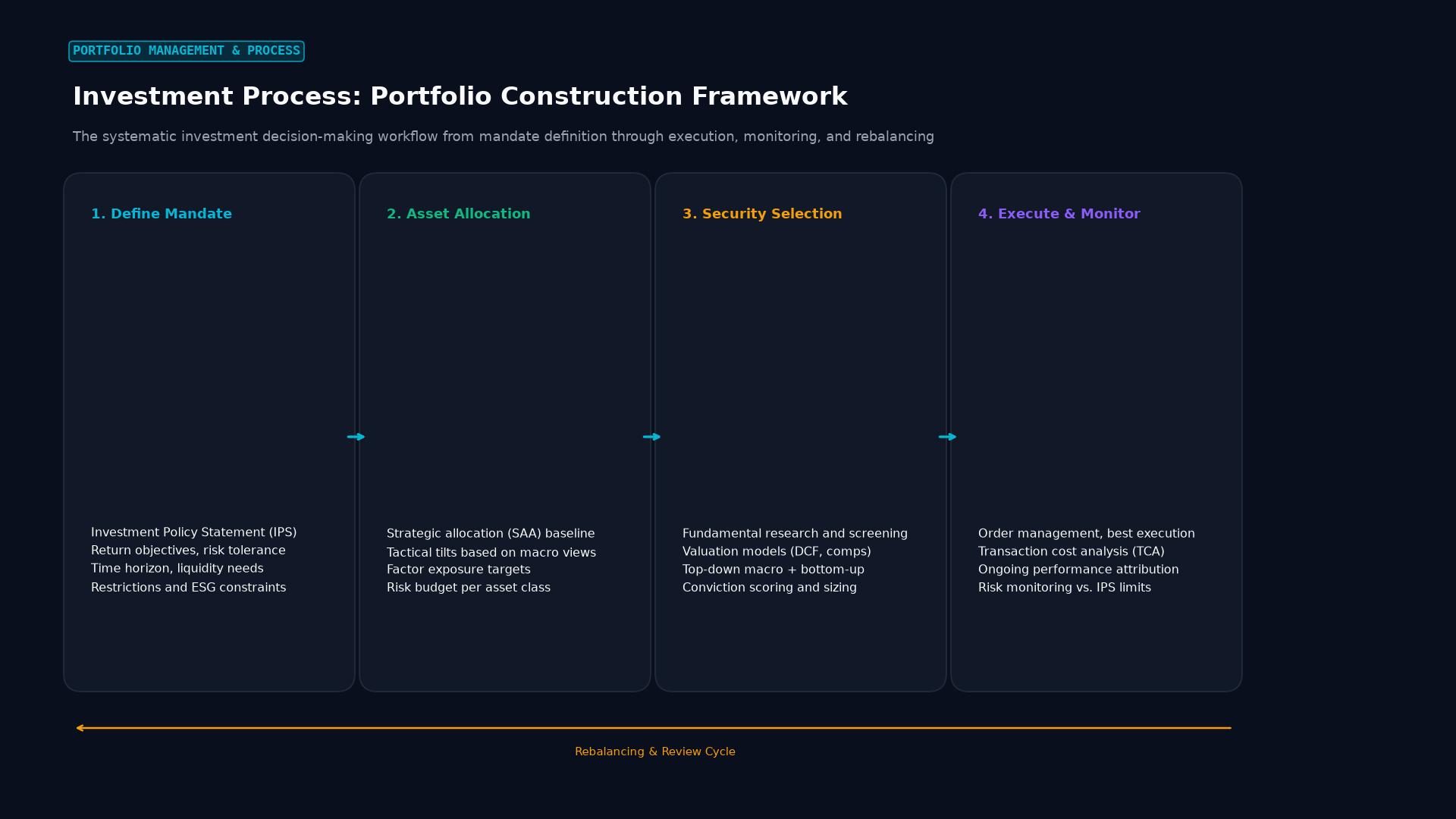 Figure: The systematic investment decision-making workflow from mandate definition through execution, monitoring, and rebalancing
The Institutional Investment Process Lifecycle
Under the standards established by the CFA Institute and institutional fiduciary mandates, the investment process is cyclical and continuous. It consists of three primary phases: Planning, Execution, and Feedback.
                +------------------------------------------------+
                |                1. PLANNING PHASE               |
                |  - Client Profiling & Constraints Formulation  |
                |  - Investment Policy Statement (IPS) Drafting  |
                |  - Strategic Asset Allocation (SAA) Modeling   |
                +------------------------------------------------+
                                       │
                                       ▼
                +------------------------------------------------+
                |               2. EXECUTION PHASE               |
                |  - Security Selection (Fundamental / Quant)    |
                |  - Tactical Asset Allocation (TAA) Overlays    |
                |  - Portfolio Construction & Risk Constraints   |
                |  - Best Execution & Transaction Cost Analysis  |
                +------------------------------------------------+
                                       │
                                       ▼
                +------------------------------------------------+
                |               3. FEEDBACK PHASE                |
                |  - Performance Measurement (Sharpe, Alpha)     |
                |  - Brinson-Hood-Beebower Attribution Analysis  |
                |  - Portfolio Rebalancing to Target Weights     |
                +------------------------------------------------+
                                       │
                                       └───────────► (Returns to Phase 1)
1. The Planning Phase: The Investment Policy Statement (IPS)
Every institutional investment process begins with the formulation of an Investment Policy Statement (IPS). The IPS serves as the legal and strategic roadmap governing all future portfolio allocations.
The planning process defines two primary elements:
- Investment Objectives: Formulates measurable return expectations and quantifies risk tolerance (e.g., maximum allowable annual drawdowns, target volatility bands).
- Investment Constraints: Dictates operational boundaries across five standardized categories (the RRTTLL framework):
- Risk Tolerance: Willingness and mathematical ability to absorb capital loss.
- Return Requirements: Net real returns required to satisfy institutional liabilities (such as future pension payouts).
- Time Horizon: Single-stage or multi-stage investment horizons.
- Tax Considerations: Tax-exempt, deferred, or taxable account treatment.
- Liquidity Needs: Anticipated cash outflows required for operating expenses or member distributions.
- Legal and Regulatory Factors: Compliance with ERISA, UCITS, or insurance solvency mandates.
2. The Execution Phase: Asset Allocation and Portfolio Construction
Once the IPS is finalized, the manager executes the strategy through a two-step allocation process:
- Strategic Asset Allocation (SAA): Establishes long-term target portfolio weights across broad asset classes (e.g., 50% Global Equities, 30% Fixed Income, 10% Private Credit, 10% Real Estate) using mean-variance optimization or risk-parity models.
- Tactical Asset Allocation (TAA): Implements short-term, discretionary, or algorithmic tilts around target weights to capitalize on transient macroeconomic mispricings.
- Security Selection: Identifies specific securities using bottom-up fundamental analysis (discounted cash flow modeling, quality screens) or quantitative multi-factor screening (value, momentum, quality, low volatility).
3. The Feedback Phase: Attribution and Rebalancing
The investment process requires continuous performance evaluation:
- Performance Attribution: Uses mathematical frameworks like the Brinson-Hood-Beebower model to determine whether portfolio outperformance (Alpha) was driven by asset allocation decisions, individual security selection, or interaction effects.
- Rebalancing Disciplines: When market movements cause asset weights to drift beyond pre-set tolerance bands (e.g., an equity rally pushing a 50% target weight to 58%), the rebalancing process triggers automated sales to trim winners and buy undervalued asset classes, enforcing long-term discipline.
The Professional Trading Process: From Edge to Execution
For proprietary traders, hedge fund execution desks, and independent foreign exchange participants, success is dictated by adherence to a trading process.
In high-volatility financial markets, an individual trade has a probabilistic outcome. However, by strictly applying an institutional trading process, market participants isolate their statistical edge and eliminate destructive behavioral biases (such as loss aversion, revenge trading, and over-leveraging).
+------------------------------------------------------------------------------------+
|                         THE 4-STAGE TRADING PROCESS CYCLE                          |
+-------------------+----------------------------------------------------------------+
| STAGE             | OPERATIONAL ACTIVITIES & CONTROLS                              |
+-------------------+----------------------------------------------------------------+
| 1. Pre-Market     | - Macro economic calendar review (NFP, CPI, Central Bank rates)|
| Preparation       | - Technical key level mapping (support, resistance, liquidity) |
|                   | - Volatility assessment (Average True Range, implied volatility)|
+-------------------+----------------------------------------------------------------+
| 2. Order Sizing   | - Calculation of trade stop-loss distance in pips or points    |
| & Risk Math       | - Exact position sizing based on portfolio risk budget (e.g. 1%)|
|                   | - Verification of risk-to-reward ratio (minimum 1:2 hurdle)    |
+-------------------+----------------------------------------------------------------+
| 3. Execution &    | - Smart order routing (Limit, Stop, Algorithmic TWAP/VWAP)     |
| In-Trade Control  | - Automated bracket orders (pre-set Take-Profit and Stop-Loss) |
|                   | - Execution rules: Zero widening of stops during drawdowns     |
+-------------------+----------------------------------------------------------------+
| 4. Post-Trade     | - Detailed trade logging in electronic journal                 |
| Audit & Journal   | - Metrics review: Entry slippage, exit compliance, R-multiples |
|                   | - Psychological check: Discipline vs emotional impulsivity     |
+-------------------+----------------------------------------------------------------+
Mathematical Position Sizing in the Trading Process
An essential step within the trading process is the decoupling of risk capital from trade lot size. Professional execution desks calculate volume directly from stop-loss distance:
$$\text{Position Size (Units)} = \frac{\text{Account Capital} \times \text{Risk Percentage}}{\text{Stop-Loss Distance (Price)} \times \text{Tick / Pip Value}}$$
By running this formula before order entry, the trader ensures that whether a stop-loss is 15 pips or 75 pips away, the portfolio loses no more than the budgeted dollar allocation.
The Post-Trade Operational and Settlement Process
Behind trading terminals sits the operational process that validates, clears, and settles transactions. Known as the trade lifecycle, this pipeline transitions a verbal or electronic execution into final legal transfer of ownership.
Execution on Electronic Platform (EBS, Currenex, Bloomberg)
                            │
                            ▼
1. Trade Capture & Internal Booking (OMS / EMS)
                            │
                            ▼
2. Allocation & Confirmation (Omgeo CTM / SWIFT MT300)
                            │
                            ▼
3. Clearing & Novation (Central Counterparty / LCH / CME)
                            │
                            ▼
4. Settlement via Payment vs. Payment (PvP) / Delivery vs. Payment (DvP)
   - Settled via Continuous Linked Settlement (CLS) for FX
   - Settled via DTCC / Euroclear for Equities and Bonds
                            │
                            ▼
5. Post-Settlement Reconciliation & Custody Accounting
The Shift to T+1 Settlement
In May 2024, the United States, Canadian, and Mexican capital markets officially shifted from a two-day settlement cycle ($T+2$) to a one-day settlement cycle ($T+1$) for equities, corporate debt, and unit investment trusts.
This accelerated timeline required institutions to re-engineer their operational settlement processes:
- Trade allocation and confirmation processes that previously had 24 hours to complete must now execute on the trade date ($T+0$), often before 9:00 PM Eastern Time.
- Global foreign exchange desks had to revise their currency conversion workflows to guarantee that foreign currency trades settle in time to deliver US dollars for stock purchases on $T+1$, avoiding expensive failed trade penalties.
Operational Due Diligence (ODD): Evaluating Process Integrity
When institutional investors (such as sovereign wealth funds or university endowments) allocate capital to external hedge fund managers, they perform two separate evaluations:
- Investment Due Diligence (IDD): Evaluates the portfolio manager’s investment strategy, track record, and pedigree.
- Operational Due Diligence (ODD): Evaluates the fund’s operational infrastructure, internal controls, and procedural safeguards.
+------------------------------------------------------------------------------------+
|                         ODD PROCESS EVALUATION CHECKLIST                           |
+-------------------+----------------------------------------------------------------+
| AUDIT AREA        | CONTROL EVALUATION CRITERIA                                    |
+-------------------+----------------------------------------------------------------+
| Governance &      | Separation of portfolio management from trade reconciliation;  |
| Segregation       | independent chief compliance officer reporting directly to BOD.|
+-------------------+----------------------------------------------------------------+
| Valuation Policy  | Third-party fund administrator calculates daily Net Asset      |
|                   | Value (NAV) using independent price feeds; no manager pricing. |
+-------------------+----------------------------------------------------------------+
| Cash Management   | Dual-authorization protocols on wire releases; strict segregation|
|                   | between management company accounts and client fund capital.   |
+-------------------+----------------------------------------------------------------+
| Business Continuity| Redundant data centers, disaster recovery testing, and real-time|
| & Cybersecurity   | penetration audits protecting client trade and banking data.   |
+-------------------+----------------------------------------------------------------+
Extensive industry data shows that the majority of catastrophic hedge fund failures (including outright frauds like Bernie Madoff’s Ponzi scheme) were caused not by poor investment thesis selection, but by the breakdown or complete absence of operational and valuation processes.
Key Takeaways
- Foundational Market Discipline: In finance, a process is a structured, repeatable methodology governing portfolio design, execution discipline, risk management, and operational settlement.
- Three-Phase Investment Cycle: Institutional capital management operates across three cyclical stages: Planning (Investment Policy Statement), Execution (Asset Allocation and Selection), and Feedback (Performance Attribution and Rebalancing).
- Trading Edge Preservation: A disciplined trading process standardizes trade preparation, mathematical position sizing, bracketed risk orders, and post-trade journaling, insulating traders from psychological biases.
- Accelerated Trade Lifecycle: Modern market plumbing operates on compressed timelines (including the $T+1$ settlement cycle), requiring automated straight-through processing (STP) from trade capture to custodial reconciliation.
- Operational Due Diligence Priority: Institutional allocators evaluate operational process integrity as rigorously as investment performance to mitigate fraud, valuation conflicts, and operational risk.
Frequently Asked Questions (FAQ)
Why do institutional allocators prioritize “process over outcome” when evaluating managers?
Institutional allocators focus on process over outcome because in the short term, market randomness and high-beta exposure can make poor investment decisions look profitable, while sound, disciplined strategies can suffer temporary losses. Over multi-year investment horizons, market randomness averages out, and only managers with a repeatable, systematic process can deliver sustained risk-adjusted alpha. An allocator wants to confirm that a manager’s positive performance was generated by genuine skill and disciplined risk controls rather than unhedged speculative luck.
How does having a documented trading process prevent emotional trading errors?
Emotional errors, such as “revenge trading” after a loss, closing profitable positions prematurely out of fear, or doubling down on losing positions, occur when traders make real-time decisions under psychological stress. A documented trading process pre-defines all trade parameters before capital is committed: the entry trigger, exact position size in lots, technical stop-loss price, profit target, and exit rules. By establishing these rules in advance, execution becomes an objective mechanical checklist, removing panic and greed from active market participation.
What is the role of an Investment Policy Statement (IPS) in the investment process?
An Investment Policy Statement (IPS) is the foundational governing document of the investment process. It formalizes the client’s financial profile, establishing specific return targets, maximum acceptable volatility, and operational constraints (such as liquidity needs, tax status, investment horizon, and asset class restrictions). The IPS serves as a protective benchmark for both the client and the investment manager, ensuring that portfolio decisions remain aligned with long-term strategic liabilities rather than short-term market noise.
Ready to trade forex?
Open a free demo account with a regulated broker. Practice with virtual funds before risking real money.