Put-Call Parity
Put-Call Parity is a foundational mathematical principle of financial derivatives that defines the static, no-arbitrage equilibrium relationship between the price of a European call option and a European put option sharing the identical underlying asset, strike price, and expiration date.
What Is Put-Call Parity?
In derivatives pricing and quantitative finance, Put-Call Parity is a core mathematical law that dictates the precise price relationship between European-style call options and put options that share the exact same underlying asset ($S$), strike price ($K$), and time to expiration ($T$).
First mathematically formulated by economist Hans Stoll in 1969, Put-Call Parity is rooted in the fundamental economic principle of the Law of One Price: two investment portfolios that produce identical financial payoffs at a future date under all possible market conditions must have the exact same market price today. If their market prices diverge, a riskless arbitrage opportunity emerges, allowing traders to lock in instantaneous, risk-free profits until market forces restore equilibrium.
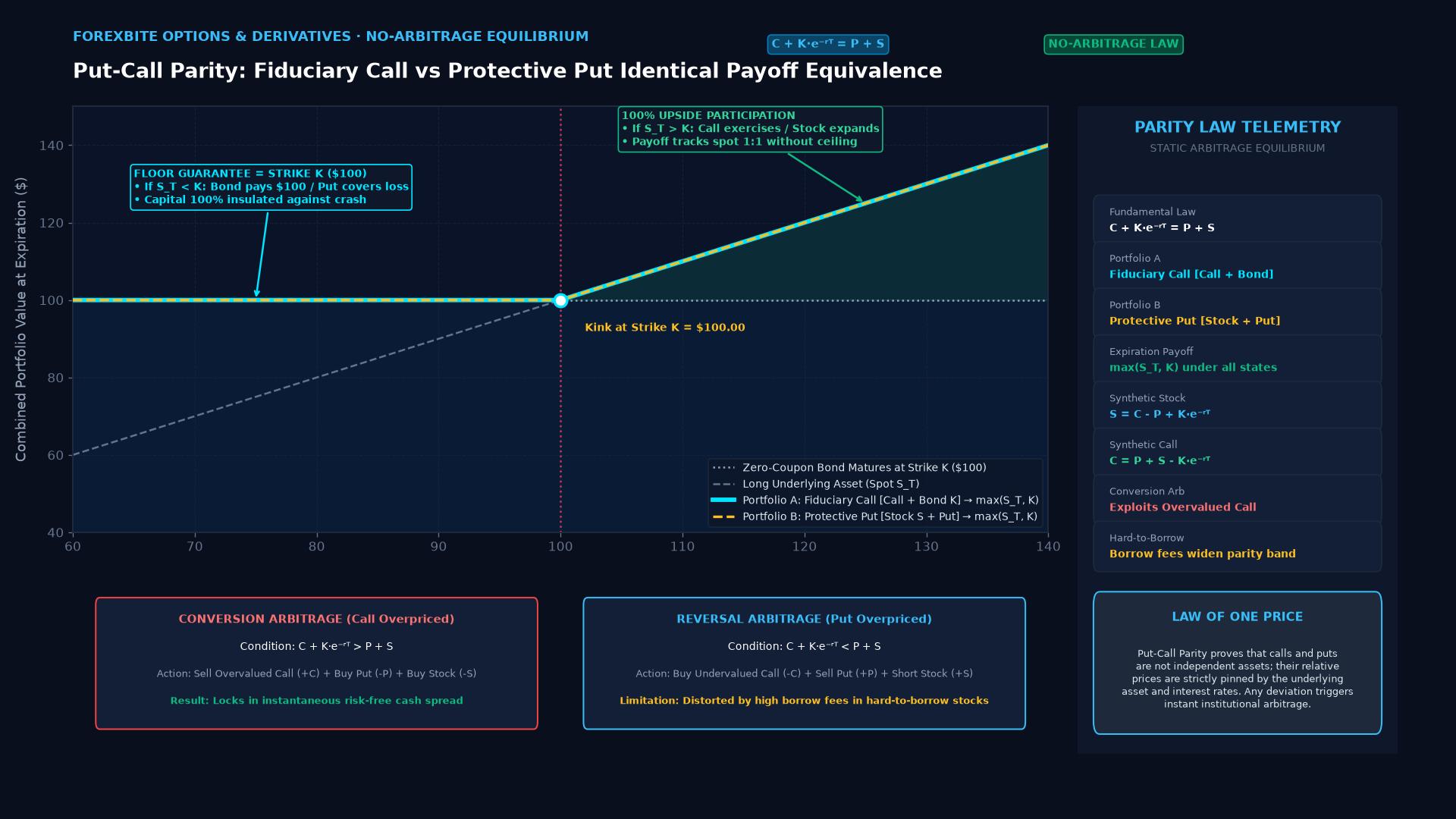
The Mathematical Derivation
Consider two distinct investment portfolios constructed at time $t=0$:
Portfolio A (Fiduciary Call)
- Consists of one European Call Option ($C$) with strike $K$ and expiration $T$.
- Plus a Zero-Coupon Bond (or cash deposit) with a face value equal to the strike price $K$, discounted to present value at risk-free rate $r$: $K \cdot e^{-rT}$.
Portfolio B (Protective Put)
- Consists of one share of the Underlying Asset ($S$).
- Plus one European Put Option ($P$) with the identical strike $K$ and expiration $T$.
Payoff at Expiration ($T$):
At expiration date $T$, the underlying asset will trade at some spot price $S_T$:
- Scenario 1: Asset Price Above Strike ($S_T \ge K$):
- In Portfolio A: The call option is worth $S_T - K$, and the bond matures at $K$. Total value = $(S_T - K) + K = \mathbf{S_T}$.
- In Portfolio B: The stock is worth $S_T$, and the put option expires worthless ($0$). Total value = $\mathbf{S_T}$.
- Scenario 2: Asset Price Below Strike ($S_T < K$):
- In Portfolio A: The call option expires worthless ($0$), and the bond matures at $K$. Total value = $\mathbf{K}$.
- In Portfolio B: The stock is worth $S_T$, and the put option is worth $K - S_T$. Total value = $S_T + (K - S_T) = \mathbf{K}$.
Because both portfolios yield an identical payoff ($\max(S_T, K)$) under every conceivable scenario, their present market values must be strictly equal:
$$C + K \cdot e^{-rT} = P + S$$
Dividend Adjustment to Put-Call Parity
When the underlying equity pays known cash dividends ($D$) with present value $\text{PV}(D)$ prior to option expiration, the stock price drops by the dividend amount on the ex-dividend date. The parity equation adjusts accordingly:
$$C + K \cdot e^{-rT} + \text{PV}(D) = P + S$$
Synthetic Relationships: Engineering Positions
Put-Call Parity allows quantitative trading desks and market makers to create synthetic positions that replicate the financial performance of another asset without physically holding it:
| Synthetic Target Asset | Mathematical Formula | Practical Trading Application |
|---|---|---|
| Synthetic Long Stock | $S = C - P + K \cdot e^{-rT}$ | Replicates owning stock by buying a call and selling a put at the same strike. |
| Synthetic Short Stock | $-S = P - C - K \cdot e^{-rT}$ | Replicates shorting stock without incurring hard-to-borrow fees. |
| Synthetic Long Call | $C = P + S - K \cdot e^{-rT}$ | Replicates a call option by owning the stock and buying a put (Protective Put). |
| Synthetic Long Put | $P = C - S + K \cdot e^{-rT}$ | Replicates a put option by buying a call and shorting the underlying stock. |
Arbitrage Mechanics: Conversions and Reversals
When market prices violate Put-Call Parity, institutional algorithmic systems exploit the pricing discrepancy through two classic arbitrage strategies:
1. The Conversion Arbitrage (Calls Overpriced Relative to Puts)
- Condition: $C + K \cdot e^{-rT} > P + S$
- Execution:
- Sell the overvalued call ($+C$).
- Buy the undervalued put ($-P$).
- Buy the underlying stock ($-S$).
- Borrow the present value of the strike at risk-free rate $r$.
- Result: Locks in a 100% riskless cash arbitrage spread regardless of where the stock trades at expiration.
2. The Reversal Arbitrage (Puts Overpriced Relative to Calls)
- Condition: $C + K \cdot e^{-rT} < P + S$
- Execution:
- Buy the undervalued call ($-C$).
- Sell the overvalued put ($+P$).
- Short the underlying stock ($+S$).
- Lend the cash proceeds at the risk-free rate $r$.
- Result: Captures the positive spread while holding a completely risk-neutral position.
                   CONVERSION ARBITRAGE WORKFLOW

  Discrepancy: Call is trading at $6.00 (Fair Parity Price is $5.20)
               |
               v
  [Sell Call @ $6.00] + [Buy Put @ $2.00] + [Buy Stock @ $100.00]
               |
               v
  Net Cash Outlay Borrowed at Risk-Free Rate
               |
               v
  At Expiration: Exact Strike $100.00 returned under all states
  Riskless Arbitrage Profit Realized: $0.80 per share ($80 per contract)
Real-World Case Study: Put-Call Parity Breakdown in Hard-to-Borrow Equities
In January 2021, during the unprecedented short squeeze of GameStop (GME), retail traders bought millions of short-dated out-of-the-money call options, while institutional short-sellers desperately sought shares to cover their short positions.
- The Anomaly: Short-borrow interest rates in the securities lending market exploded to over 120% annualized.
- The Parity Distortion: Under theoretical Put-Call Parity: $$C - P = S - K \cdot e^{-rT}$$ However, because physical stock could not be easily borrowed or shorted, market makers pricing deep ITM puts and OTM calls could not execute the classic reversal arbitrage without paying astronomical borrow fees ($r_{\text{borrow}} \gg r_{\text{risk-free}}$).
- The Market Reality: The market price of GME synthetic stock constructed via options traded at a massive discount (up to $30.00 lower) than the cash stock price on the New York Stock Exchange.
- The Institutional Takeaway: Put-Call Parity holds near-perfectly in liquid, easily borrowable assets. However, in hard-to-borrow stocks with sky-high borrow fees or severe short-sale restrictions, parity transforms from an exact equality into a wide arbitrage band governed by lending costs.
Frequently Asked Questions
Does Put-Call Parity apply to American-style options?
Strict Put-Call Parity applies as an exact equality only to European-style options, which can only be exercised on the expiration date. For American-style options (which can be exercised early by the holder), Put-Call Parity is expressed as an inequality band: $$S - K \le C_{\text{Amer}} - P_{\text{Amer}} \le S - K \cdot e^{-rT}$$ This reflects the added economic value that American calls and puts carry due to early exercise rights.
How do retail traders benefit from Put-Call Parity?
Retail traders use Put-Call Parity to check for fair pricing in options chains. If a retail trader wants to buy a call option, they can compare its price against a synthetic call ($P + S - K \cdot e^{-rT}$). If the synthetic call is significantly cheaper, the trader can construct the synthetic position instead to save on execution costs.
What is the “Fiduciary Call”?
A Fiduciary Call is an investment strategy that combines buying an out-of-the-money European call option with investing enough cash into a risk-free government bond to cover the full exercise strike price upon maturity. It guarantees that the investor will never lose their principal capital while retaining full upside exposure to the underlying stock.
Ready to trade forex?
Open a free demo account with a regulated broker. Practice with virtual funds before risking real money.