Rainbow Option
A rainbow option is an exotic multi-asset derivative contract whose terminal financial payoff depends on the performance, relative ranking, or mathematical combination of two or more distinct underlying reference assets, such as a basket of currencies, commodities, or equities.
What Is a Rainbow Option?
In quantitative finance and institutional derivatives engineering, a rainbow option is an exotic multi-asset options contract whose payoff is contingent upon the price behavior, correlation, or relative ranking of two or more distinct underlying reference assets. The colorful moniker “rainbow” originates from the mathematical convention of viewing each distinct asset or risk factor as a different “color” in a multidimensional spectrum of market risk.
Unlike standard vanilla options—which derive their value from a single underlying asset (such as Apple stock or the EUR/USD exchange rate)—rainbow options evaluate an entire basket of assets. Depending on the contractual design, the payoff may be tied to the best-performing asset, the worst-performing asset, the difference (spread) between two assets, or a weighted combination that sorts assets from highest to lowest return at expiration.
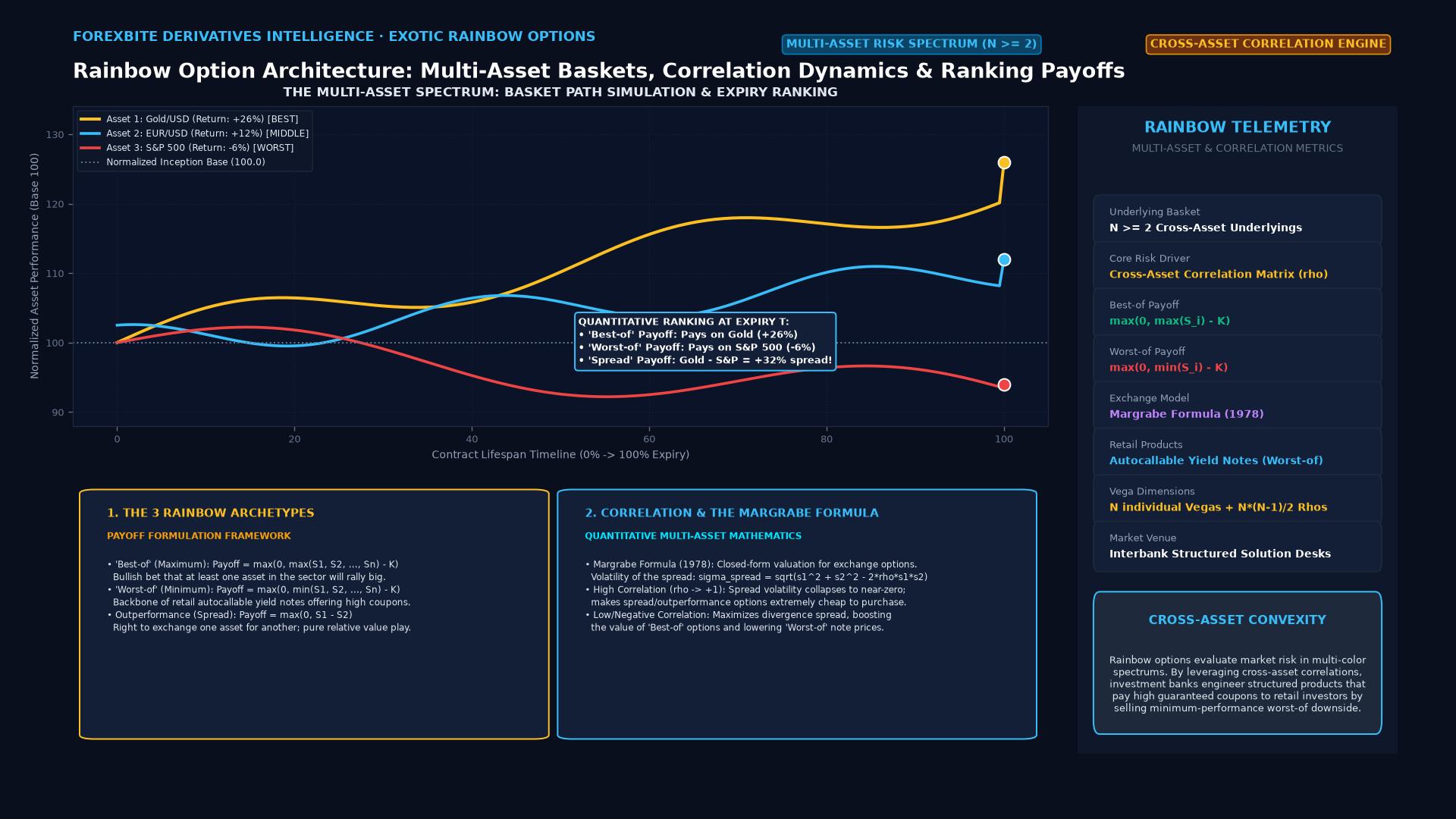 Figure: Rainbow option multi-asset basket architecture illustrating best-of, worst-of, and spread payoffs across correlated underlyings.
Primary Structural Variations of Rainbow Options
Investment banks and structured product desks engineer rainbow options across several standardized configurations:
1. “Best-of” (Maximum) Rainbow Options
Pays out based on whichever underlying asset in the basket achieves the highest return at expiration: $$\text{Payoff} = \max\left(0, \max(S_1, S_2, \dots, S_n) - K\right)$$ Investors buy “best-of” options when they believe that at least one asset in a sector will stage a massive rally, but are uncertain which specific company or currency will lead the advance.
2. “Worst-of” (Minimum) Rainbow Options
Pays out based on whichever underlying asset in the basket experiences the lowest return: $$\text{Payoff} = \max\left(0, \min(S_1, S_2, \dots, S_n) - K\right)$$ “Worst-of” puts and calls are the core building blocks of retail structured products (such as Autocallable Yield Notes). Because the probability that at least one asset among three will perform poorly is high, selling “worst-of” structures allows banks to pay attractive, above-market double-digit annual coupon yields to retail wealth clients.
3. Outperformance (Exchange) Options (Margrabe’s Formula)
Conveys the right to exchange one asset for another at expiration without a cash strike price ($K = 0$), paying the excess return of Asset A over Asset B: $$\text{Payoff} = \max\left(0, S_1 - S_2\right)$$ Priced mathematically using the Margrabe Formula (1978), outperformance options are widely utilized by hedge funds betting on sector divergence (e.g., Tech vs. Energy).
Comparison: Rainbow Options vs. Basket Options vs. Vanilla Options
Traders frequently confuse rainbow options with traditional basket options:
| Contract Dimension | Vanilla Option | Standard Basket Option | Rainbow Option |
|---|---|---|---|
| Number of Assets | Exactly 1 asset. | Multiple assets ($n \ge 2$). | Multiple assets ($n \ge 2$). |
| Weighting Architecture | Single asset price. | Fixed linear weights (e.g., $0.4A + 0.3B + 0.3C$). | Non-linear sorting: Weights depend on performance ranking at expiry. |
| Payoff Driver | Directional move of single asset. | Average basket performance. | Performance of the extreme asset (Best-of or Worst-of). |
| Correlation Impact | Zero correlation dependency. | Lower asset correlation reduces option premium. | High sensitivity: Correlation shifts rank order of assets. |
| Pricing Method | Analytical Black-Scholes formula. | Moment-matching approximations. | Monte Carlo simulation or multi-dimensional PDEs. |
The Role of Cross-Asset Correlation ($\rho$)
In quantitative pricing, the most critical parameter in a rainbow option is the correlation coefficient ($\rho_{ij}$) between each pair of underlying assets:
$$\mathbf{\Sigma} = \begin{pmatrix} \sigma_1^2 & \rho_{12}\sigma_1\sigma_2 & \dots \ \rho_{12}\sigma_1\sigma_2 & \sigma_2^2 & \dots \ \vdots & \vdots & \ddots \end{pmatrix}$$
- Impact on “Best-of” Options: When correlation is strongly negative ($\rho \to -1$), the assets move in opposite directions. The likelihood that at least one asset experiences a massive upside surge is maximized; therefore, lower correlation makes “best-of” options more expensive.
- Impact on “Worst-of” Options: When correlation is low, the probability that at least one asset plunges is elevated, making “worst-of” puts significantly more valuable.
Real-World Case Study: The 2022 Structured Autocallable Shock
In late 2021, private banks in Switzerland and Singapore issued billions in structured Reverse Convertible Rainbow Notes to high-net-worth investors seeking yield in a zero-interest-rate environment:
- The Note Structure: 1-year maturity, offering a lucrative 11.5% guaranteed annual coupon.
- The Rainbow Mechanism: The principal was linked to a “Worst-of” put on three blue-chip tech stocks: Apple (AAPL), Microsoft (MSFT), and Meta Platforms (META).
- The Barrier Covenant: If none of the three stocks dropped by more than 30% from inception (knock-in barrier at 70%), investors would receive 100% of their principal back at maturity plus the 11.5% coupon.
- The 2022 Collapse: During the 2022 tech bear market, Apple and Microsoft held up relatively well (falling ~20%). However, Meta Platforms plummeted over 64% following disappointing earnings.
- The Rainbow Payoff: Because the contract was governed by the worst-performing asset, the knock-in barrier was breached. At maturity, investors did not receive cash principal; they were forced to take delivery of depressed Meta shares at the original high strike price, suffering an immediate 52% net capital loss despite the other two stocks performing adequately.
Frequently Asked Questions
Why are rainbow options called “rainbow”?
The term was coined by quantitative derivatives theorist Mark Rubinstein in 1991. He noted that because the contract’s payoff depends on a combination of multiple distinct underlying assets—each with its own volatility and drift—the option integrates a colorful “rainbow” of different market risk factors into a single instrument.
Can rainbow options be traded on public exchanges?
No. Rainbow options are exclusively over-the-counter (OTC) exotic derivatives. Because they require customized asset combinations, tailored strikes, and non-standard correlation modeling, they are negotiated bilaterally between institutional clients and investment bank derivatives desks.
How do investment banks hedge rainbow options?
Banks hedge rainbow options dynamically using a technique called multi-asset cross-gamma hedging. The trading desk continuously buys and sells the underlying cash assets and vanilla options to neutralize Delta and Gamma across every individual asset in the basket, while monitoring cross-asset correlation shifts via proprietary Monte Carlo engines.
Ready to trade forex?
Open a free demo account with a regulated broker. Practice with virtual funds before risking real money.