Real-Time
In financial markets and trading technology, real-time refers to the instantaneous, un-delayed streaming and processing of market quotations, order executions, depth-of-book data, and settlement messaging with zero artificial latency, reflecting actual transactions as they occur.
What Does “Real-Time” Mean in Financial Markets?
In modern electronic trading and market infrastructure, real-time describes the instantaneous transmission and processing of financial data without intentional, artificial, or systemic delays. When a price quote, volume print, or execution report is designated as “real-time,” it reflects the exact state of the market matching engine at that precise fraction of a second.
The concept stands in stark contrast to delayed market data—a legacy industry standard where financial websites and non-professional retail portals receive price feeds delayed by 15 to 20 minutes unless the user pays specialized exchange licensing fees. In fast-moving, high-frequency currency and derivative markets, trading on delayed data is impossible; real-time data feeds are mandatory for accurate price discovery, slippage minimization, and automated risk management.
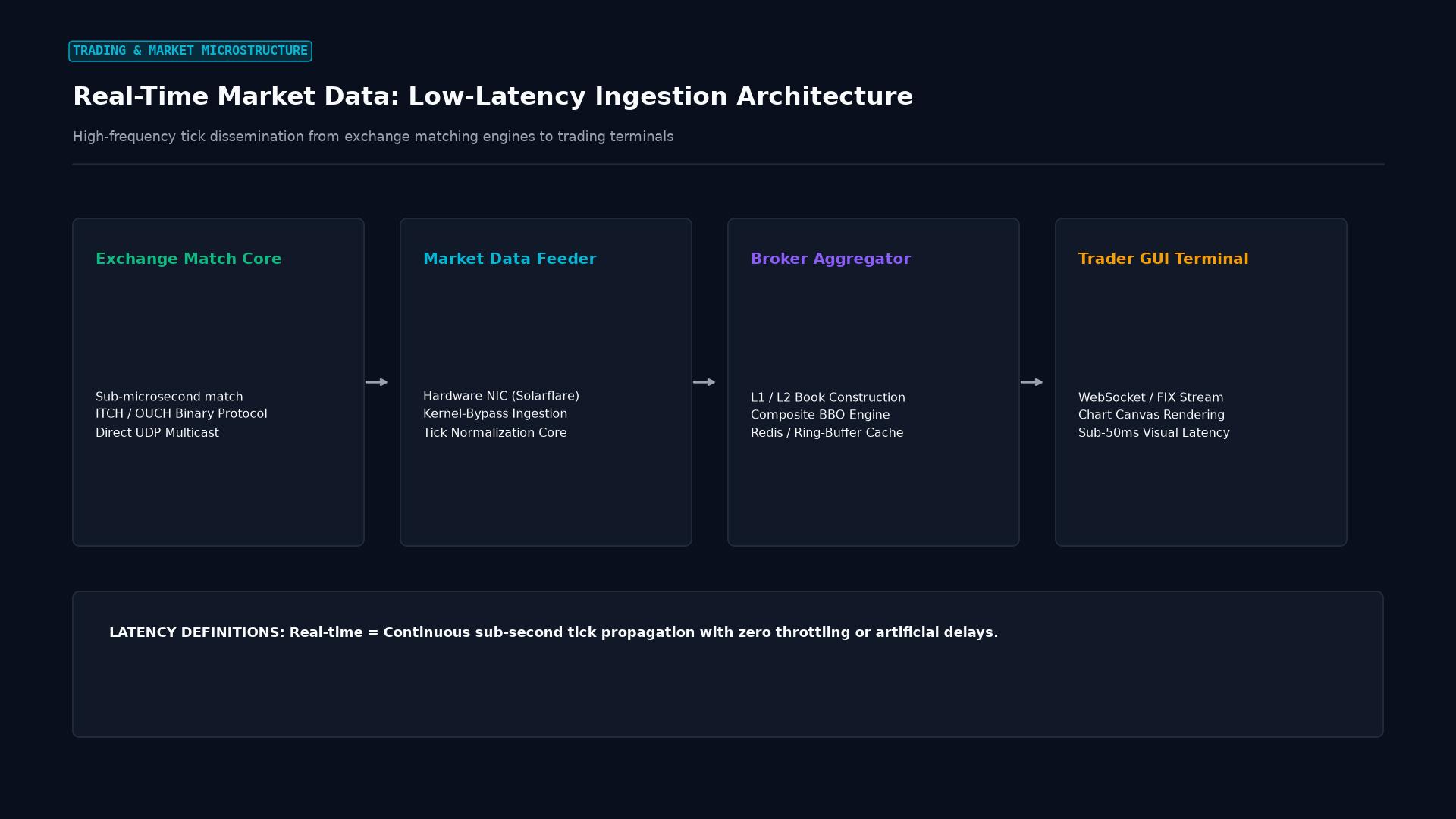 Figure: Tick dissemination architecture: sub-microsecond binary matching protocols, hardware-accelerated feeds, and real-time terminal charting.
Tiers of Real-Time Market Data Feeds
Institutional exchanges (such as CME, Nasdaq, and NYSE) and interbank ECNs (EBS, Refinitiv) distribute real-time market data across three standardized tiers:
1. Level 1 Data (Top of Book / Best Bid & Offer)
Provides the most basic real-time price information:
- The current National Best Bid and National Best Offer (NBBO).
- The volume available at the best bid and best ask.
- The timestamp and volume of the last executed trade.
- Standard for most retail forex and equity charting platforms.
2. Level 2 Data (Market Depth / Depth of Book - DOM)
Provides a comprehensive view of the limit order book:
- Displays resting bids and offers across the top 5 to 20 price tiers above and below the current market price.
- Shows the aggregate volume of contracts or shares waiting at each price level.
- Essential for order-flow traders, scalpers, and algorithmic execution models to assess institutional liquidity thickness.
3. Level 3 Data (Full Order-by-Order Tick Data)
The highest tier of institutional market data:
- Disseminates every individual order entered, modified, or cancelled in the matching engine with unique order IDs.
- Utilized exclusively by high-frequency market makers and quantitative hedge funds to analyze order queue positions and algorithmic order flow toxicity.
Real-Time Gross Settlement (RTGS) in Banking
Beyond price quoting, the term “real-time” forms the structural backbone of sovereign central banking settlement systems through Real-Time Gross Settlement (RTGS):
| System | Sovereign Jurisdiction | Operational Architecture | Daily Turnover |
|---|---|---|---|
| Fedwire Funds Service | United States (Federal Reserve) | Real-time, gross, final, and irrevocable settlement of funds transfers between commercial banks. | Over $4.0 Trillion daily. |
| TARGET2 / TARGET Services | European Union (ECB) | Real-time interbank euro gross payment system operating across Eurosystem central banks. | Over €2.2 Trillion daily. |
| CHAPS | United Kingdom (Bank of England) | Real-time high-value sterling wholesale payment network. | Over £350 Billion daily. |
In an RTGS network, transactions are not bundled and netted at the end of the day; each high-value payment is settled individually on a continuous, gross basis the exact second it is processed, completely eliminating interbank settlement counterparty risk.
The Race for Microseconds: Colocation and Latency
In institutional high-frequency trading (HFT), real-time is measured not in seconds or milliseconds, but in microseconds ($10^{-6}$ s) and nanoseconds ($10^{-9}$ s):
$$\text{Total Execution Latency} = \text{Network Propagation Delay} + \text{Feed Handler Parsing} + \text{Algorithm Decision Time} + \text{Order Gateway Transit}$$
To achieve true zero-latency real-time market access, quantitative hedge funds pay tens of thousands of dollars per month to rent server rack space inside the exchange’s physical data center—a practice known as colocation (e.g., Equinix NY4 in Secaucus, NJ for US forex and equities, or Equinix LD4 in Slough, UK for European forex). By connecting to the exchange matching engine via direct fiber-optic cross-connects, algorithms receive real-time quotes in less than 5 microseconds.
       COLOCATION ARCHITECTURE: REDUCING REAL-TIME LATENCY

  [External Trader over Public Internet]
  Trader Terminal (London) === (Public Web: 85ms) ===> NY Exchange Engine
                                                         ^
  [Colocated Algorithmic Desk]                           |
  Server Rack in Same Building === (Direct Fiber: 2µs) ==+
  * Colocated desk sees quotes and executes 40,000x faster than internet trader!
Real-World Case Study: The 2013 Fed Minutes Algorithmic Leak
On September 18, 2013, the Federal Reserve Open Market Committee (FOMC) was scheduled to release its monumental policy statement regarding whether it would begin tapering Quantitative Easing:
- The Lock-Up Procedure: Accredited financial journalists were placed in a secure, embargoed lock-up room in Washington D.C., with transmission lines strictly disconnected until exactly 2:00:00 PM EST.
- The High-Speed Leak: At exactly 1:59:59.998 PM EST—two milliseconds before the official 2:00 PM bell—an electronic data transmission occurred over a high-speed microwave network connecting Washington D.C. to algorithmic servers in Chicago.
- The Market Reaction: Within 7 milliseconds, before human traders in New York or London had even seen the headline hit their screens, high-frequency algorithms in Chicago executed over $600 million in gold futures and Treasury contracts, instantly moving the market price.
- The Lesson: In modern algorithmic markets, “real-time” is an ultra-competitive physical continuum where fractions of a millisecond determine who captures liquidity and who suffers execution slippage.
Frequently Asked Questions
Why do some financial websites show delayed data?
Exchanges (like the NYSE, Nasdaq, and CME) charge significant commercial data licensing fees for real-time quotation feeds. To avoid passing these costs to non-paying users, public financial portals display quotes delayed by 15 or 20 minutes under standard exchange distribution agreements.
Does a retail forex trader need Level 2 real-time data?
For swing traders and long-term macro investors, standard Level 1 real-time quotes are more than sufficient. However, for intraday scalpers trading news breakouts or high-volume sessions, Level 2 Market Depth (DOM) is highly valuable for spotting large resting institutional limit orders and evaluating order book thickness.
What is the difference between real-time processing and batch processing?
- Real-Time Processing: Every single transaction or piece of data is processed, validated, and executed the exact microsecond it enters the system.
- Batch Processing: Transactions are collected, accumulated into a queue, and processed together at scheduled intervals (e.g., end-of-day bank clearing).
Ready to trade forex?
Open a free demo account with a regulated broker. Practice with virtual funds before risking real money.