Reserve Bank of Australia (RBA)
The Reserve Bank of Australia (RBA) is the central bank and monetary authority of the Commonwealth of Australia, responsible for conducting national monetary policy, setting the official cash rate, managing sovereign foreign exchange reserves, and maintaining the financial stability of the Australian Dollar (AUD).
What Is the Reserve Bank of Australia (RBA)?
Headquartered on Martin Place in Sydney, the Reserve Bank of Australia (RBA) is Australia’s sovereign central bank. Established under the statutory provisions of the Reserve Bank Act 1959, the RBA operates with operational independence from the Australian federal government to manage the nation’s currency, banking system, and monetary policy.
The RBA’s primary statutory mandate—codified in the Statement on the Conduct of Monetary Policy agreed between the Governor and the Treasurer—requires the Bank to target an annual Consumer Price Index (CPI) inflation rate of 2.0% to 3.0% on average over the business cycle, while supporting sustainable economic growth and full employment.
In global foreign exchange markets, decisions announced by the RBA are of paramount importance. The Australian Dollar (AUD) is the world’s sixth most-traded currency, widely regarded as a premier high-beta commodity currency and a global barometer of Chinese economic demand.
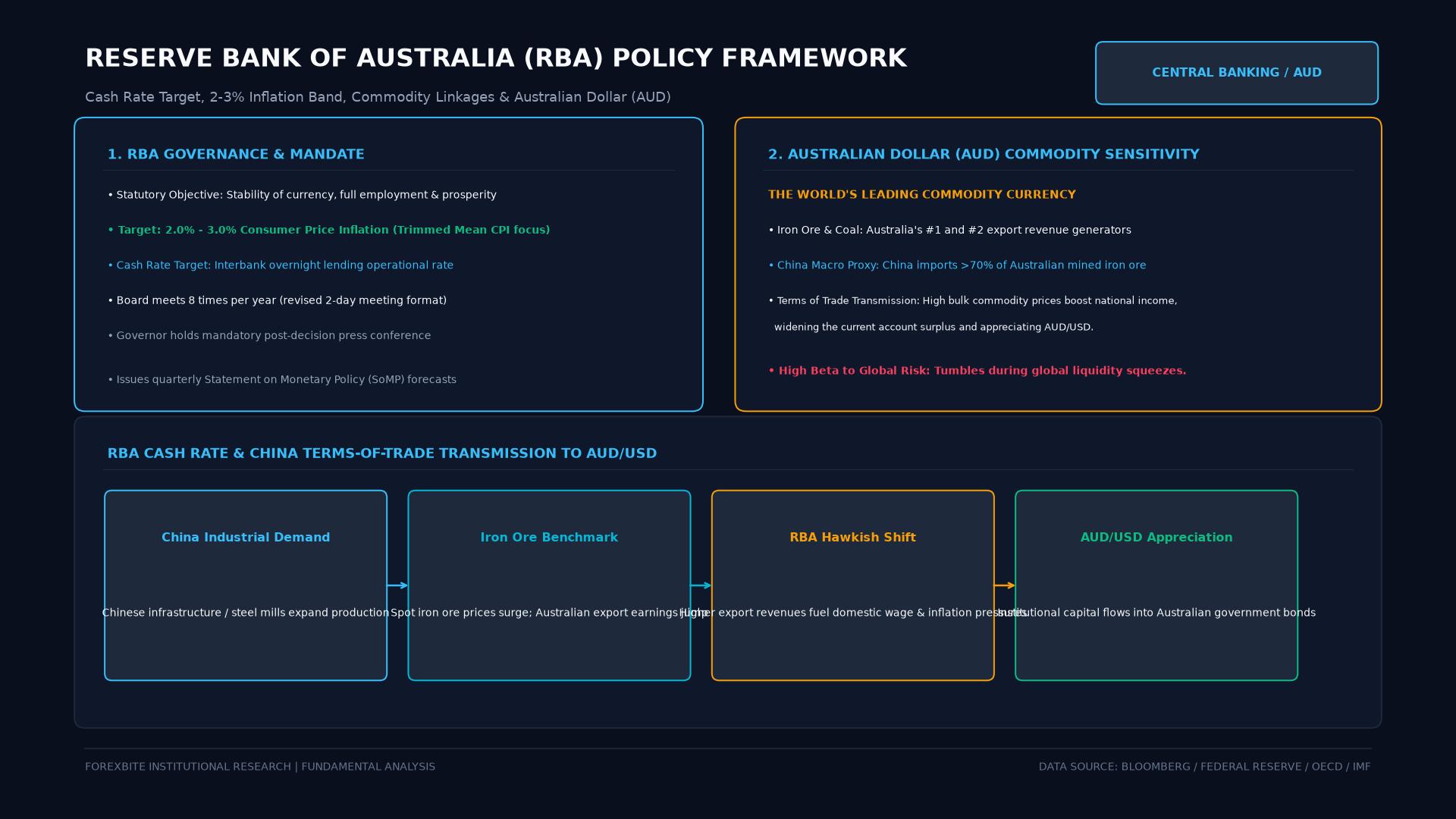 Figure: Policy framework of the Reserve Bank of Australia (RBA), illustrating the Cash Rate target, the 2-3% inflation objective, and the direct terms-of-trade transmission linking bulk commodity exports (iron ore, coal) to AUD/USD valuation.
The Primary Policy Tool: The Official Cash Rate (OCR)
The primary instrument utilized by the RBA to implement monetary policy is the Cash Rate Target:
- The cash rate is the benchmark interest rate that commercial banks pay to borrow unsecured funds in the Australian overnight interbank cash market.
- By adjusting the cash rate, the RBA directly influences commercial borrowing rates, variable mortgage payments, corporate loan costs, and the exchange rate of the Australian Dollar.
RBA Meeting Schedule and Announcement Mechanics
The Reserve Bank Board meets eight times per year to review macroeconomic conditions.
- The Decision Release: Published at exactly 2:30 PM Sydney Time (03:30 or 04:30 UTC) on the Tuesday of the meeting.
- The Policy Statement: Released immediately alongside the interest rate decision, providing critical forward guidance on inflation projections, labor market tightness, and consumer spending.
- The Press Conference: The Governor hosts a live televised media conference one hour after the rate announcement to explain the Board’s economic rationale.
Macro Factors Driving RBA Policy and the Australian Dollar
The Australian economy and RBA policy are uniquely shaped by several distinct structural pillars:
| Macroeconomic Driver | Structural Mechanism | Impact on RBA Policy & AUD |
|---|---|---|
| Commodity Prices (Bulk Exports) | Australia is the world’s leading exporter of iron ore, liquefied natural gas (LNG), coal, and agricultural products. | Rising commodity prices boost Australia’s Terms of Trade, expanding national revenue and supporting a stronger AUD. |
| The China Economic Cycle | China is Australia’s largest trading partner, consuming over 35% of total Australian exports. | Chinese industrial expansion accelerates demand for Australian raw materials; Chinese economic slowdowns directly depress the Aussie Dollar. |
| Household Debt & Variable Mortgages | The majority of Australian residential mortgages are floating-rate (variable). | RBA rate hikes transmit directly into household disposable income within weeks, making the Australian economy highly sensitive to rate hikes. |
| Global Risk Sentiment (Beta) | AUD is classified as a “risk-on” asset. | In times of global equity market rallies, AUD appreciates strongly; during geopolitical crises, capital flees AUD into USD, JPY, and CHF. |
Real-World Case Study: The 2021 Yield Curve Control (YCC) Exit Shock
In March 2020, to combat the economic fallout of the global pandemic, the RBA introduced an unconventional monetary policy tool known as Yield Curve Control (YCC):
- The Promise: The RBA pledged to anchor the yield on the 3-year Australian Government Bond (April 2024 maturity) at 0.10%, buying unlimited quantities of sovereign bonds to defend the target.
- The Forward Guidance: RBA Governor Philip Lowe repeatedly stated that interest rates were unlikely to rise until 2024 at the earliest.
- The Inflation Surprise: In October 2021, Australian trimmed-mean core inflation surged past 2.1%, far faster than the RBA’s forecasts.
- The Market Revolt: Global macro hedge funds challenged the RBA’s target, aggressively selling Australian 3-year government bonds.
- The Collapse of YCC: On October 29, 2021, the RBA abruptly halted its bond purchases. The 3-year bond yield skyrocketed from 0.10% to over 0.75% in a single trading session—the most violent single-day yield spike in Australian history.
- The Policy Reversal: Days later, on November 2, 2021, the RBA officially abandoned Yield Curve Control, subsequently delivering aggressive rate hikes starting in May 2022 that pushed the cash rate to 4.35%.
       RBA 2021 YIELD CURVE CONTROL COLLAPSE & RATE CYCLE

 [March 2020] RBA Anchors 3-Year Bond Yield at 0.10% (Pledges 0% Rates to 2024)
                                    |
                                    v
 [Oct 2021] Inflation Surges ---> Hedge Funds Attack 3-Year Bond Peg
                                    |
                                    v
 [Oct 29, 2021] RBA Ceases Defense; 3Y Yield Spikes 65 bps to 0.75% in Minutes!
                                    |
                                    v
 [Nov 2021] YCC Formally Abandoned ---> Aggressive Rate Hiking Cycle Begins
Frequently Asked Questions
What currency pairs are most sensitive to RBA rate decisions?
The primary pair is AUD/USD (the “Aussie”). Other heavily traded crosses include AUD/JPY (a favorite vehicle for global carry trade positioning), EUR/AUD (European-Australian capital rotation), and AUD/NZD (the trans-Tasman regional trade).
What is the “Statement on Monetary Policy” (SoMP)?
The Statement on Monetary Policy is the RBA’s flagship quarterly analytical report, published in February, May, August, and November. It provides detailed multi-year economic forecasts for GDP growth, headline and core inflation, the unemployment rate, and household consumption.
Why is the Australian Dollar called a “Commodity Currency”?
The Australian Dollar is classified as a commodity currency because commodities (specifically iron ore, metallurgical coal, gold, wheat, and natural gas) account for over 60% of Australia’s total exports. When global commodity demand expands, foreign buyers must purchase Australian Dollars to pay for shipments, driving currency appreciation.
Ready to trade forex?
Open a free demo account with a regulated broker. Practice with virtual funds before risking real money.