Reserves
Reserves (specifically official international foreign exchange reserves) are liquid financial and monetary assets held and controlled by a nation's central bank or monetary authority—encompassing foreign convertible currencies, monetary gold, Special Drawing Rights (SDRs), and IMF reserve positions—to manage exchange rate volatility and guarantee sovereign financial solvency.
What Are Official Reserves?
In international macroeconomics, sovereign banking, and global trade, reserves (formally designated as official international reserves or foreign exchange reserves) are readily available external assets controlled by a sovereign monetary authority. Under the International Monetary Fund’s (IMF) Balance of Payments Manual (BPM6), reserve assets must be claims on non-residents that are denominated in foreign convertible currencies and available unconditionally to the central bank.
Reserves act as a nation’s ultimate macroeconomic insurance policy. When private capital departs during a financial crisis, or when an exchange rate peg comes under speculative attack, the central bank draws upon its international reserves to settle external sovereign debts, finance critical food and energy imports, and conduct direct foreign exchange intervention in spot markets.
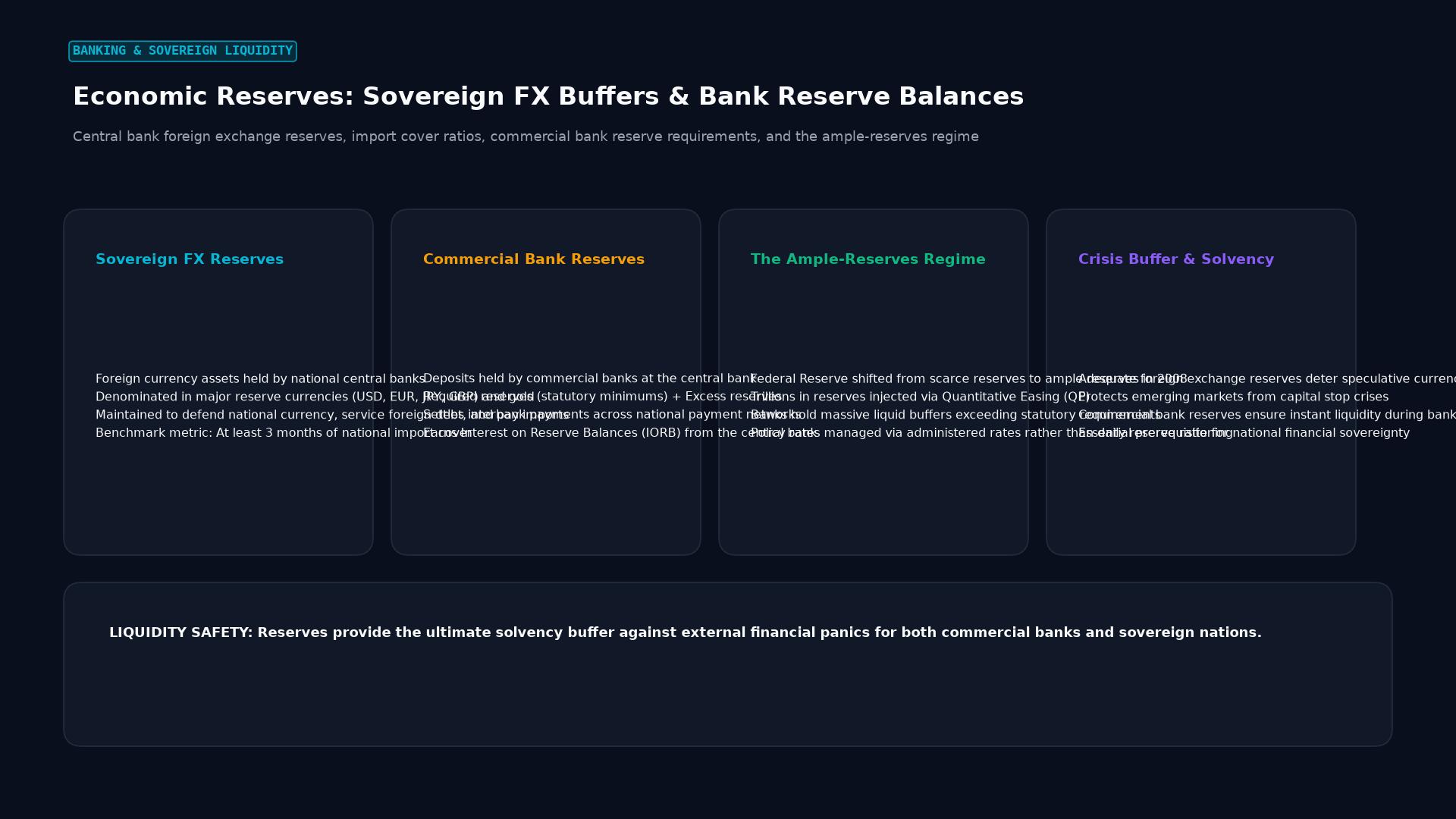 Figure: Central bank foreign exchange reserves, import cover ratios, commercial bank reserve requirements, and the ample-reserves regime
The Four Pillars of Official Sovereign Reserves
Under standardized international accounting, official reserve assets are categorized into four distinct balance sheet components:
1. Foreign Currency Assets (FX Reserves)
Comprising over 80% of total global reserves. These include cash balances, commercial bank deposits held abroad, and marketable sovereign securities issued by foreign governments (e.g., US Treasury bills, German Bunds, UK gilts, Japanese government bonds). Because they are invested in sovereign debt, they generate ongoing interest yield for the central bank.
2. Monetary Gold
Physical gold bullion (bars of minimum 99.5% purity) owned by the central bank. Unlike foreign currency bonds, physical gold carries zero counterparty credit risk and cannot be frozen or defaulted upon by a foreign government if stored domestically. Central banks hold over 36,000 metric tons of monetary gold worldwide.
3. Special Drawing Rights (SDRs)
International reserve assets created by the IMF in 1969 to supplement member countries’ official reserves. SDRs are allocated periodically to member nations and can be exchanged between central banks for freely usable convertible currencies during balance-of-payments crises.
4. Reserve Position in the Fund (Reserve Tranche)
The portion of a member nation’s financial quota paid to the IMF in reserve currencies (typically 25% of quota). The member country can draw upon its reserve tranche unconditionally on demand without paying interest or accepting IMF structural policy adjustments.
Strategic Functions: Why Central Banks Hold Reserves
A sovereign nation’s foreign reserve stockpile serves four critical macroeconomic functions:
1. Exchange Rate Management and Market Intervention
For nations operating pegged, crawling, or managed-floating currency systems, reserves are the operational ammunition needed to defend the currency. When the domestic currency depreciates excessively, the central bank enters the spot market to sell foreign currency reserves and buy domestic currency, absorbing excess supply and defending the exchange rate.
2. Import Coverage (Food and Energy Security)
A country that exhausts its foreign currency reserves cannot purchase imported food, medicine, or petroleum from global suppliers who demand settlement in hard currencies (USD or EUR). The traditional macroeconomic rule of thumb mandates that a nation must maintain a minimum of three to six months of import cover:
$$\text{Import Cover (Months)} = \frac{\text{Total Official Foreign Reserves}}{\text{Average Monthly Imports}}$$
3. Solvency Backstop: The Greenspan-Guidotti Rule
Formulated by former Federal Reserve Chairman Alan Greenspan and Argentine economist Pablo Guidotti, the Greenspan-Guidotti Rule states that an emerging market’s liquid foreign reserves should equal or exceed 100% of its short-term external debt maturing within one year:
$$\text{Reserve Adequacy Ratio} = \frac{\text{Total Reserves}}{\text{Short-Term External Debt (Maturity } \le 1 \text{ Year)}} \ge 1.0 \ (100%)$$
Meeting this threshold guarantees that a country can continue servicing its foreign sovereign debt even if global capital markets freeze completely for 12 months.
Global Reserves Distribution Across Sovereign Economies
Foreign exchange reserves are heavily concentrated among major export-driven nations and global trading hubs:
| Sovereign Nation / Jurisdiction | Total Reserves (USD Equivalent) | Primary Reserve Asset Composition | Primary Policy Motivation |
|---|---|---|---|
| China (PRC) | $3.2+ Trillion | US Treasuries, European sovereign debt, gold. | Manages Renminbi exchange rate; insulates against global trade disruptions. |
| Japan | $1.2+ Trillion | US Treasury securities, foreign cash deposits. | Defends against excessive Yen appreciation/depreciation; FX intervention fund. |
| Switzerland (SNB) | $850+ Billion | Foreign government bonds, US & European equities. | Accumulated during multi-year defense of the EUR/CHF 1.20 floor. |
| India (RBI) | $650+ Billion | US Treasuries, sovereign bonds, gold. | Shields Indian Rupee (INR) from emerging market capital flight. |
| Saudi Arabia (SAMA) | $450+ Billion | US Dollar fixed-income debt, sovereign cash. | Maintains the static 3.75 SAR per USD currency peg. |
Real-World Case Study: Sri Lanka’s Reserve Exhaustion Crisis (2022)
In early 2022, the island nation of Sri Lanka experienced a catastrophic balance-of-payments collapse:
- The Reserve Drain: Tourism revenues vanished during the pandemic, and the government attempted to defend an artificial currency peg of 200 Sri Lankan Rupees (LKR) per US Dollar by burning through its foreign reserves.
- The Depletion: Usable foreign exchange reserves plunged from over $7.5 billion in 2019 to less than $50 million in April 2022—leaving the nation with virtually zero import cover.
- The Economic Collapse: With zero foreign currency left in central bank vaults:
- Ships carrying crude oil and cooking gas were stranded offshore, unable to unload because Sri Lankan banks could not honor letters of credit.
- 13-hour daily electricity blackouts paralyzed the economy, food inflation skyrocketed past 90%, and public protests toppled the government.
- The Default: In May 2022, Sri Lanka formally defaulted on its sovereign external debt for the first time in its history, providing a stark reminder that foreign exchange reserves are the bedrock of national economic sovereignty.
       SRI LANKA 2022: RESERVE EXHAUSTION COLLAPSE

 Defending Unsustainable Currency Peg ---> Sells USD Reserves Continuously
                                                    |
 Reserves Collapse from $7.5B to < $50M <-----------+
                                                    |
 Inability to Pay for Fuel & Food Imports ---> Letters of Credit Rejected Worldwide
                                                    |
 Sovereign Debt Default Announced ---> Rupee Plummets 45% (200 to 360 LKR/USD)
Frequently Asked Questions
Why does the United States maintain relatively small foreign exchange reserves?
The United States holds only modest foreign currency reserves (~$40 billion) because the US Dollar is the world’s primary reserve currency. If the US government or Federal Reserve needs foreign currency, it can issue Treasury debt in dollars or execute bilateral currency swap lines with foreign central banks.
How does central bank gold differ from foreign currency reserves?
Foreign currency reserves consist of paper debt (e.g., US Treasuries) that carries the credit and geopolitical risk of the issuing nation. Monetary gold is a tangible physical asset with zero counterparty credit risk and cannot be devalued by foreign inflation or frozen by international sanctions if held inside domestic borders.
What is the difference between gross reserves and net reserves?
- Gross Reserves: The total market value of all reserve assets appearing on the central bank’s balance sheet.
- Net Usable Reserves: Gross reserves minus the central bank’s short-term foreign currency liabilities (such as forward currency swap commitments or foreign bank credit lines). Net reserves reflect the true liquidity available for emergency intervention.
Ready to trade forex?
Open a free demo account with a regulated broker. Practice with virtual funds before risking real money.