Same Day Transaction
A financial trade executed and settled on the identical calendar date (known as Value Today or T+0), bypassing standard multi-day settlement cycles to achieve immediate transfer of ownership and cash.
What Is a Same Day Transaction?
A same day transaction—referred to in interbank foreign exchange and fixed-income markets as a Value Today (or Cash) transaction—is a trade agreed upon, processed, and fully settled on the identical calendar day ($T+0$).
Under standard market conventions, spot foreign exchange trades do not settle immediately; they follow a $T+2$ settlement cycle (two business days after execution), while North American equity and bond markets traditionally settled on a $T+2$ or $T+1$ basis. A same day transaction bypasses these standard multi-day deferrals, requiring that the exchange of funds, clearing verification, and final transfer of legal title occur before the close of domestic central bank payment systems on trade date $T$.
In retail trading terminology, a “same day transaction” also colloquially describes an intraday round trip where an open speculative position is initiated and liquidated within the same trading session, incurring zero overnight rollover charges.
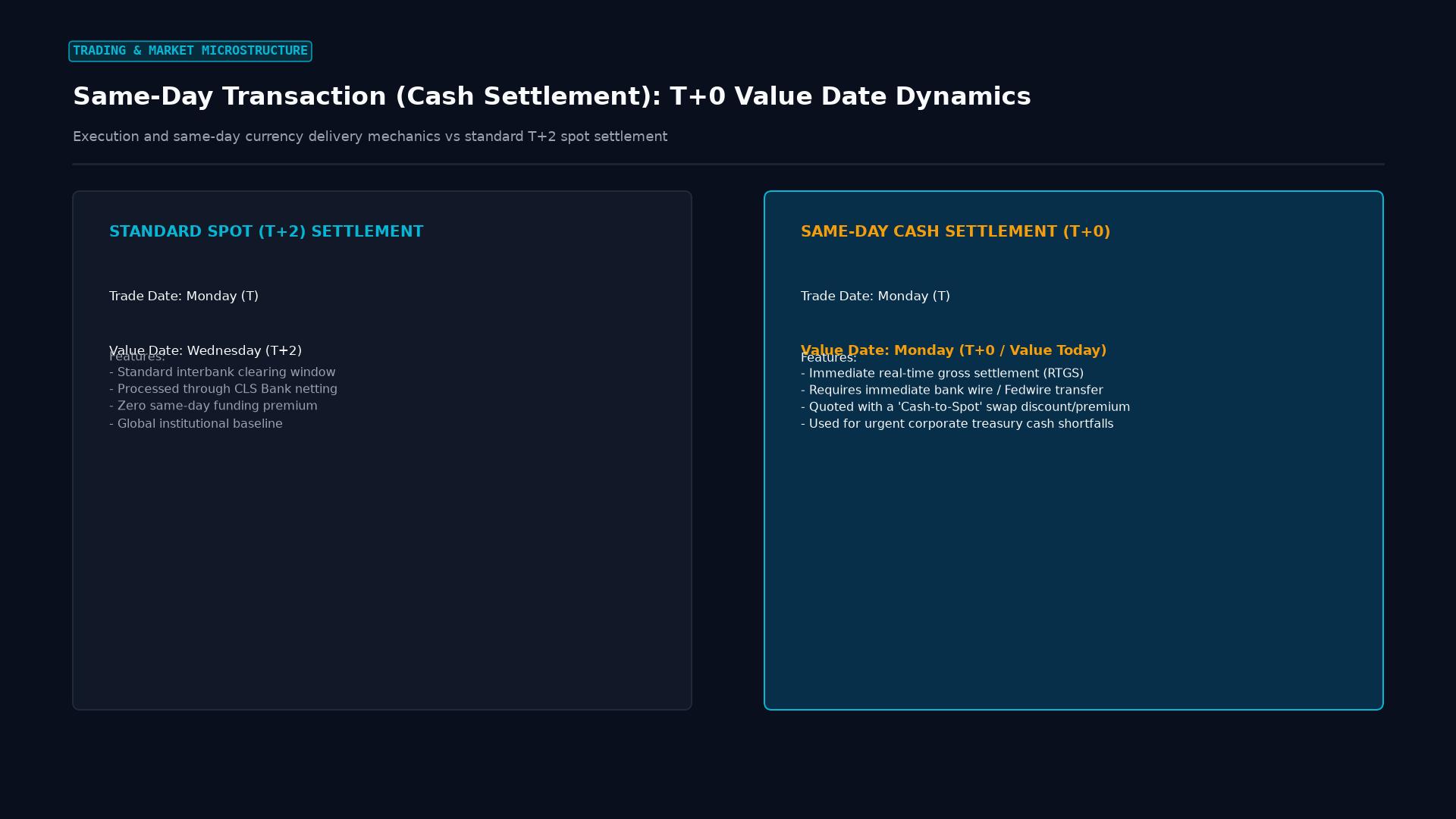 Figure: Cash FX delivery mechanics: execution and settlement occurring on the same calendar day (T+0) via immediate real-time gross settlement wires.
Interbank Pricing: The Cash/Spot Swap Points Adjustment
Because standard spot exchange rates reflect settlement two days in the future, institutional dealers executing a same-day ($T+0$) transaction must adjust the quoted rate to reflect the time value of money between “Today” and “Spot Date.”
This pricing adjustment is conducted through the interbank Cash-to-Spot (Overnight and Tom-Next) swap market. The dealer mathematically discounts or premiums the spot price using interbank interest rate differentials:
$$\text{Same Day Rate (Value Today)} = \text{Spot Rate} - \text{Cash/Spot Swap Points}$$
Where:
- $\text{Cash/Spot Points} = \text{Overnight (O/N) Points} + \text{Tomorrow-Next (Tom-Next) Points}$.
- The interest rates of the respective currencies determine whether the same-day rate trades at a discount or premium relative to the headline spot market.
Practical Pricing Example
Assume corporate treasurer needs to convert $10,000,000 into EUR for immediate European wire release:
- Prevailing Spot EUR/USD ($T+2$): 1.0850
- US Benchmark Overnight Rate: 5.25%
- Eurozone Benchmark Rate: 3.75%
- Because the US Dollar yields more than the Euro, holding cash today rather than two days from now incurs an interest penalty. The combined O/N and Tom-Next swap points total $+0.40$ pips.
- Value Today Execution Rate: $1.0850 - 0.00004 = \mathbf{1.08496}$.
Same Day Transaction vs. Day Trade vs. Standard Spot Transaction
| Characteristic | Same Day Transaction (Value Today) | Day Trade (Retail Speculation) | Standard Spot Transaction ($T+2$) |
|---|---|---|---|
| Settlement Horizon | $T+0$ (Identical calendar day) | No physical settlement; offset prior to 5:00 PM EST | $T+2$ business days ($T+1$ for select pairs) |
| Primary Participant | Corporate treasuries, commercial banks, sovereigns | Retail traders, day trading prop desks | Hedge funds, asset managers, institutional funds |
| Cash Transfer | Gross wire transfer via RTGS payment networks | Virtual profit/loss credit or debit to broker ledger | Exchange of interbank nostro balances via CLS Bank |
| Operational Cutoff | Strict central bank wire cutoffs (e.g., 2:00 PM local) | Broker server rollover cutoff (5:00 PM EST) | End of regular global trading session |
| Financing Fee | Priced via Cash/Spot swap point adjustments | Zero overnight rollover debit or credit | Subject to daily Tom-Next rollover if held past 5 PM |
Real-World Institutional Case Study: Corporate Treasury Margin Call Crisis
During the violent market dislocations of March 2020 (the COVID-19 liquidity shock), global energy corporations and multinational manufacturers faced acute intraday liquidity squeezes.
       MULTINATIONAL CORPORATE EMERGENCY LIQUIDITY SQUEEZE

 09:00 EST: European energy conglomerate receives €50,000,000 margin call
            from London clearinghouse due to Brent crude volatility.
            Clearinghouse mandates cash delivery by 14:00 GMT (Same Day).

 09:30 EST: Corporate Treasury holds surplus USD in New York, but zero EUR.
            Standard T+2 spot execution would settle in 48 hours (DEFAULT).

 10:15 EST: Desk executes €50,000,000 Same Day (Value Today) EUR/USD transaction
            with Tier-1 interbank dealer.

 11:30 EST: Bank routes EUR payment via TARGET2 real-time gross settlement.
            Margin call successfully met with 2.5 hours to spare.
In this scenario, standard spot market execution was legally and operationally useless. By paying a slight liquidity premium for a same-day transaction, the multinational treasury avoided technical default on exchange-cleared hedges.
Technological Infrastructure Powering Same-Day Settlement
Executing same-day transactions requires specialized high-value payment systems operating on Real-Time Gross Settlement (RTGS) architecture:
                  REAL-TIME GROSS SETTLEMENT ARCHITECTURE

   [ Corporate / Bank Initiator ] ────► Routes MT103 / ISO 20022 Swift Message
                                                  │
                                                  ▼
   [ Central Bank RTGS Core Engine ] ──► Verifies Continuous Ledger Solvency
   - Fedwire Funds Service (USA)
   - TARGET2 / T2 (Eurosystem)
   - CHAPS (United Kingdom)
   - BOJ-NET (Japan)
                                                  │
                                                  ▼
[ Receiving Commercial Bank ] ──────► Final, Irrevocable Immediate Funds Delivery- Fedwire Funds Service: Operated by the U.S. Federal Reserve Banks, processing over $4 trillion in irrevocable same-day payments daily.
- TARGET2 / T2: The Eurosystem’s RTGS platform, enabling pan-European cross-border transfers settled in central bank money within seconds.
- Continuous Linked Settlement (CLS): CLS Now provides same-day bilateral settlement services in select major currencies, mitigating intraday Herstatt settlement risk.
Frequently Asked Questions
Why do banks charge wider spreads on same-day foreign exchange transactions?
Same-day execution forces the market-making bank to mobilize central bank reserves immediately, incurring intraday credit costs and tight operational time constraints. Because clearing networks close their daily windows in early afternoon, the bank accepts heightened execution risk, which is priced into a wider bid-ask spread.
What happens if a same-day transaction misses the daily settlement cutoff?
If an institution fails to route the transaction instructions before the local RTGS system cutoffs (e.g., 5:00 PM EST for Fedwire or 17:00 CET for TARGET2), the trade experiences a settlement fail. The transaction rolls automatically into Value Tomorrow ($T+1$), and the failing party must reimburse the counterparty for overnight overdraft interest charges.
Can retail traders trade Value Today transactions on standard broker platforms?
Typically, no. Retail foreign exchange brokers operate off-exchange contracts for difference (CFDs) or margin spot accounts that systematically roll all open positions forward via Tom-Next swaps. Retail traders do not take physical delivery of currencies; genuine Value Today cash transactions are reserved for institutional commercial clients, corporate treasuries, and hedge funds accessing prime brokerage desks.
Ready to trade forex?
Open a free demo account with a regulated broker. Practice with virtual funds before risking real money.