Selling Short
The investment or trading strategy of selling an asset that the seller does not own (or selling the base currency in a forex pair), aiming to buy it back at a lower future price to capture profits from its market depreciation.
What Is Selling Short?
Selling short (colloquially known as “shorting”) is a fundamental financial strategy where a market participant initiates a position by selling an asset they anticipate will decline in value, intending to repurchase (or “cover”) the asset at a cheaper price in the future.
While conventional investing follows a “buy low, sell high” progression, short selling reverses the chronological order: the trader sells high first and buys low later.
Short selling plays a critical structural role in capital markets. It accelerates price discovery, prevents speculative asset bubbles from expanding unchecked, provides liquidity to eager buyers, and exposes corporate fraud and accounting irregularities.
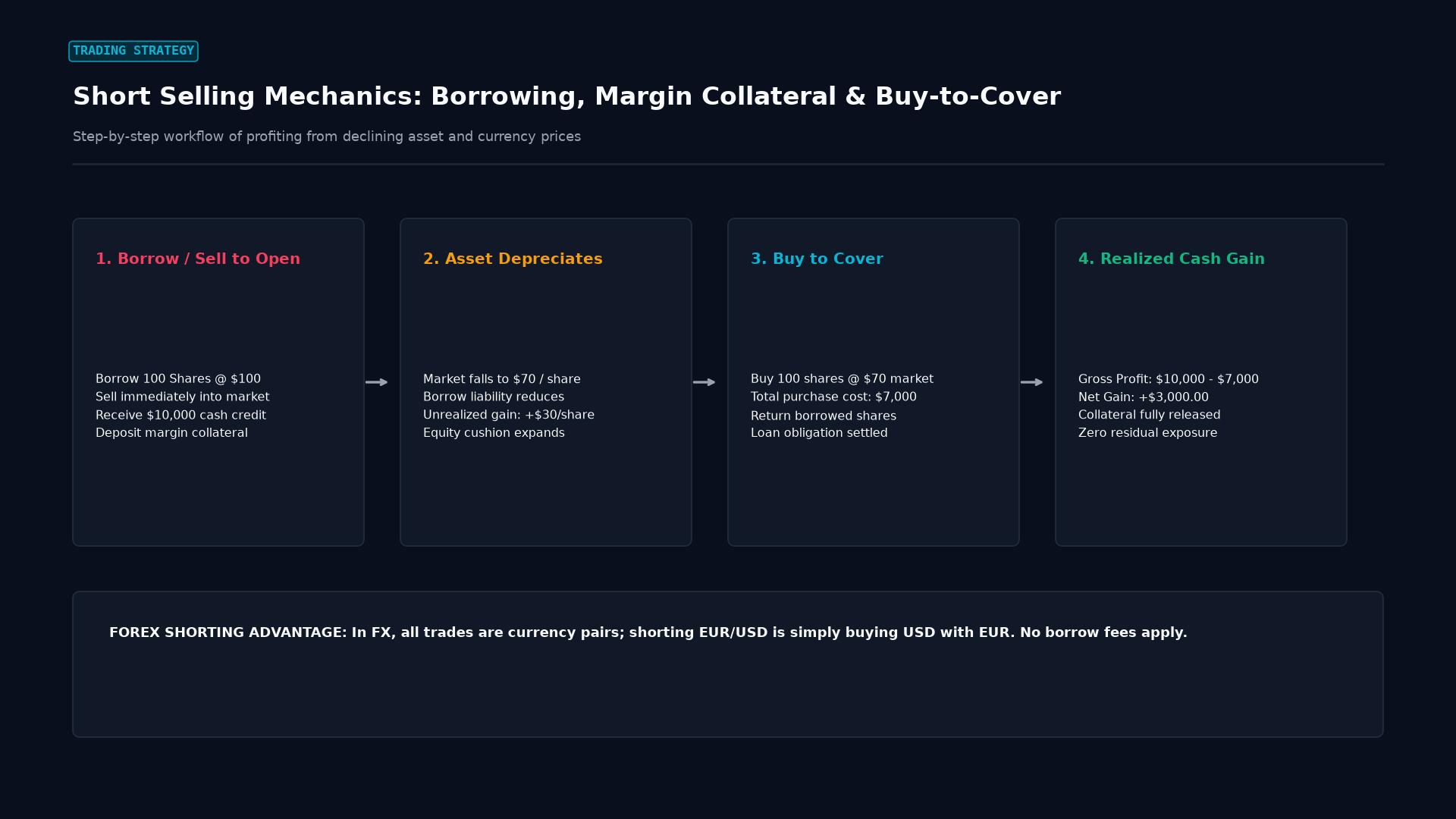 Figure: Workflow of profiting from falling prices: borrowing assets, selling to open, capturing market decline, and buying back to cover at a discount.
Mechanics: Equity Shorting vs. Foreign Exchange Shorting
The operational mechanics of short selling differ substantially depending on the underlying financial instrument:
1. Equity Markets: The Share Borrow Mechanism
In stock markets, an investor cannot sell shares they do not possess without first “borrowing” them.
- The Locate: The broker must locate shares available for lending from institutional custodians or margin accounts.
- Borrow Fees: The short seller pays an annualized borrow fee (ranging from 0.30% for general collateral stocks to over 50% for “hard-to-borrow” equities).
- Dividend Obligations: If the company distributes a dividend while the stock is shorted, the short seller must pay that dividend out-of-pocket to the share lender.
2. Foreign Exchange Markets: Symmetrical Dual-Currency Nature
In foreign exchange, short selling carries zero borrowing friction. Because every currency transaction is a reciprocal pair:
- Selling EUR/USD is mathematically identical to selling Euros while simultaneously buying US Dollars.
- Selling GBP/JPY is selling British Pounds while purchasing Japanese Yen.
- Traders require no stock loan, no locate approval, and no special hard-to-borrow fees. The position is merely subject to standard margin requirements and the prevailing overnight rollover debit or credit.
The Asymmetric Payoff Mathematics of Short Selling
Short selling possesses an inherently asymmetric risk-reward profile that makes it fundamentally more hazardous than long investing:
        ASYMMETRIC RISK PROFILE: LONG VS. SHORT

   Direction   Maximum Profit Potential      Maximum Loss Potential
  ──────────────────────────────────────────────────────────────────
   LONG:       UNLIMITED (+∞)                CAPPED (-100% of capital)
   SHORT:      CAPPED (+100% if price to $0) UNLIMITED (+∞ theoretical)
Mathematical Formulation of Short Profitability
$$\text{Gross Profit} = (\text{Entry Price} - \text{Exit Price}) \times \text{Position Size}$$
If an investor shorts 100 shares of a stock at $100:
-
Maximum Theoretical Gain: If the company goes bankrupt and the stock collapses to $0.00, the investor earns:
$$\text{Max Profit} = ($100 - $0) \times 100 = \mathbf{$10,000} \quad (+100%)$$
-
Maximum Theoretical Loss: Because there is no mathematical ceiling on how high an asset price can rise, if the stock surges to $500, the loss is:
$$\text{Loss} = ($100 - $500) \times 100 = \mathbf{-$40,000} \quad (-400%)$$
Selling Short vs. Going Long vs. Buying Put Options
| Parameter | Selling Short (Direct Spot/Shares) | Going Long (Buying) | Buying a Put Option |
|---|---|---|---|
| Market Bias | Bearish (Profits from decline) | Bullish (Profits from advance) | Bearish (Profits from decline) |
| Max Loss | Theoretically Unlimited | Limited to initial invested capital | Strictly limited to option premium paid |
| Margin Requirement | Yes (Subject to maintenance margin calls) | Cash accounts: No; Margin accounts: Yes | No margin needed (100% upfront premium) |
| Borrow Fee / Decay | Ongoing borrow fees / overnight swap debits | None (or earn positive carry) | Time decay ($\Theta$) continuously erodes value |
| Short Squeeze Risk | Extreme (Can force catastrophic liquidation) | None | Zero (Cannot be squeezed out) |
Real-World Institutional Case Study: George Soros and “Black Wednesday” (1992)
The most iconic short sale in financial history occurred in September 1992, when George Soros and Stan Druckenmiller’s Quantum Fund executed a massive short position against the British Pound (GBP).
       GBP/DEM COLLAPSE - THE BREAKDOWN OF THE ERM (SEPTEMBER 1992)

 2.95 DM ──┐ (Bank of England ERM Lower Bound Peg)
           │
 2.90 DM ──┼─\  [ Bank of England spends £27 Billion defending the peg ]
           │  \
 2.85 DM ──┼───\___ [ Sept 16: UK Raises Base Rates from 10% to 15% ]
           │       \
 2.78 DM ──┼────────\  BOE Capitulates; Exits European Exchange Rate Mechanism
           │         \
 2.65 DM ──┼──────────\___ GBP Collapses against German Mark
└───────────────────────────────────────────────────────────- The Vulnerability: The UK had entered the European Exchange Rate Mechanism (ERM), artificially pegging the Pound to the German Deutsche Mark (DEM). High UK inflation and sluggish growth made maintaining the 2.778 DEM floor economically unsustainable.
- The Short Execution: Quantum Fund built a leveraged $10 billion short position on the British Pound, borrowing Sterling and converting it into Deutsche Marks and French Francs.
- The Climax: On September 16, 1992 (“Black Wednesday”), despite the Bank of England hiking interest rates from 10% to 12% and then to 15% in a single day to attract Sterling buyers, institutional selling overwhelmed the central bank.
- The Resolution: Britain withdrew from the ERM, and the Pound plunged 15% against the Deutsche Mark. Soros closed the short position, netting over $1 billion in profit in a single week.
Systemic Hazards: Short Squeezes and Regulatory Bans
Traders who engage in short selling must continuously navigate two systemic hazards:
- The Short Squeeze: When a heavily shorted asset begins to rise unexpectedly, short sellers are hit with margin calls and forced to buy back shares to cap losses. This wave of panic buying drives the price exponentially higher, triggering subsequent stop-loss liquidations across other short sellers. A classic example occurred in January 2021 with GameStop (GME), which surged over 1,500% in days as retail buying forced institutional short funds into bankruptcy.
- Emergency Short-Selling Bans: During financial panics (e.g., September 2008 and March 2020), regulatory bodies such as the U.S. SEC, UK FCA, and European ESMA routinely implement emergency restrictions prohibiting short sales on financial equities to prevent artificial destabilization.
Frequently Asked Questions
Can retail forex traders sell short as easily as they buy?
Yes. In foreign exchange, there is no structural difference between executing a buy order and executing a sell order. Clicking “Sell” simply opens a position that is short the base currency and long the quote currency. The execution speed, platform interface, and margin mechanics are identical.
How does a broker close a short position if a trader runs out of margin?
If an asset rises rapidly against an open short position, the account’s equity falls relative to the required maintenance margin. When the margin level reaches the broker’s Stop-Out Level (typically 20% to 50%), the broker’s risk engine automatically executes an aggressive market buy order to close the short position and protect the brokerage from a negative balance.
What is the “Uptick Rule” in stock short selling?
The Alternative Uptick Rule (SEC Rule 201) is a circuit-breaker regulation in U.S. stock markets. If a stock declines by 10% or more within a single trading day, short selling is restricted for the remainder of that day and the following day. Traders may only execute short sales on an “uptick” (at a price higher than the current national best bid), preventing short sellers from driving an asset into a freefall.
Ready to trade forex?
Open a free demo account with a regulated broker. Practice with virtual funds before risking real money.