Rating Agency
A credit rating agency (CRA) is an independent financial institution—dominated globally by the "Big Three": S&P Global Ratings, Moody's, and Fitch Ratings—that assesses the creditworthiness, default probability, and debt-servicing capacity of sovereign governments, municipal authorities, and corporate debt issuers.
What Is a Credit Rating Agency?
A Credit Rating Agency (CRA) is an independent commercial organization that analyzes the financial health, governance, and macroeconomic stability of debt issuers. By evaluating balance sheet solvency, cash flow sustainability, and sovereign political risks, rating agencies assign standardized letter-grade credit ratings to bond issuances, commercial paper, and sovereign debt facilities.
The global credit rating industry is an institutional oligopoly dominated by the “Big Three” agencies, which collectively control approximately 95% of all credit rating business worldwide:
- S&P Global Ratings (Standard & Poor’s)
- Moody’s Investors Service
- Fitch Ratings
These ratings determine the interest rate at which sovereign governments and corporations can borrow capital. A downgrade by a single notch can trigger mandatory liquidations by institutional pension funds, cause sovereign bond yields to spike, and precipitate severe currency depreciation in foreign exchange markets.
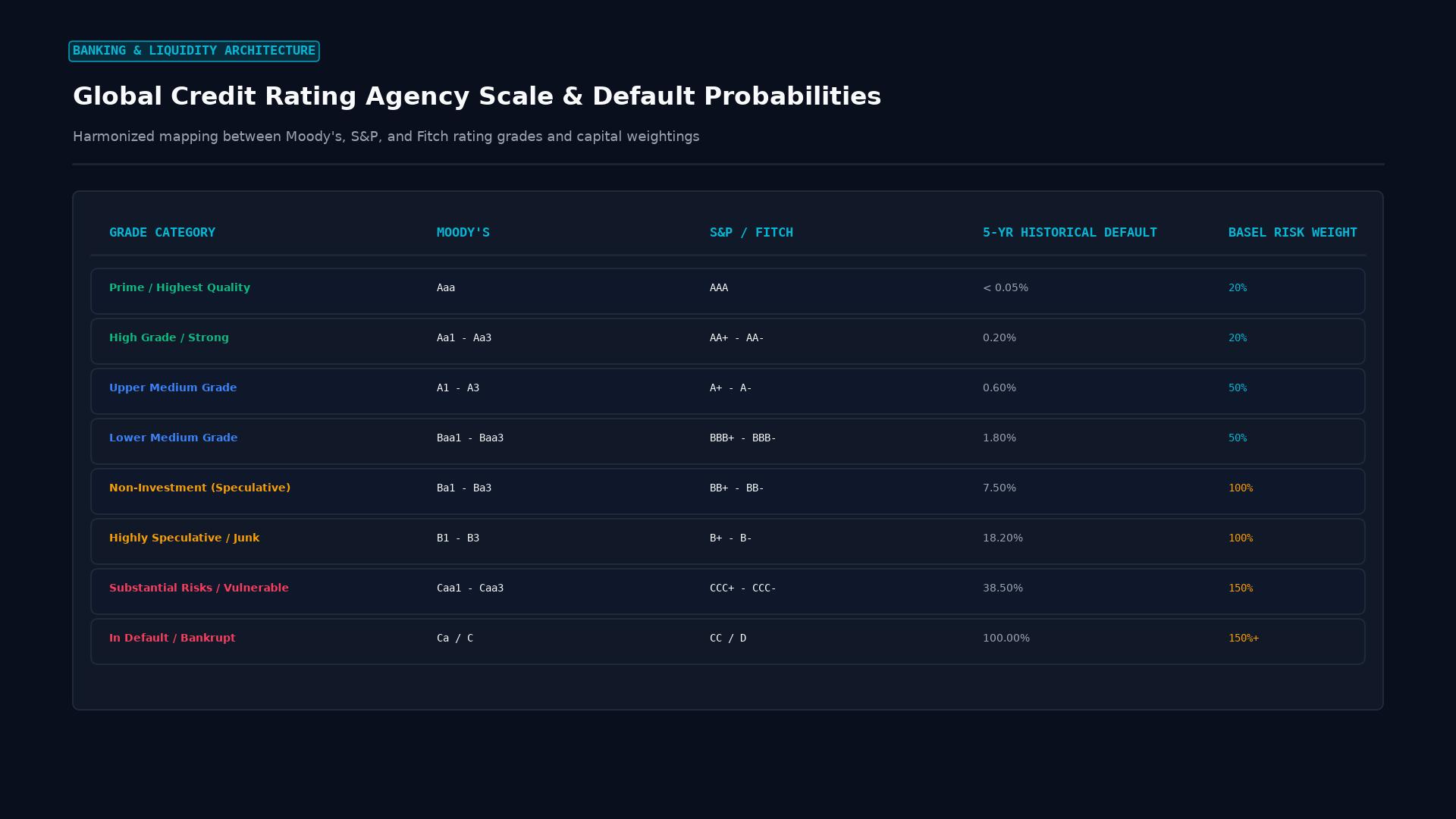 Figure: Harmonized credit rating scales across Moody’s, S&P, and Fitch: mapping investment grade vs speculative debt, historical default rates, and Basel risk weights.
The Rating Scale: Investment Grade vs. High Yield (Junk)
Credit ratings are divided into two distinct regulatory universes, separated by the crucial boundary between BBB- and BB+:
1. Investment Grade (AAA down to BBB-)
Debt obligations rated BBB- or higher are classified as Investment Grade. Institutional investors—such as national central bank reserve managers, sovereign wealth funds, and regulated pension plans—are often legally prohibited by their charters from purchasing bonds rated below investment grade. Investment-grade debt commands narrow credit spreads and low financing costs.
2. Speculative Grade / High Yield / Junk (BB+ down to D)
Debt rated BB+ or lower carries substantial credit risk and default probability. If an investment-grade corporate or sovereign issuer is downgraded across the threshold into junk status, it is labeled a “Fallen Angel”. This triggers massive, automated forced selling from institutional bond funds, creating violent price dislocations and liquidity freezes.
Credit Rating Scales Comparison
The following table contrasts the standardized letter-grade rating nomenclatures across the Big Three agencies:
| Credit Classification | S&P Global | Moody’s | Fitch Ratings | Default Probability (5-Year Historical) |
|---|---|---|---|---|
| Prime / Maximum Safety | AAA | Aaa | AAA | $< 0.1%$ |
| High Quality (Upper Tier) | AA+, AA, AA- | Aa1, Aa2, Aa3 | AA+, AA, AA- | $\approx 0.3%$ |
| Upper Medium Grade | A+, A, A- | A1, A2, A3 | A+, A, A- | $\approx 0.7%$ |
| Lower Medium Grade | BBB+, BBB, BBB- | Baa1, Baa2, Baa3 | BBB+, BBB, BBB- | $\approx 1.8%$ |
| Non-Investment (Speculative) | BB+, BB, BB- | Ba1, Ba2, Ba3 | BB+, BB, BB- | $\approx 8.5%$ |
| Highly Speculative | B+, B, B- | B1, B2, B3 | B+, B, B- | $\approx 22.0%$ |
| Substantial Default Risk | CCC / CC / C | Caa / Ca / C | CCC / CC / C | $> 45.0%$ |
| Default / Bankruptcy | D | C | D | $100%$ |
Macroeconomic Impact: Sovereign Ratings and Spot Forex
A sovereign credit rating revision is one of the most powerful macroeconomic catalysts in global foreign exchange:
$$\text{Sovereign Credit Downgrade} \implies \text{Bond Yields Surge} \implies \text{Capital Outflow} \implies \text{Currency Depreciates}$$
- The Credit Spread Channel: When a sovereign issuer is downgraded, international investors demand a higher risk premium (credit spread). The government must pay higher yields on new Treasury auctions, inflating national debt servicing costs.
- Capital Flight: Foreign asset managers with strict mandate covenants are forced to liquidate their holdings of the downgraded nation’s sovereign bonds, converting the sales proceeds back into USD or EUR and triggering sharp downward pressure on the local currency.
Real-World Case Study: S&P’s Historic Downgrade of the United States (2011)
On Friday evening, August 5, 2011, following months of intense political debt-ceiling brinkmanship in the US Congress, Standard & Poor’s stripped the United States of its pristine AAA credit rating for the first time in history, downgrading US sovereign debt to AA+.
- The Paradoxical Reaction: Theoretical economic models predicted that a downgrade of US debt would cause US Treasury yields to spike and the US Dollar to collapse.
- The Flight-to-Safety Reality: Instead, global financial markets plunged into panic. Because US Treasuries are the primary collateral asset underpinning the entire global financial architecture, international investors panicked and rushed to liquidate risky emerging markets and European equities.
- The Market Outcome: Rather than selling Treasuries, investors aggressively bought them as safe havens! The US 10-Year Treasury yield fell from 2.56% to below 2.00%, and the US Dollar surged against risk assets, highlighting the unique reserve-currency hegemony of the United States.
       S&P 2011 US DOWNGRADE & THE FLIGHT-TO-SAFETY PARADOX

 [Aug 5, 2011] S&P Downgrades US Sovereign Debt from AAA to AA+
                               |
                               v
 [Global Equity Panic] ------> S&P 500 Plummets -6.6% on Monday (Aug 8)
                               |
                               v
 [Treasury Paradox] ---------> Global Investors Rush INTO US Treasuries!
                               10-Year Treasury Yield Drops 50 bps (2.56% to 2.00%)
                               Gold Surges to Record High ($1,900/oz)
Frequently Asked Questions
What is the “Issuer-Pays” conflict of interest in rating agencies?
The “Issuer-Pays” model is a controversial industry structure where the company or government issuing the debt pays the rating agency to evaluate it. Critics argue this creates an inherent conflict of interest, as agencies may be incentivized to award inflated ratings to maintain commercial relationships with lucrative corporate clients (a key contributing factor to the 2008 subprime mortgage crisis).
What is a “Rating Watch” or “Credit Outlook”?
Alongside the letter-grade rating, agencies publish an Outlook indicating the likely directional trajectory over the subsequent 6 to 24 months:
- Positive: High likelihood of an upgrade.
- Stable: Low probability of a rating change.
- Negative: Heightened probability of a downgrade.
- CreditWatch (Watchlist): Signals that an event has occurred (e.g., an acquisition or fiscal crisis) that will trigger a formal rating decision within 90 days.
What are Nationally Recognized Statistical Rating Organizations (NRSROs)?
In the United States, NRSRO is an official designation granted by the Securities and Exchange Commission (SEC) to credit rating agencies whose ratings can be used by financial institutions to satisfy statutory capital and collateral requirements. The Big Three are the largest registered NRSROs.
Ready to trade forex?
Open a free demo account with a regulated broker. Practice with virtual funds before risking real money.