Country Risk
Country risk represents the aggregate financial, economic, and political perils unique to operating, investing, or holding assets in a specific sovereign jurisdiction, encompassing sovereign default, transfer freezes, and currency devaluations.
What Is Country Risk?
Country risk (broadly encompassing sovereign, political, and economic risk) refers to the probability that macroeconomic deterioration, political instability, institutional corruption, or sovereign government actions within a specific nation will erode the value of financial assets, disrupt foreign corporate operations, or prevent the repatriation of investment capital.
Unlike idiosyncratic company risk, which can be mitigated through sector diversification, country risk affects all assets, corporations, and debt instruments located within a sovereign border. In international foreign exchange and global emerging market investing, country risk dictates the sovereign risk premium required by global investors to hold a nation’s government debt or trade its national currency.
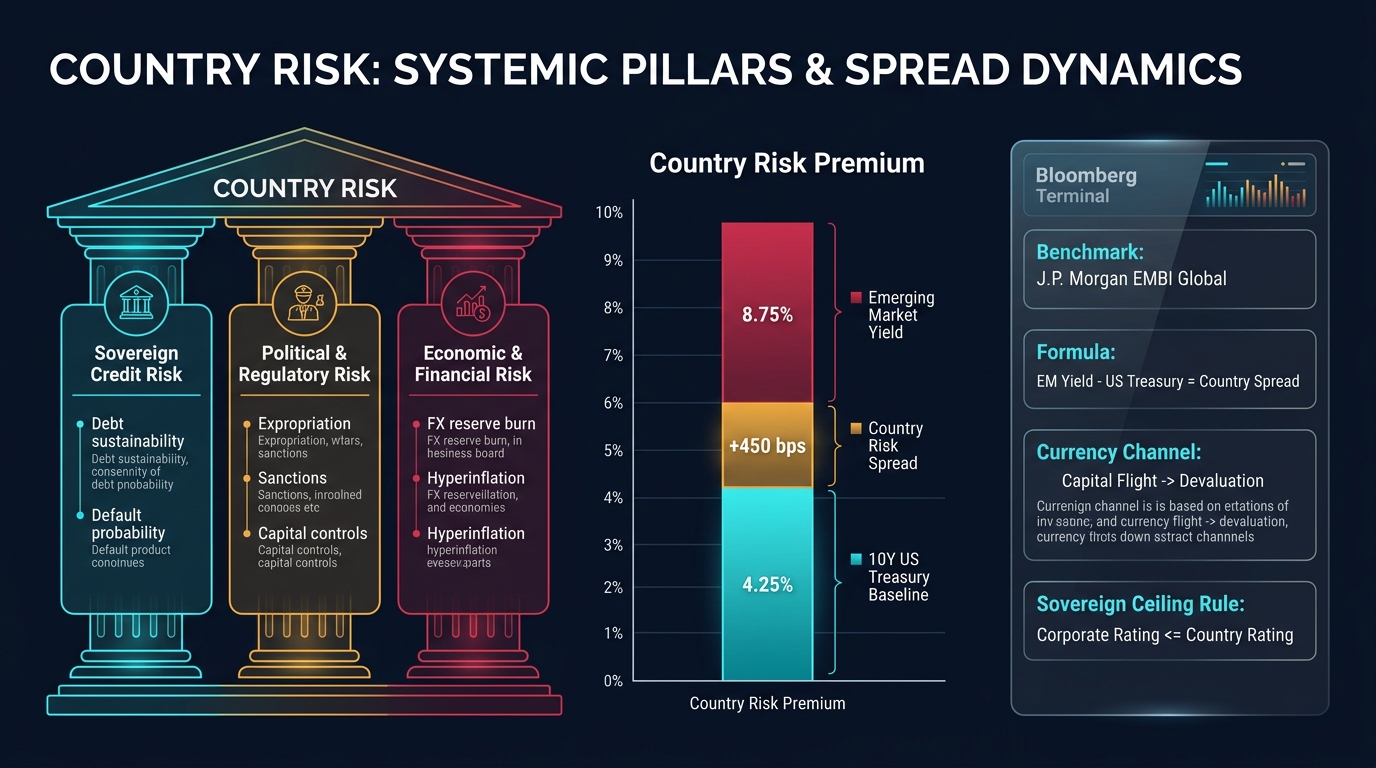
Taxonomy of Country Risk Components:
┌────────────────────────────────────────────────────────┐
│                      COUNTRY RISK                      │
└──────────────────────────┬─────────────────────────────┘
                           │
      ┌────────────────────┼────────────────────┐
      ▼                    ▼                    ▼
┌──────────────┐     ┌──────────────┐     ┌──────────────┐
│  SOVEREIGN   │     │  POLITICAL   │     │   ECONOMIC   │
│  CREDIT RISK │     │  & REGULATORY│     │ & FINANCIAL  │
│ Sovereign    │     │ Expropriation│     │ Hyper-       │
│ debt default │     │ capital      │     │ inflation, FX│
│ moratoriums, │     │ controls,    │     │ reserve      │
│ restructuring│     │ civil unrest │     │ depletion    │
└──────────────┘     └──────────────┘     └──────────────┘
Key Takeaways
- Three Primary Pillars: Country risk comprises Sovereign Risk (government default), Political Risk (regime change, war, expropriation), and Transfer & Convertibility Risk (capital controls restricting outbound funds).
- Quantifying via CDS Spreads: Institutional markets quantify country risk through Sovereign Credit Default Swap (CDS) spreads and the yield spread of sovereign debt over benchmark U.S. Treasuries (e.g., the J.P. Morgan EMBI Index).
- Currency Impact: Rising country risk triggers immediate institutional capital flight, forcing central banks to burn foreign reserves, hike interest rates to emergency levels, or execute sharp currency devaluations.
- Transfer Risk Barrier: Even a financially prosperous local corporation can be forced into cross-border default if the host national government imposes exchange controls that block outbound U.S. Dollar wire transfers.
The Core Components of Country Risk
Analysts evaluate country risk through a structured institutional matrix:
| Country Risk Dimension | Underlying Vulnerabilities | Practical Real-World Manifestation |
|---|---|---|
| Sovereign Credit Risk | High debt-to-GDP, unsustainable fiscal deficits, dependence on foreign-currency debt | A national treasury fails to make a coupon payment on sovereign Eurobonds |
| Transfer & Convertibility Risk | Depleted foreign currency reserves, severe balance-of-payments crisis | Central bank limits foreign wire transfers to $10,000/month, trapping foreign corporate profits |
| Political & Legal Risk | Regulatory caprice, nationalization of assets, weak property rights | Government abruptly expropriates foreign-owned mines or imposes punitive windfall taxes |
| Socioeconomic & Security Risk | Severe income inequality, widespread civil unrest, sanctions, military conflict | Geopolitical sanctions freeze offshore central bank assets and sever SWIFT access |
How Global Markets Quantify Country Risk
Institutional debt desks and macro hedge funds price country risk into traded instruments using two primary benchmarks:
1. Sovereign Bond Yield Spread (EMBI Spread)
The yield premium demanded by international investors to hold sovereign debt relative to a risk-free benchmark (such as 10-Year U.S. Treasuries):
$$\text{Sovereign Spread} = Y_{\text{Sovereign}} - Y_{\text{US Treasury Benchmark}}$$
- An emerging sovereign trading at a yield of 9.50% when U.S. Treasuries yield 4.25% carries a sovereign country spread of 525 basis points (5.25%).
- When political risk escalates, this spread blows out, triggering immediate currency depreciation.
2. Sovereign Credit Default Swaps (CDS)
A sovereign CDS acts as an insurance policy against government default. If 5-year Brazil CDS trades at 180 bps ($1.80%$), an investor must pay $18,000 annually to insure $1,000,000 in Brazilian sovereign debt against non-payment.
Real-World Case Study: The 2001 Argentine Debt Default & “Corralito”
Argentina’s economic collapse in late 2001 represents a textbook manifestation of catastrophic country risk:
The Macro Crisis:
- Throughout the 1990s, Argentina maintained the Convertibility Plan, fixing the Argentine Peso 1:1 to the U.S. Dollar via a rigid currency board.
- Persistent fiscal deficits, heavy foreign-denominated dollar borrowing, and economic stagnation caused international investors to lose confidence in Argentina’s debt sustainability.
The Country Risk Eruption:
- Capital Flight: In November 2001, nervous depositors withdrew hundreds of millions of dollars daily from commercial banks.
- Transfer Controls (“El Corralito”): On December 1, 2001, the government imposed emergency banking restrictions, freezing bank accounts and limiting cash withdrawals to 250 pesos per week. Cross-border transfers were completely banned.
- Sovereign Default: On December 23, 2001, interim President Adolfo Rodríguez Saá formally defaulted on $93 billion in sovereign debt—at the time, the largest sovereign debt default in human history.
- Currency Devaluation (“Asymmetric Pesification”): In early 2002, the 1:1 peg was severed. Dollar deposits were forcibly converted into devalued pesos at an artificial rate. Within weeks, the peso plunged by over 75%, trading down to nearly 4.00 pesos per dollar.
Defensive Strategies for Forex and Emerging Market Traders
Traders navigating cross-border investments protect against country risk through rigorous controls:
- Avoid Pegged Illusion: Never assume a fixed currency peg is permanent. When country risk indicators spike, sovereign pegs almost invariably collapse into violent devaluations.
- Trade via Offshore Liquid Derivatives: When expressing a view on high-risk emerging markets, trade via Non-Deliverable Forwards (NDFs) settled offshore in U.S. Dollars rather than physical domestic currency onshore, completely bypassing local capital controls.
- Monitor the Current Account & FX Reserve Ratio: Countries whose foreign exchange reserves fall below three months of import cover or fail the Greenspan-Guidotti rule (FX reserves must cover 100% of short-term external debt maturing within one year) face critical country risk vulnerability.
Frequently Asked Questions
What is the difference between sovereign risk and country risk?
Sovereign risk refers strictly to the credit risk of the national government itself defaulting on its sovereign debt obligations. Country risk is a much broader umbrella concept that includes sovereign default as well as political turmoil, economic recessions, expropriation, and local banking failures affecting private businesses within the country.
What are Non-Deliverable Forwards (NDFs) and how do they relate to country risk?
NDFs are foreign exchange forward contracts where there is no physical delivery of the underlying currency. Instead, on settlement day, the net profit or loss is calculated against a benchmark spot rate and paid out offshore in U.S. Dollars. NDFs enable global investors to trade currencies with high country risk (such as the Indian Rupee or Brazilian Real) without exposing capital to domestic transfer controls.
Which agencies publish country risk ratings?
Major institutions include sovereign credit rating agencies (Moody’s, S&P Global, and Fitch Ratings), multilateral bodies (the OECD Country Risk Classification), and private political risk consultancies such as the PRS Group (International Country Risk Guide - ICRG).
Ready to trade forex?
Open a free demo account with a regulated broker. Practice with virtual funds before risking real money.