Speculation
The deliberate financial practice of allocating capital to assets characterized by high risk of loss in pursuit of outsized capital appreciation, distinguishing itself from conservative investing and commercial hedging through its embrace of short-to-medium-term price volatility.
What Is Speculation?
Speculation is the act of conducting financial transactions that involve substantial risk of capital loss in exchange for the prospect of significant, above-average capital gains. Unlike passive or defensive investing—which seeks steady capital preservation and yield through long-term economic expansion—speculation focuses on anticipating, exploiting, and profiting from directional price fluctuations across currencies, commodities, equities, and derivative instruments.
In modern market theory, speculation is not an unsavory or reckless pursuit; rather, it is a vital structural pillar of global capitalism. Speculators willingly assume price and volatility risk that commercial enterprises and hedgers seek to offload, providing the liquidity and continuous order flow necessary for smooth, continuous price discovery.
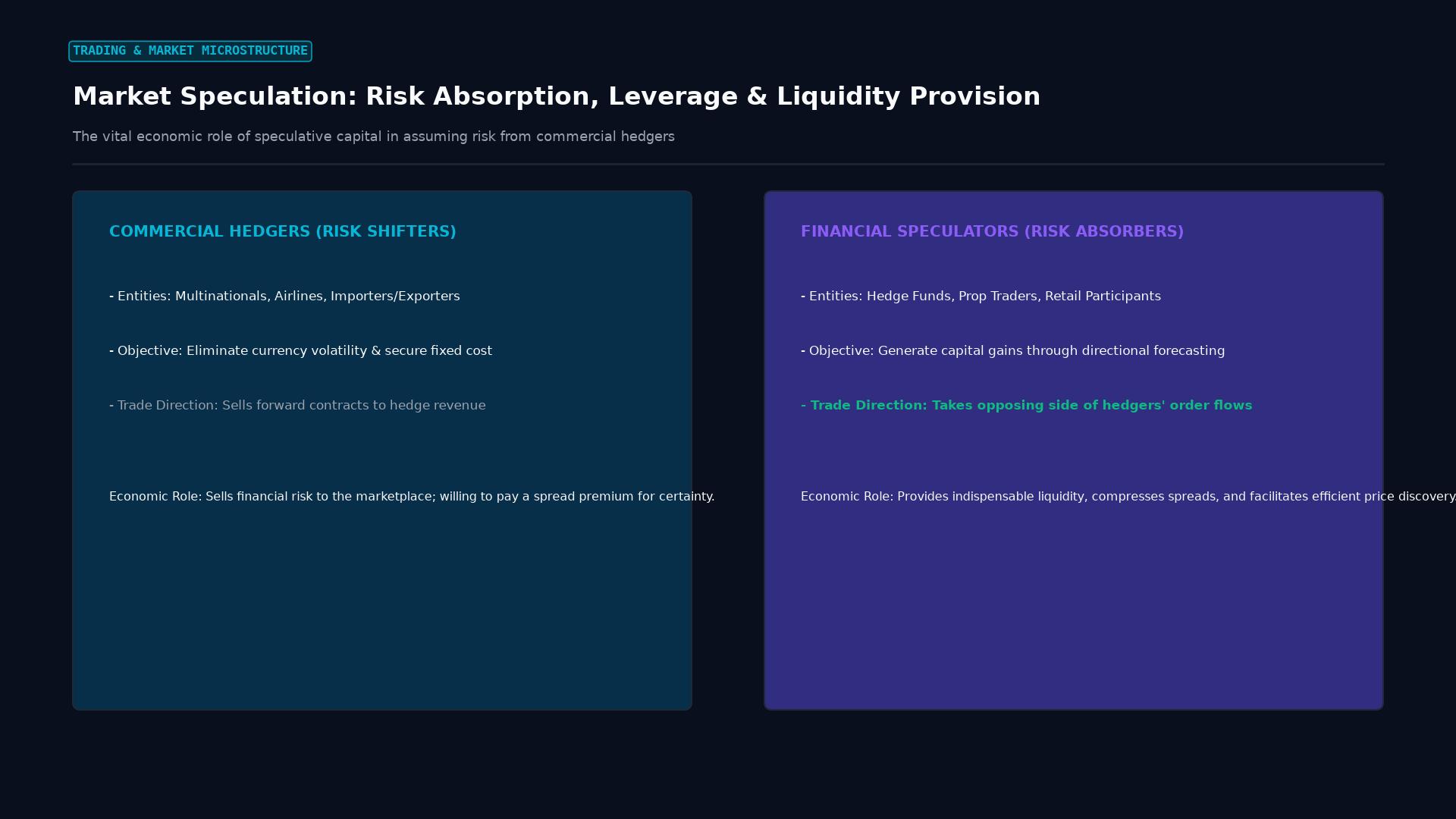 Figure: Economic symbiosis: commercial hedgers transferring currency risk to financial speculators who provide liquidity and price discovery.
Speculation vs. Investing vs. Gambling
To maintain professional discipline, financial analysts apply the foundational definitions established by Benjamin Graham and David Dodd in their 1934 masterpiece Security Analysis:
| Dimension | Speculation | Investing | Gambling |
|---|---|---|---|
| Primary Objective | Capital appreciation via price movement | Long-term capital growth and recurring yield (dividends/interest) | Pure recreational risk-taking |
| Analytical Basis | Technical analysis, macroeconomic catalysts, sentiment shifts | Fundamental valuation, discounted cash flows, earnings power | Pure chance; house statistical advantage |
| Mathematical Expectancy | Positive when executed with a proven edge ($E > 0$) | Positive over historical multi-year horizons ($E > 0$) | Strictly Negative by mathematical design ($E < 0$) |
| Time Horizon | Minutes, hours, days, to months | Years to decades | Seconds to hours (immediate payoff) |
| Underlying Value | Trades price movements of economic assets | Owns productive, cash-generating business assets | Artificial zero-sum or negative-sum wagering game |
The Mathematical Engine: Expected Value and Position Sizing
Institutional speculators never view trades as isolated gambles; they model market outcomes as repeated trials of a probabilistic distribution. A speculative strategy is viable only if it generates a positive mathematical expected value (EV):
$$\text{Expected Value (EV)} = (P_{\text{win}} \times W) - (P_{\text{loss}} \times L)$$
Where:
- $P_{\text{win}}$: Probability of a winning trade.
- $W$: Average dollar or pip gain on winning trades.
- $P_{\text{loss}}$: Probability of a losing trade ($1 - P_{\text{win}}$).
- $L$: Average dollar or pip loss on losing trades.
The Kelly Criterion for Speculative Sizing
To prevent capital ruin while optimizing long-term wealth compounding, quantitative speculators utilize the Kelly Criterion:
$$f^* = \frac{b \cdot p - q}{b}$$
Where:
- $f^*$: The optimal fraction of account equity to risk on a single trade.
- $b$: The payoff ratio ($\text{Average Win} / \text{Average Loss}$).
- $p$: The probability of winning ($P_{\text{win}}$).
- $q$: The probability of losing ($1 - p$).
Professional fund managers standardly trade at Half-Kelly or Quarter-Kelly to buffer against market regime shifts and liquidity slippage.
Real-World Institutional Case Study: Andy Krieger’s 1987 Short NZD Speculation
In October 1987, amidst the chaos of the Wall Street stock market crash, a 32-year-old currency trader named Andy Krieger at Bankers Trust executed one of the most aggressive foreign exchange speculations in history:
       ANDY KRIEGER'S NZD/USD SHORT SPECULATION (OCTOBER 1987)

 The Thesis:
 - Following the Black Monday crash, global investors fled U.S. Dollars into
   currencies they assumed were safe, including the New Zealand Dollar (NZD / Kiwi).
 - Krieger recognized that the New Zealand Dollar was severely overvalued
   relative to its underlying macroeconomic fundamentals.

 The Execution:
 - Utilizing Bankers Trust's massive capital and up to 400:1 leverage, Krieger built
   a short position in NZD options and spot totaling an estimated $3 Billion.
 - ASTONISHING FACT: Krieger's short position exceeded the entire money supply (M3)
   of New Zealand at the time.

 The Resolution:
 - The Kiwi collapsed by 3% to 5% within hours under the speculative assault.
 - Bankers Trust extracted an estimated $300 Million in net speculative profits,
   with Krieger personally receiving a $3 million annual bonus.
Krieger’s trade underscored the profound influence that institutional currency speculation exerts on exchange rate pricing, prompting the Reserve Bank of New Zealand to lodge formal diplomatic complaints regarding systemic market manipulation.
The Economic Benefits: Why Markets Need Speculators
While popular media frequently scapegoats speculators during market crises, professional economists universally acknowledge their three essential functions:
- Liquidity Provision: In the absence of speculators, a grain farmer wanting to sell wheat futures or an airline wanting to hedge jet fuel would have to wait weeks to find an exact counterparty with an identical offsetting operational need. Speculators act as buyers of last resort, absorbing trades instantly.
- Efficient Price Discovery: By ruthlessly exploiting pricing discrepancies between currencies and sovereign bonds, speculators eliminate artificial market distortions, forcing exchange rates back toward economic equilibrium.
- Risk Assumption: Speculators allow productive enterprises (manufacturers, exporters, miners) to transfer their unmanageable operational risks to willing financial risk-takers.
Monitoring Speculation: The CFTC Commitments of Traders (COT) Report
In institutional currency trading, tracking speculative sentiment is a core analytical methodology. Every Friday, the U.S. Commodity Futures Trading Commission (CFTC) publishes the Commitments of Traders (COT) report, dividing market participants into:
- Commercial Traders: Multinational companies and producers hedging operational exposure (hedgers).
- Non-Commercial Traders: Large hedge funds, CTAs, and institutional asset managers (speculators).
When Non-Commercial speculative positioning reaches extreme historical net-long or net-short records, it serves as a powerful contrarian indicator, signaling that the speculative trend is exhausted and vulnerable to a sharp reversal.
Frequently Asked Questions
Can speculative currency trading cause inflation or devalue a nation’s currency?
Speculation can accelerate the speed of a currency’s depreciation, but it rarely causes it in isolation. Speculators target currencies that already suffer from unsustainable government debt, massive budget deficits, or irresponsible central bank money printing. Speculation merely acts as the market mechanism that exposes underlying economic weaknesses.
What is the primary difference between day-trading speculation and swing trading?
The difference lies in holding duration and market exposure. Day-trading speculators open and liquidate positions within the same trading day to eliminate overnight gap risk. Swing-trading speculators hold open positions over days or weeks to capture larger multi-hundred-pip macroeconomic and technical swings.
What percentage of retail forex speculators lose money?
Regulatory disclosures mandated by the European ESMA, UK FCA, and US CFTC consistently reveal that between 70% and 85% of retail forex traders lose money. The primary culprits are excessive leverage, lack of statistical risk modeling, absence of stop-loss discipline, and emotional capitulation during drawdowns.
Ready to trade forex?
Open a free demo account with a regulated broker. Practice with virtual funds before risking real money.