Spot/Next Roll
An interbank foreign exchange swap transaction that rolls an open currency position from the standard spot settlement date (T+2) forward to the subsequent business day (T+3), utilized to prevent physical delivery while maintaining directional exposure.
What Is a Spot/Next Roll?
In the interbank foreign exchange and institutional money markets, a Spot/Next Roll (standardly abbreviated as S/N or Spot-Next) is an overnight swap agreement designed to extend an open foreign exchange contract by exactly one business day beyond the standard spot settlement date.
Under global market conventions, spot foreign exchange trades settle two business days after trade execution ($T+2$). When an institutional entity—such as a corporate treasury, commercial bank, or macro fund—holds a spot position that has already reached its $T+2$ settlement date but wishes to delay physical cash delivery, the dealing desk executes a Spot/Next swap.
The transaction consists of two simultaneous, offsetting legs executed with the same liquidity provider:
- Near Leg: The trader sells (or buys) the currency for settlement on Spot Date ($T+2$).
- Far Leg: The trader simultaneously repurchases (or resells) the identical notional quantity for settlement on the Next Business Day ($T+3$).
By executing both legs simultaneously, directional market risk is completely eliminated. The price difference between the two legs—quoted in swap points—reflects the overnight interest rate differential between the two sovereign currencies.
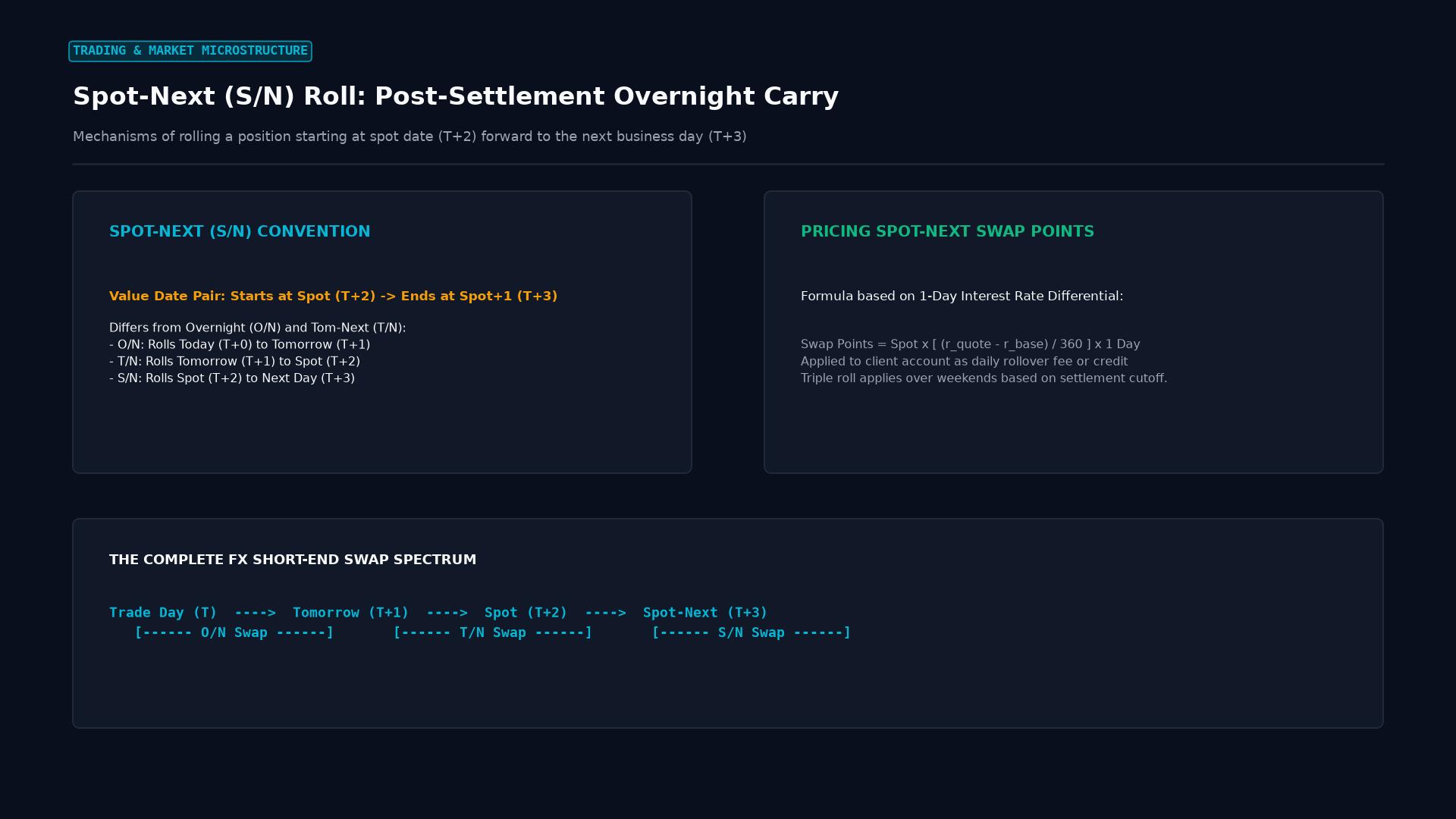 Figure: Short-end FX swap framework: extending settlement from Spot (T+2) to Spot+1 (T+3) based on one-day interbank interest rate differentials.
The Mathematical Pricing of Spot/Next Swap Points
In wholesale foreign exchange markets, Spot/Next swap points are mathematically derived from Covered Interest Parity (CIP). The points represent the cost or credit of borrowing one currency to deposit the other for a single overnight duration beginning on the spot date:
$$\text{S/N Swap Points} = S \times \left[ \frac{1 + \left(r_{\text{quote}} \times \frac{d}{360}\right)}{1 + \left(r_{\text{base}} \times \frac{d}{360}\right)} - 1 \right]$$
Where:
- $S$: Prevailing spot exchange rate.
- $r_{\text{quote}}$: Overnight interbank lending/deposit rate for the quote currency (e.g., SOFR for USD).
- $r_{\text{base}}$: Overnight interbank lending/deposit rate for the base currency (e.g., €STR for EUR).
- $d$: Number of calendar days between Spot ($T+2$) and Next ($T+3$), typically 1 day (or 3 days over a weekend).
- Day count convention: 360 days for USD and EUR; 365 days for GBP, AUD, and CAD.
Practical Pricing Example
Consider an institutional desk rolling a €50,000,000 long EUR/USD position via Spot/Next:
- Spot Rate ($S$): 1.0850
- Quote (USD) Rate: 5.25%
- Base (EUR) Rate: 3.75%
- Because the US Dollar yields 1.50% more than the Euro, holding EUR and borrowing USD over the S/N period incurs a negative interest rate differential.
- The dealer quotes S/N at -0.45 / -0.42 swap points.
- The position is rolled forward to $T+3$ at an effective cash debit of approximately -$2,260.41, without changing the desk’s gross currency exposure.
Spot/Next vs. Tomorrow/Next vs. Overnight Rolls
Understanding the differences between short-end interbank roll structures is essential for institutional treasury operations:
| Swap Structure | Abbreviation | Starting Value Date | Ending Value Date | Primary Market Application |
|---|---|---|---|---|
| Overnight | O/N | Today ($T+0$) | Tomorrow ($T+1$) | Managing same-day intraday liquidity shortages |
| Tomorrow/Next | T/N | Tomorrow ($T+1$) | Spot ($T+2$) | Core engine used by brokers for daily 5:00 PM EST rollovers |
| Spot/Next | S/N | Spot ($T+2$) | Next Day ($T+3$) | Extending maturing spot contracts; commercial cash management |
| Spot/Week | S/W | Spot ($T+2$) | One Week Post-Spot ($T+9$) | Short-term liquidity hedging for multinational supply chains |
Real-World Institutional Case Study: Corporate Treasury Delivery Delay
In global commerce, supply chain logistics and financial settlements do not always synchronize perfectly. In September 2023, a major European aerospace manufacturer faced an operational settlement challenge:
       AEROSPACE TREASURY SPOT/NEXT ROLL EXECUTION

 1. Underlying Trade:
    - Manufacturer purchased $100,000,000 against EUR at 1.0700 for delivery
      on Wednesday, September 20 (Spot Date T+2) to pay a jet engine supplier.

 2. Operational Disruption:
    - On Tuesday afternoon, the supplier notified the treasury that the engine
      shipment was delayed by 24 hours, requesting payment on Thursday, September 21.

 3. The Dilemma:
    - If the treasury accepted the $100M on Wednesday, the funds would sit in an
      uninvested non-interest account, creating capital inefficiency and overdraft risk.

 4. The Spot/Next Solution:
    - The treasury desk contacted its Tier-1 relationship bank and executed a
      $100,000,000 Spot/Next EUR/USD swap, selling USD on Value Wednesday and
      buying USD on Value Thursday.
    - Result: Delivery was cleanly deferred by 24 hours to match the shipment,
      saving the company over $15,000 in unhedged cash drag.
Operational Mechanics: Booking a Spot/Next Roll
In wholesale financial systems (such as Bloomberg FIT, FXall, or Reuters Dealing), executing a Spot/Next roll follows a standardized confirmation protocol:
- Request for Quote (RFQ): The institutional dealer broadcasts an RFQ for an S/N swap specifying the currency pair, direction, and notional volume.
- Two-Way Points Quote: Market makers respond with two-way swap points (e.g.,
-0.50 / -0.45). The first number represents the points when selling base currency near / buying far; the second represents buying near / selling far. - Automated Nostro Booking: Once executed, the confirmation generates automated SWIFT MT300 messages to both institutions’ clearing custodians, updating value dates across central bank RTGS ledgers without requiring manual wire transfers.
Frequently Asked Questions
Why do retail forex traders rarely see the term “Spot/Next”?
Retail brokerages aggregate all overnight financing through Tom/Next (T/N) swaps. Because retail traders trade on margin without physical delivery, retail platforms automatically execute a T/N rollover every day at 5:00 PM EST. The term Spot/Next (S/N) is primarily used by wholesale banks, corporate treasurers, and institutional hedgers who actively manage actual physical settlement dates.
How does the Wednesday roll convention affect Spot/Next pricing?
If a Spot/Next swap is executed on a Tuesday (where Spot Date is Thursday $T+2$), the “Next” business day rolls into Friday (1 calendar day). However, if an S/N swap is executed on a Wednesday (where Spot Date is Friday), the “Next” business day is Monday. In this case, the S/N swap covers 3 calendar days of weekend interest, tripling the swap points.
Can a Spot/Next roll result in a positive cash credit?
Yes. If an investor holds a spot position in a currency that carries a higher benchmark interest rate than the counter-currency, rolling the position forward via a Spot/Next swap earns a positive interest rate differential, crediting the investor’s cash account with net swap points.
Ready to trade forex?
Open a free demo account with a regulated broker. Practice with virtual funds before risking real money.