Tomorrow-Next (Tom-Next)
A short-term interbank foreign exchange swap that rolls an open spot position from tomorrow's settlement date (T+1) to the standard spot settlement date (T+2), serving as the core operational mechanism for daily overnight rollover credits and debits.
What Is Tomorrow-Next (Tom-Next)?
Tomorrow-Next (universally abbreviated as Tom-Next or T/N) is a specialized interbank foreign exchange swap transaction that rolls an open currency position forward by one business day. It enables financial market participants to maintain open speculative or hedging positions continuously without being forced to take or deliver physical banknotes upon settlement.
Because standard spot foreign exchange contracts settle two business days after trade execution ($T+2$), any open position held past the daily market close (5:00 PM Eastern Standard Time / New York close) would naturally mature into physical delivery unless extended.
To avert physical delivery, the broker or liquidity provider executes a Tom-Next swap:
- The existing trade is synthetically closed at tomorrow’s value date ($T+1$).
- An identical position is simultaneously re-opened for the subsequent spot value date ($T+2$).
The exchange rate difference between these two simultaneous transactions is quoted in swap points (or forward points), which reflect the net overnight interest rate differential between the two currencies.
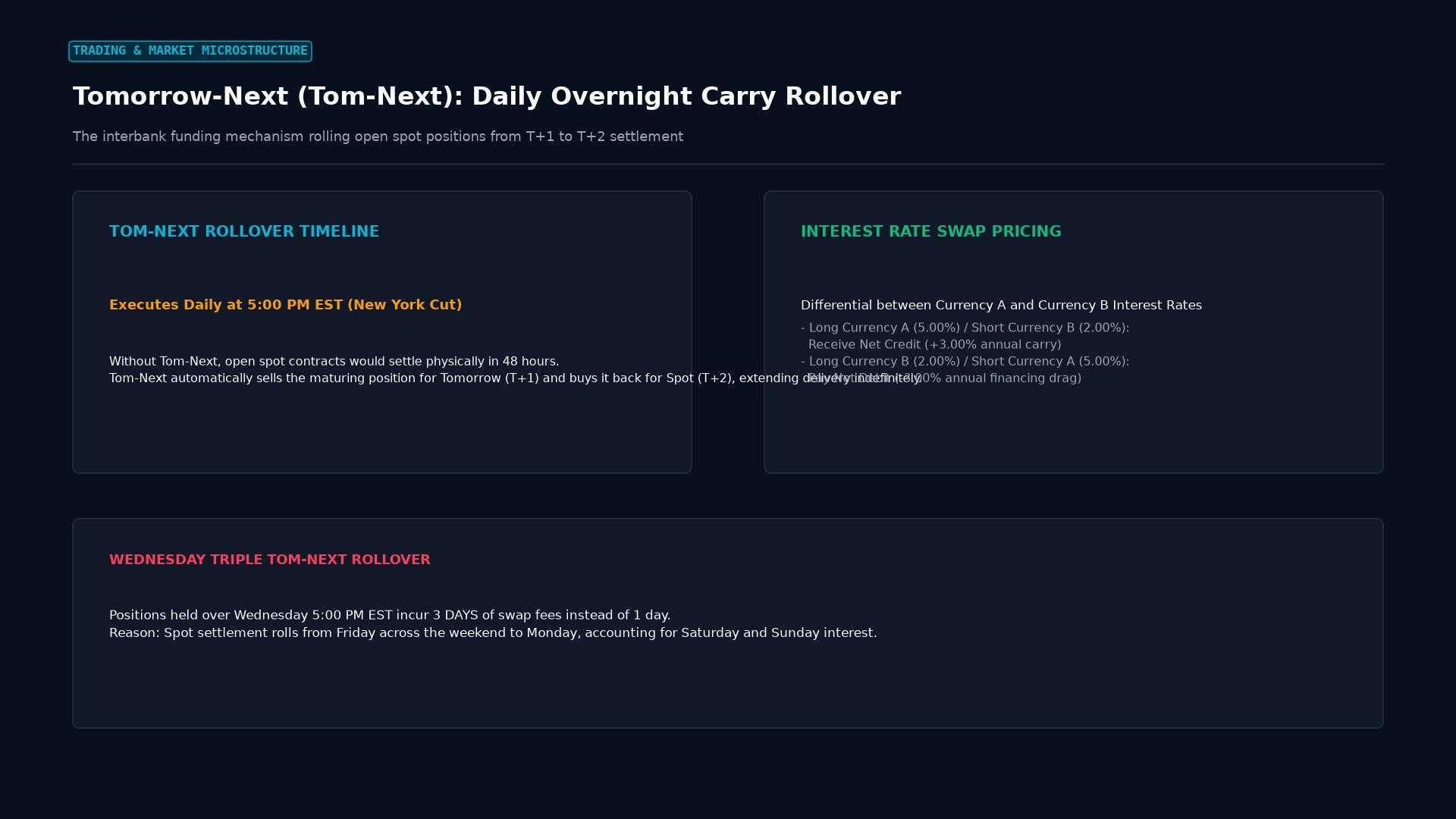 Figure: Daily overnight rollover mechanism: rolling settlement from T+1 to T+2 at 5:00 PM EST, applying interest differentials, and Wednesday triple roll.
The Mathematical Pricing of Tom-Next Swap Points
In institutional wholesale markets, Tom-Next swap points are mathematically calculated based on the principle of Covered Interest Parity (CIP):
$$\text{Tom-Next Swap Points} = S \times \left[ \frac{1 + \left(r_{\text{quote}} \times \frac{d}{360}\right)}{1 + \left(r_{\text{base}} \times \frac{d}{360}\right)} - 1 \right]$$
Where:
- $S$: Current spot exchange rate.
- $r_{\text{quote}}$: Overnight interbank lending rate for the quote currency.
- $r_{\text{base}}$: Overnight interbank lending rate for the base currency.
- $d$: Number of rollover calendar days (typically 1 day for standard weekdays, 3 days on Wednesday).
- Day-count convention: 360 days for USD, EUR, CHF; 365 days for GBP, AUD, NZD, CAD.
The Wednesday “Triple Swap” Anomaly
Because global commercial banking networks are closed on Saturdays and Sundays, transactions cannot settle over the weekend.
Under the $T+2$ spot convention:
- A trade rolled over on Wednesday at 5:00 PM EST rolls its settlement date from Friday ($T+2$) to Monday ($T+5$).
- To compensate counterparties for the two weekend days of capital commitment and counterparty risk, brokers assess three days of Tom-Next swap charges (3x rollover) in a single transaction on Wednesday evening.
Short-End Interbank Settlement Hierarchy
| Roll Structure | Abbreviation | Starting Value Date | Ending Value Date | Primary Purpose |
|---|---|---|---|---|
| Overnight | O/N | Today ($T+0$) | Tomorrow ($T+1$) | Intraday cash balancing and same-day payment fixes |
| Tomorrow-Next | T/N | Tomorrow ($T+1$) | Spot ($T+2$) | The universal daily engine for forex margin rollover |
| Spot-Next | S/N | Spot ($T+2$) | Next Day ($T+3$) | Extending maturing spot contracts by one extra business day |
| Spot-Week | S/W | Spot ($T+2$) | One Week ($T+9$) | Commercial corporate short-term cash flow matching |
Real-World Institutional Case Study: The 5:00 PM EST Rollover Liquidity Vacuum
Every business day at precisely 5:00:00 PM EST, the global foreign exchange market undergoes its mandatory daily settlement reconciliation. While retail traders merely see a line item labeled “Swap” appear in their trading history, institutional trading desks navigate a critical liquidity transition:
       5:00 PM EST INSTITUTIONAL ROLLOVER TRANSITION

 16:59:50 EST: Spot EUR/USD trades with liquid 0.2 pip interbank spread.
 17:00:00 EST: New York desks officially close; clearing engines freeze books.
               Tom-Next swap engines execute billions in automated offsetting rolls.
 17:00:15 EST: Liquidity providers pull spot quotes momentarily to avoid
               cross-settlement toxic order flow.
               Bid-Ask Spreads widen temporarily from 0.2 pips to 3.0–8.0 pips.
 17:01:30 EST: New value date established; Asian market makers (Wellington, Sydney)
               assume quoting responsibility; spreads compress back to normal.
Institutional algorithms are programmed to avoid executing market orders during this 60-to-90-second rollover window to prevent paying inflated bid-ask spreads.
Strategic Implications: How Speculators Navigate Tom-Next
- Intraday Liquidation (Day Trading): Scalpers and day traders systematically close all speculative positions prior to 4:59 PM EST. By remaining 100% flat at the 5:00 PM cutoff, they eliminate Tom-Next rollover debits entirely.
- Carry Trade Alignment: Long-term macro swing traders deliberately align their directional exposure with positive Tom-Next points (buying higher-yielding currencies against lower-yielding funding currencies), turning the daily Tom-Next roll into a continuous income stream.
- Swap-Free (Islamic) Account Structuring: For traders observing Islamic financial principles prohibiting riba (usury/interest), brokers disable the Tom-Next interest mechanism, substituting it with a fixed administrative holding fee or widened spreads.
Frequently Asked Questions
Why is Tom-Next used instead of just settling trades immediately?
Spot foreign exchange contracts technically represent the exchange of physical bank deposits across sovereign jurisdictions. If brokers did not execute Tom-Next swaps, retail traders would be legally obligated to wire hundreds of thousands of Euros, Dollars, or Yen to physical bank vaults every two days. Tom-Next automates the roll into perpetuity, allowing traders to speculate purely on price differentials.
Does a position opened at 4:59 PM EST incur a full day of Tom-Next charges?
Yes. Tom-Next charges are not prorated by the minute or hour. The rollover engine executes a binary check: if a trade is open at precisely 5:00:01 PM EST, it incurs the full 24-hour Tom-Next debit or credit. A trade opened at 4:59 PM and closed at 5:02 PM incurs the exact same rollover fee as a trade held for twenty hours.
Can Tom-Next swap points turn negative for both buy and sell positions?
Yes. In an ideal interbank world, one side earns interest while the opposite side pays interest. In the retail brokerage sector, however, brokers apply an administrative financing markup (spread) to both sides. If the underlying central bank interest rate differential is narrow (e.g., 0.25%), the broker’s 1.00% markup pushes both the long swap and short swap into negative territory, charging debits regardless of trade direction.
Ready to trade forex?
Open a free demo account with a regulated broker. Practice with virtual funds before risking real money.