Stable Market
A financial or foreign exchange market environment characterized by deep liquidity, balanced two-way order flow, narrow bid-ask spreads, and sufficient depth of market to absorb large institutional transaction volumes without triggering excessive price volatility.
What Is a Stable Market?
A stable market is a financial trading environment characterized by equilibrium between buying and selling forces, robust liquidity, and consistent market depth. In a stable market, price discovery occurs smoothly and predictably; exchange rates and asset values adjust in measured, orderly increments rather than experiencing erratic, violent price shocks.
The hallmark of a genuinely stable market is order-book resilience. When an institutional participant (such as a sovereign wealth fund, global central bank, or multinational corporate treasury) executes a massive multi-hundred-million-dollar order, a stable market possesses sufficient liquidity to absorb that block trade without causing significant execution slippage or structural price dislocations.
In foreign exchange, major currency pairs—particularly EUR/USD and USD/JPY during peak trading hours—represent the premier global benchmarks for market stability.
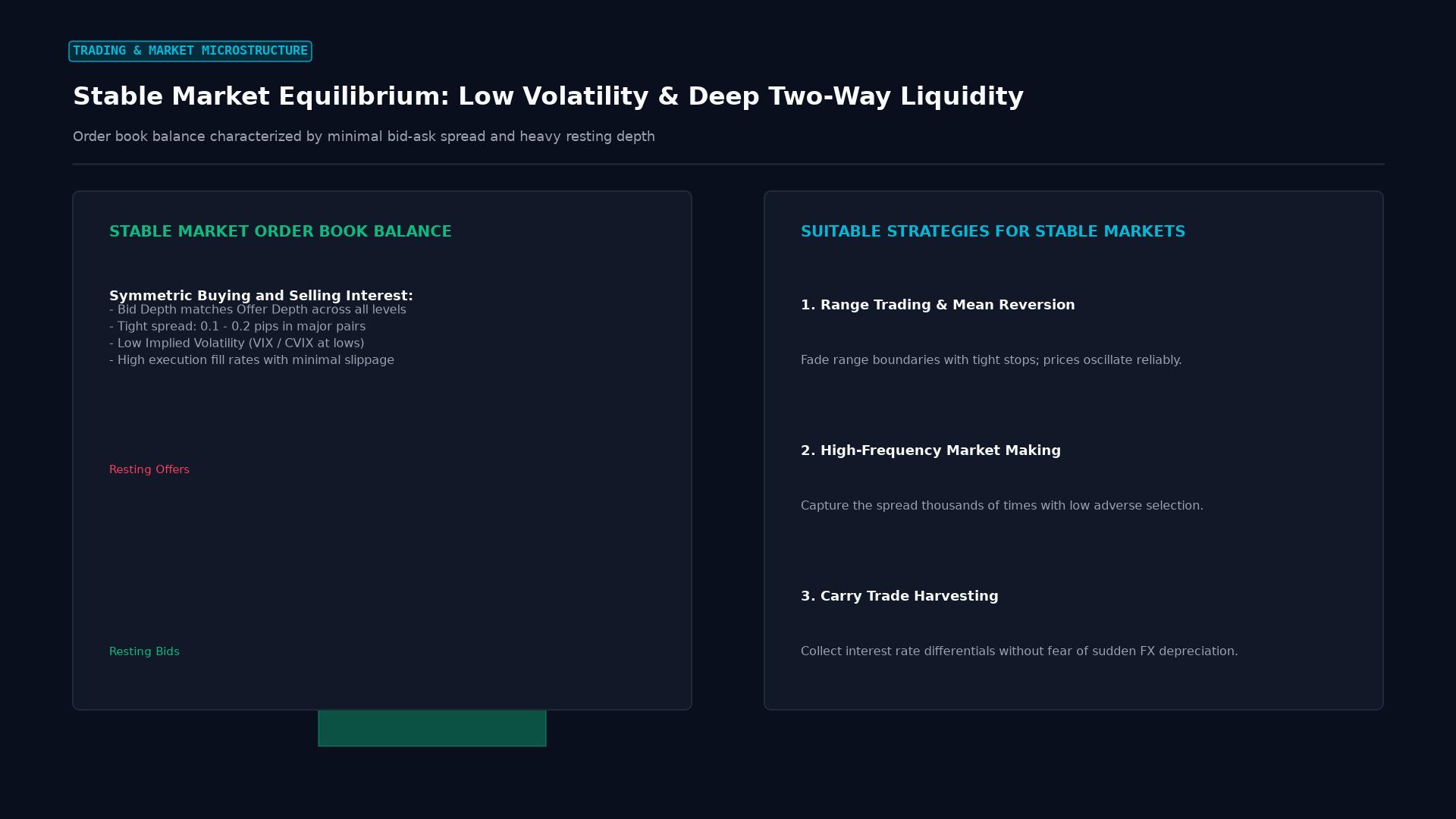 Figure: Equilibrium market structure: symmetric bid and ask depth, tight spreads, and optimal conditions for range trading and carry harvesting.
Quantitative Metrics Defining Market Stability
Institutional market microstructure research quantifies stability across four core mathematical and structural dimensions:
1. Kyle’s Lambda ($\lambda$) – Market Impact Parameter
Formulated by financial economist Albert S. Kyle, this metric measures the illiquidity and price impact of order flow:
$$\Delta P_t = \lambda \cdot Q_t + \epsilon_t$$
Where:
- $\Delta P_t$: Price change resulting from an executed order.
- $Q_t$: The net order size (trade volume).
- $\lambda$: Kyle’s lambda (the illiquidity parameter).
In a highly stable market, $\lambda$ approaches zero ($\lambda \to 0$), indicating that massive trade volumes ($Q$) generate minimal price displacement ($\Delta P$).
2. Bid-Ask Spread Compression
Stable markets exhibit ultra-tight, consistent bid-ask spreads. In major spot currency pairs, spreads standardly compress to 0.1 to 0.4 pips, reflecting minimal inventory risk for tier-1 market-making algorithms.
3. Realized Volatility ($\sigma$)
Price movements conform to predictable statistical distributions without extreme fat-tailed kurtosis. Realized volatility remains within historical baseline ranges, permitting reliable options pricing and risk budgeting.
4. Order Book Replenishment Rate (Resilience)
When a large trade consumes liquidity at the best bid or ask, automated algorithms and market makers replenish resting limit orders within milliseconds, preventing persistent liquidity voids.
Stable Market vs. Volatile Market vs. Thin Market
| Dimension | Stable Market | Volatile Market | Thin (Illiquid) Market |
|---|---|---|---|
| Market Depth (DOM) | Extremely deep; multiple heavy tiers | Fluctuating; orders pulled rapidly | Extremely shallow; sparse order book |
| Bid-Ask Spreads | Ultra-tight; fixed within fractional pips | Expanding significantly; erratic | Wide; subject to substantial dealer markups |
| Execution Slippage | Near zero on standard lot sizes | Elevated; negative slippage frequent | Severe; sweeping multiple price tiers |
| Price Trajectory | Smooth, continuous trending or ranging | Explosive breakouts, spikes, and whipsaws | Gappy, jagged, and easily manipulated |
| Dominant Participants | Broad institutional and commercial mix | Momentum hedge funds and algorithmic CTAs | Specialized boutique dealers; retail internalizers |
Real-World Institutional Case Study: The London-New York Session Overlap
The ultimate real-world manifestation of market stability occurs daily in the global foreign exchange market between 13:00 GMT and 17:00 GMT, known as the London-New York Overlap:
       GLOBAL FX TURNOVER BY TIME WINDOW (GMT)

 00:00 - 08:00 GMT: Asian Session (Tokyo, Singapore)  ──► Moderate Stability
 08:00 - 13:00 GMT: European Session (London Opens)    ──► High Liquidity
 ─────────────────────────────────────────────────────────────────────────────
 13:00 - 17:00 GMT: LONDON - NEW YORK OVERLAP          ──► MAXIMUM STABILITY
                    - Over 50% of Global Daily FX Volume ($7.5T) Processed
                    - Deepest Order Books on Earth
                    - Tightest Bid-Ask Spreads (EUR/USD, GBP/USD)
 ─────────────────────────────────────────────────────────────────────────────
 17:00 - 22:00 GMT: US Afternoon Session               ──► Declining Stability
 22:00 - 00:00 GMT: Roll Period / Off-Peak Transition  ──► Lowest Stability (Spreads Widen)
During this four-hour window:
- The world’s two largest financial trading centers operate simultaneously.
- Commercial banks, sovereign reserves, global import-export corporations, and pension funds execute massive institutional portfolio rebalancing flows.
- Because thousands of competitive market-making algorithms actively quote simultaneous two-way prices, a $100 million EUR/USD transaction executes with virtually zero price impact, epitomizing the benefits of a stable market.
What Threatens and Disrupts Market Stability?
Even the most stable financial markets can experience rapid structural degradation under specific conditions:
- Scheduled Macroeconomic Catalysts: In the minutes immediately preceding high-impact economic releases (e.g., U.S. CPI or FOMC rate announcements), algorithmic market makers systematically pull passive resting limit orders, temporarily transforming a stable market into a fragile, thin environment.
- Geopolitical Black Swans: Unforeseen events (such as war outbreaks, emergency currency devaluations, or systemic bank failures) cause risk models to freeze, destroying two-way bidding.
- Off-Peak Hour Transitions: During the daily settlement roll period (around 5:00 PM EST), interbank trading desks close their books, causing spreads to widen and market depth to drop precipitously until the Asian session gains momentum.
Frequently Asked Questions
Does a stable market mean asset prices remain completely static?
No. A stable market does not mean prices are frozen. Rather, it means that price adjustments occur in a continuous, orderly manner supported by ample liquidity. An asset can maintain a steady, powerful 200-pip trend in a stable market without experiencing erratic gaps, violent flash spikes, or order-book collapses.
Why do institutional asset managers prefer executing large trades in stable markets?
Large funds manage billions of dollars. If an institution attempts to execute a $200 million order in a thin, unstable market, the trade sweeps through resting bids, driving the execution price against itself (adverse market impact) and inflicting massive slippage costs. Stable markets provide the deep liquidity required to fill massive orders at optimal, predictable prices.
How do algorithmic market makers contribute to market stability?
Algorithmic market makers continuously calculate the statistical fair value of an asset and submit simultaneous limit buy orders (bids) and limit sell orders (asks) across multiple price levels. By constantly absorbing inventory imbalances and competing against other liquidity providers, algorithms narrow spreads and provide the constant liquidity depth that defines a stable market.
Ready to trade forex?
Open a free demo account with a regulated broker. Practice with virtual funds before risking real money.