Sterling
The official institutional and historical designation for the legal tender of the United Kingdom, formally titled the Pound Sterling (ISO code: GBP, symbol: £), recognized as the oldest continuously used sovereign currency in existence.
What Is Sterling?
Sterling (formally known as the Pound Sterling, with the currency code GBP and symbol £) is the official currency of the United Kingdom, the British Crown Dependencies (Jersey, Guernsey, and the Isle of Man), and several British Overseas Territories (such as South Georgia and the British Antarctic Territory).
Dating back over 1,200 years to Anglo-Saxon England around 775 AD—when silver pennies were minted from high-purity “sterling silver” ($92.5%$ pure silver)—Sterling is the oldest national currency continuously used in the modern world.
In global financial markets, Sterling is an elite tier-1 global reserve currency. According to the Bank for International Settlements (BIS) Triennial Central Bank Survey, Sterling ranks as the fourth most traded currency globally (behind the U.S. Dollar, Euro, and Japanese Yen), accounting for approximately $13%$ of daily global foreign exchange turnover ($>$900 \text{ billion daily}$). It also constitutes approximately $5%$ of official global foreign exchange reserves allocated in the International Monetary Fund’s (IMF) COFER database.
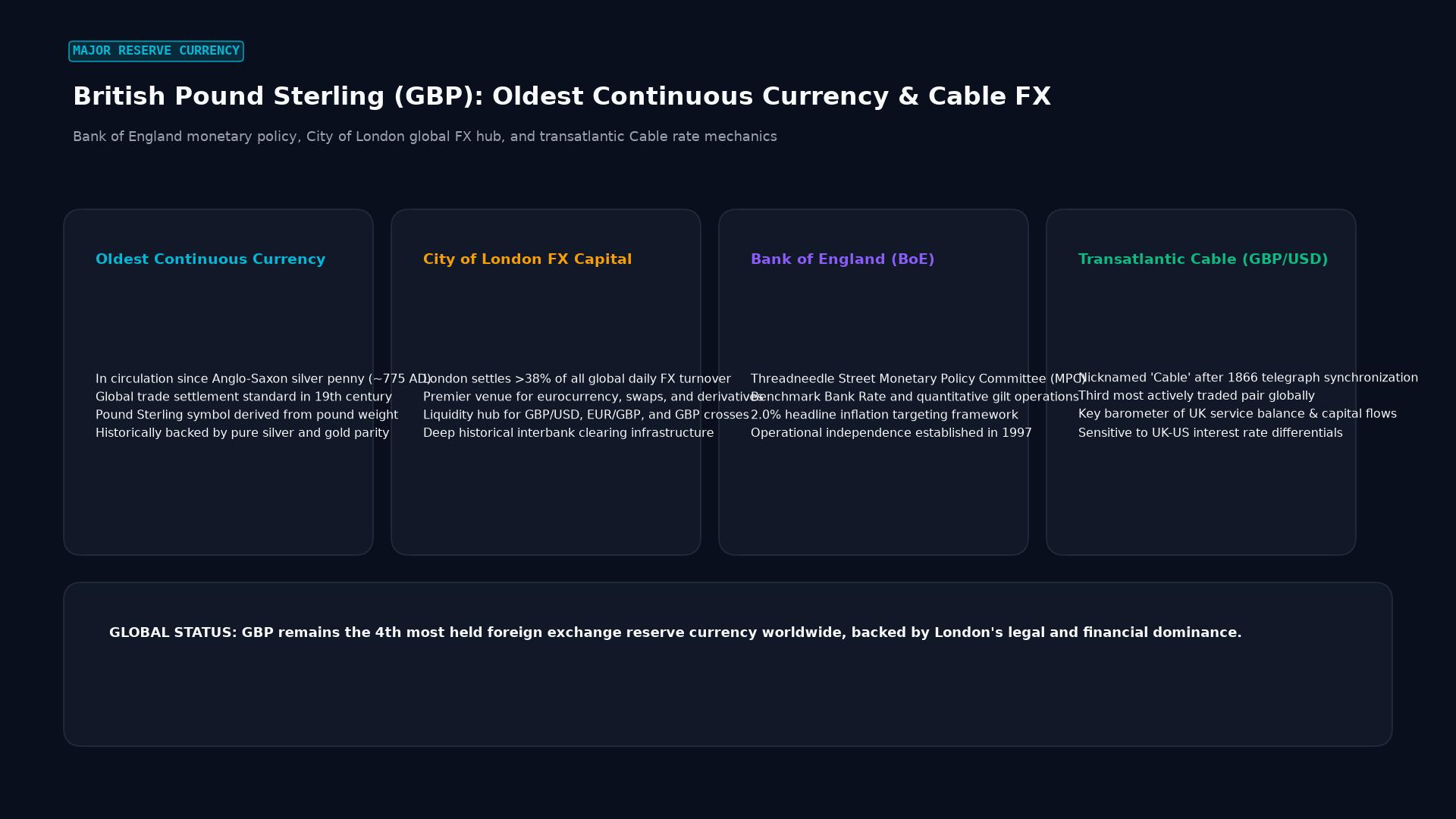 Figure: Bank of England monetary policy, City of London global FX hub, and transatlantic Cable rate mechanics
The Historical Origin of “Cable”
In professional trading desks and interbank dealing terminology, the currency pair GBP/USD is universally referred to as “Cable”.
The moniker originated in 1866, when the first commercially viable transatlantic telegraph cable was successfully laid across the seabed between Foilhummerum Bay on Valentia Island in western Ireland and Heart’s Content in eastern Newfoundland, Canada. For the first time in history, financial institutions in the City of London and on Wall Street in New York could synchronize exchange rate quotations, orders, and clearing confirmations across an undersea telegraph cable in minutes rather than waiting weeks for steamships to cross the Atlantic.
To this day, executing a GBP/USD transaction is referred to on institutional trading floors as “trading the Cable.”
Macroeconomic Drivers of Sterling Exchange Rates
The valuation of Sterling against foreign currencies is governed by four primary macroeconomic pillars:
- Bank of England (BoE) Monetary Policy Committee (MPC): Established in 1694 (known affectionately as “The Old Lady of Threadneedle Street”), the Bank of England sets the Bank Rate through its nine-member MPC. Sterling exhibits acute sensitivity to BoE inflation projections, quantitative easing (QE) or quantitative tightening (QT) balance-sheet shifts, and MPC vote splits.
- The “Kindness of Strangers” (Current Account Deficit): The United Kingdom runs a persistent structural current account deficit (importing more goods and services than it exports). Consequently, Sterling relies on continuous foreign capital inflows into UK assets (real estate, corporate equities, and sovereign gilts). As former BoE Governor Mark Carney famously warned, this dynamic leaves Sterling vulnerable to capital flight if international investor confidence falters.
- The City of London Financial Engine: The UK economy is heavily dominated by its world-leading financial and professional business services sector. Capital flows entering London’s banking, insurance, and derivatives clearing ecosystems exert massive structural demand for GBP.
- Geopolitical and Trade Friction (Post-Brexit Dynamics): Following the UK’s departure from the European Union, cross-border regulatory barriers, UK-EU trade treaties, and Scottish constitutional debates remain critical long-term structural drivers of Sterling valuation.
Key Currency Crosses: Volatility Profiles
| Currency Pair | Market Shorthand | Average Daily Range (Pips) | Market Character / Behavioral Profile |
|---|---|---|---|
| GBP/USD | “Cable” | 90 – 140 pips | Highly liquid, clean trend structure, sensitive to US macro data releases |
| EUR/GBP | “The Chunnel” | 40 – 70 pips | Low volatility, mean-reverting, heavily driven by regional UK-Eurozone trade flows |
| GBP/JPY | “Guppy” or “The Beast” | 130 – 220 pips | Extreme volatility; combines risk-sensitive Yen carry with high-beta UK yield; prone to multi-hundred pip intraday sweeps |
| GBP/AUD | “Pound Aussie” | 110 – 170 pips | Driven by commodity pricing cycles and Chinese macroeconomic performance |
Real-World Institutional Case Study: The September 2022 UK “Mini-Budget” Crisis
The catastrophic vulnerability of Sterling to sovereign fiscal mismanagement was dramatically exposed in September 2022 during the brief premiership of Liz Truss:
       GBP/USD (CABLE) COLLAPSE - THE "MINI-BUDGET" CRISIS

 1.1500 ──┐ (Sept 22: Baseline Trading)
          │\
 1.1200 ──┼─\  [ Sept 23: Chancellor Announces £45B Unfunded Tax Cuts ]
          │  \
 1.0800 ──┼───\___ International Capital Flight; UK Gilt Yields Surge
          │       \
 1.0350 ──┼────────\___ ALL-TIME HISTORIC LOW: Sept 26, 2022 (Asian Session)
          │            /
 1.0800 ──┼───────────/   Bank of England Emergency Interventions (Buys Gilts)
          │          /
 1.1500 ──┼─────────/    Government Cancels Tax Cuts; Prime Minister Resigns
└─────────────────────────────────────────────────────────────- The Catalyst: On September 23, 2022, Chancellor Kwasi Kwarteng unveiled an emergency “mini-budget” containing £45 billion in unfunded tax cuts alongside massive energy subsidies, without independent economic forecasts from the Office for Budget Responsibility (OBR).
- The Market Panic: Global investors balked at the reckless expansion of UK sovereign debt. Foreign institutional investors dumped UK sovereign bonds (gilts) and liquidated Sterling.
- The Pension Crisis: Surging gilt yields triggered emergency margin calls on Liability-Driven Investment (LDI) pension funds, forcing funds to liquidate billions in assets.
- The Historic Collapse: On Monday, September 26, during thin Asian trading hours, GBP/USD went into freefall, collapsing to an all-time historic low of 1.0350, nearing 1:1 parity with the U.S. Dollar.
- The Reversal: Sterling stabilized only after the Bank of England intervened with an emergency £65 billion gilt-buying program, and the government completely abandoned the fiscal plan.
Frequently Asked Questions
What is the exact difference between the “Pound” and “Sterling”?
“Pound” is the unit of currency denomination (e.g., ten pounds, one hundred pounds). “Sterling” is the official collective name of the currency itself. In international financial and diplomatic contexts, it is formally termed the “Pound Sterling” to distinguish it from other sovereign currencies that share the name “pound” (such as the Egyptian Pound or Lebanese Pound).
Why is GBP/JPY referred to as “The Beast”?
Retail and institutional traders nickname GBP/JPY “The Beast” (or “The Dragon”) due to its extreme daily volatility and explosive price velocity. It combines the high interest-rate volatility of the UK economy with the risk-off safe-haven and carry-trade unwind dynamics of the Japanese Yen, regularly generating intraday price swings exceeding 200 to 300 pips.
How does the Bank of England publish interest rate decisions?
The Bank of England’s Monetary Policy Committee (MPC) announces interest rate decisions eight times a year on “Super Thursdays.” The announcement is released at precisely 12:00 PM London time, accompanied immediately by the meeting minutes, the voting record of all nine MPC members (e.g., 7-2 vote), and the quarterly Monetary Policy Report containing official GDP and inflation projections.
Ready to trade forex?
Open a free demo account with a regulated broker. Practice with virtual funds before risking real money.