Cable
Cable is the traditional financial market slang for the British Pound against the US Dollar currency pair (GBP/USD). The nickname originates from the transatlantic telegraph cables laid across the Atlantic Ocean floor in the mid-19th century to transmit exchange rate quotes between London and New York.
What Is Cable in Forex?
In global foreign exchange dealing rooms, Cable is the universal colloquial term for the currency pair GBP/USD—the British Pound Sterling quoted against the United States Dollar. When a currency dealer mentions that “Cable is trading up 40 pips” or asks for “a price on Cable,” they are referring exclusively to GBP/USD.
Along with EUR/USD, USD/JPY, and USD/CHF, Cable is one of the world’s original “majors.” It represents the financial bridge between the world’s primary international financial center—the City of London—and the world’s largest economy, the United States. According to the Bank for International Settlements (BIS), GBP/USD consistently ranks as the third most heavily traded currency pair globally, accounting for approximately 10% to 13% of all daily foreign exchange turnover.
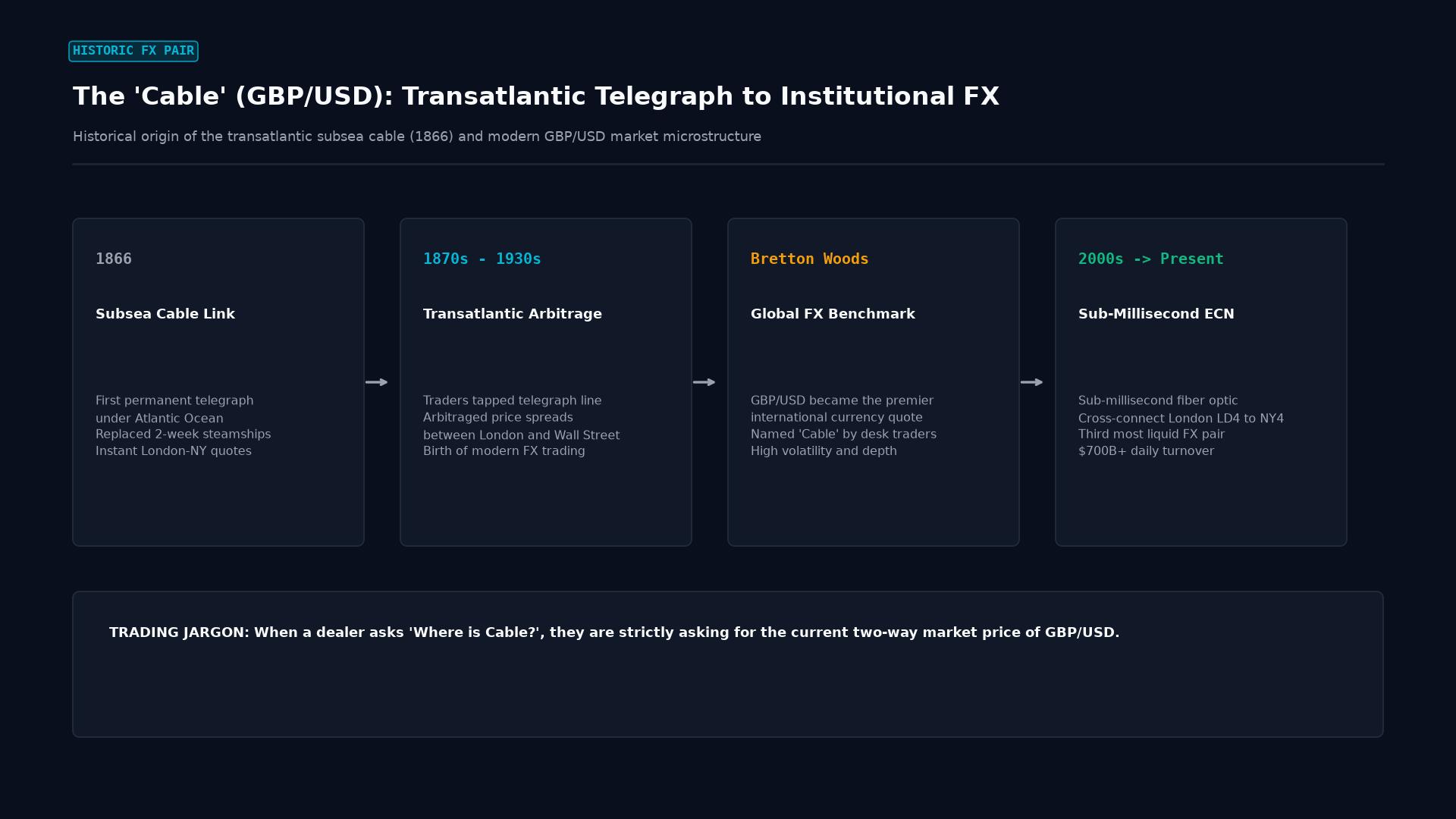 Figure: Historic currency pairing: transatlantic telegraph cable origin (1866), transatlantic price arbitrage, and modern sub-millisecond LD4-NY4 electronic matching.
The Historic Origin of the Name
The moniker “Cable” dates back to the Victorian era and the birth of modern telecommunications.
Prior to the 1860s, financial communication between Europe and the Americas relied on steamships crossing the Atlantic, a journey that took 10 to 14 days. Consequently, currency exchange rates between the London Stock Exchange and Wall Street were perpetually out of sync by nearly two weeks, severely limiting cross-border arbitrage and international trade.
In July 1866, after multiple failed attempts, the Anglo-American Telegraph Company successfully laid the first enduring, commercially viable transatlantic telegraph cable along the ocean floor between Valentia Island off the western coast of Ireland and Heart’s Content in Newfoundland, Canada.
For the first time in human history, messages could travel across the Atlantic in a matter of minutes. Financial institutions utilized this subsea telegraph line to synchronize daily exchange rate quotations between the London and New York bourses. Traders referred to the wire transmissions as “cabling” and began calling the exchange rate itself “the Cable.” More than a century and a half later, despite microwave towers, satellite links, and fiber-optic networks, the historic name remains firmly entrenched on modern trading desks.
Trading Characteristics of Cable (GBP/USD)
Forex traders prize Cable for its distinctive price behavior and structural characteristics:
1. High Volatility and Wide Daily Range
Cable is historically more volatile than EUR/USD. Its Average True Range (ATR) routinely spans 80 to 140 pips per day on the daily timeframe, compared to 50 to 80 pips for EUR/USD. This elevated volatility attracts day traders, breakout specialists, and algorithmic momentum strategies seeking sizable intraday swings.
2. Deep Interbank Liquidity
Despite its wide daily price swings, Cable features immense market depth. Spreads on institutional ECN accounts are razor-thin, typically ranging from 0.5 to 1.2 pips during active market hours, allowing traders to enter and exit multi-million-dollar positions with minimal market impact.
3. The London / New York Overlap (The “Golden Hours”)
Cable experiences its peak trading volume and sharpest directional trends between 12:00 GMT and 16:00 GMT, when the London afternoon session coincides with the New York morning open. Economic news releases from both the Bank of England (BoE) and the US Federal Reserve, along with US macroeconomic data (such as CPI, Nonfarm Payrolls, and Retail Sales), hit the tape during this window, generating intense price discovery.
4. Severe Sensitivity to Political Headlines
Historically, the British Pound has exhibited acute sensitivity to domestic political developments in Westminster. Major political transitions, general elections, fiscal budget speeches (“mini-budgets”), and the multi-year Brexit negotiations triggered massive, hundreds-of-pips dislocations in Cable within seconds.
Primary Catalysts Driving Cable
Macroeconomic fundamentals between the United Kingdom and the United States govern Cable’s multi-month trends:
- Monetary Policy Divergence: Shifts in the policy interest rate differential between the Bank of England’s Monetary Policy Committee (MPC) and the US Federal Open Market Committee (FOMC). When the BoE adopts a more hawkish stance than the Fed, Cable rallies; when the Fed tightens faster, Cable declines.
- UK Economic Indicators: UK Gross Domestic Product (GDP), Consumer Price Index (CPI), employment figures, and retail sales reported by the Office for National Statistics (ONS).
- US Macro Data & Dollar Sentiment: Broad movements in the US Dollar Index (DXY) exert an immediate, powerful inverse gravitational pull on Cable.
- Global Risk Appetite: While both are major reserve currencies, the British Pound exhibits higher beta to global economic growth than the defensive US Dollar. During global market rallies, Cable tends to advance; during severe geopolitical shocks, capital flees Sterling into the safety of the US Dollar.
Practical Trading Example: Cable News Breakout
Consider a day trader preparing for a high-impact UK data release:
- Scenario: The UK Office for National Statistics is scheduled to release its monthly CPI inflation report at 07:00 GMT.
- Pre-Release Context: Cable has consolidated quietly during the Asian session inside a narrow 25-pip range between 1.2720 and 1.2745.
- The Data Release: Headline UK CPI prints at 3.6% year-over-year, significantly hotter than the consensus forecast of 3.1%. Services inflation remains stubbornly elevated.
- Market Interpretation: Currency desks instantly price out previously expected Bank of England rate cuts and begin discounting a 25-basis-point rate hike at the upcoming MPC meeting.
- Price Action: Within 30 seconds, a surge of algorithmic buying bursts through resistance at 1.2745.
- Trade Execution: The trader enters a momentum breakout buy order at 1.2755 once the 5-minute candle closes decisively above previous resistance.
- Risk Management: The stop-loss is placed at 1.2725 (30 pips risk, risking $300 on 1 standard lot).
- Outcome: Cable trends aggressively throughout the European morning, climbing 95 pips to reach daily resistance at 1.2850. The trader closes the trade for a +$950 gain, capturing a 3.1:1 reward-to-risk ratio.
Key Takeaways
- Cable is the traditional foreign exchange market slang for the GBP/USD currency pair.
- The name originates from the first transatlantic subsea telegraph cable laid between Ireland and North America in 1866.
- GBP/USD is the third most liquid currency pair in the world, representing roughly 10-13% of daily global forex turnover.
- Cable is characterized by higher daily pip volatility (ATR) than EUR/USD, combined with tight spreads and deep institutional liquidity.
- Primary catalysts include monetary policy decisions by the Bank of England and Federal Reserve, UK inflation data, and broad US Dollar sentiment.
FAQ
Why do traders still use nicknames like Cable? Financial dealing rooms develop shorthand terminology to communicate rapidly and unambiguously in high-pressure trading environments. Saying “buy Cable” is faster and less prone to auditory misunderstanding over phone lines and voice squawk boxes than saying “buy Great Britain Pound against US Dollar.”
Is Cable suitable for beginner forex traders? Cable is highly liquid, meaning execution is seamless and transaction costs are low. However, its wide daily range and tendency to execute sharp intraday reversals (“whipsaws”) require strict stop-loss discipline and conservative position sizing compared to slower-moving pairs.
What other currency pairs have traditional nicknames? Several major pairs carry recognized nicknames: EUR/USD is often called “Fiber,” USD/JPY is called “Ninja” or the “Gopher,” EUR/JPY is called “Eppy,” USD/CHF is “Swissy,” AUD/USD is “Aussie,” and NZD/USD is “Kiwi.”
Ready to trade forex?
Open a free demo account with a regulated broker. Practice with virtual funds before risking real money.