Bank of England (BoE)
The Bank of England is the central bank of the United Kingdom, established in 1694 — one of the oldest central banks in the world. It is responsible for maintaining monetary and financial stability in the UK. Its Monetary Policy Committee (MPC) sets the Bank Rate (base interest rate), which directly influences GBP exchange rates against all major currencies.
The Bank of England’s Role in Forex Markets
The Bank of England is one of the “Big Four” central banks that forex traders track most closely — alongside the Federal Reserve (USD), European Central Bank (EUR), and Bank of Japan (JPY). Its decisions on interest rates directly move GBP/USD, EUR/GBP, GBP/JPY, and every other pound-denominated pair.
The BoE’s primary mandate is price stability — defined as a 2% annual inflation target (measured by the Consumer Price Index). Secondary to this is supporting the government’s economic objectives, including growth and employment. When inflation runs significantly above 2%, the BoE typically raises rates. When inflation is below target or the economy is in recession, it cuts.
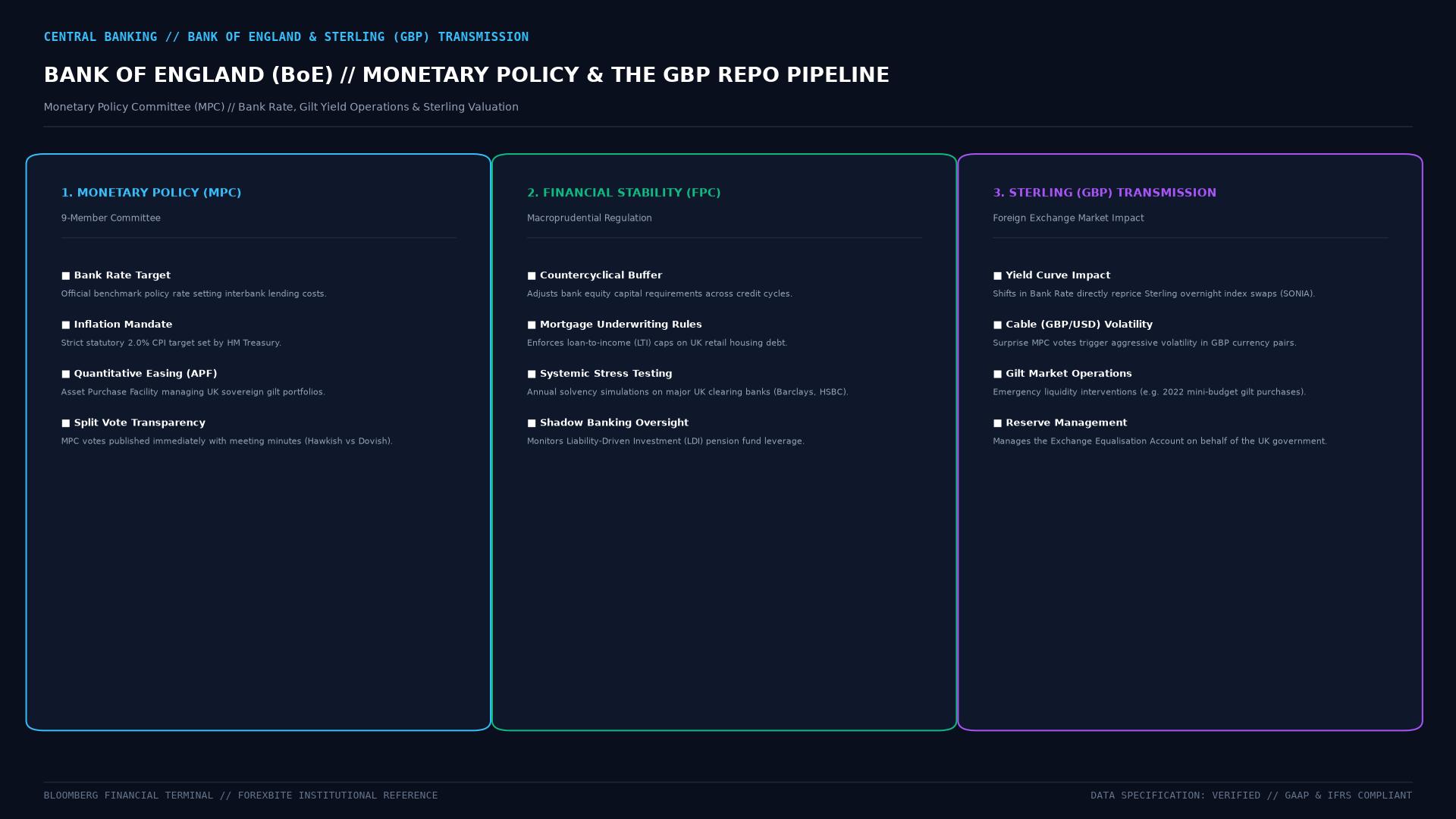 Figure: Governance and policy execution structure of the Bank of England, featuring the Monetary Policy Committee (MPC), Official Bank Rate setting, Asset Purchase Facility operations, and sterling transmission channels.
The Monetary Policy Committee (MPC)
The MPC is the BoE’s rate-setting body. It consists of nine members:
- The Governor of the Bank of England (currently chairs the meeting)
- Three Deputy Governors
- The Chief Economist
- Four external independent members appointed by the Chancellor of the Exchequer
The MPC meets eight times per year (roughly every six weeks). At each meeting, members vote on the Bank Rate. Votes are published alongside the decision — the split (e.g., 6-3 to hold, with 3 members voting for a cut) can be as market-moving as the decision itself, since it signals the committee’s direction of travel.
Key BoE Events on the Forex Calendar
MPC Rate Decision: The headline event. Released at 12:00 PM GMT on decision day. Accompanies a statement and voting record.
Monetary Policy Report (MPR): Published quarterly (February, May, August, November), the MPR contains the BoE’s economic forecasts — growth, inflation, unemployment projections. The inflation fan chart within the MPR is closely analyzed for signals about future rate direction.
Governor’s Press Conference: Follows quarterly MPR publications. The Governor’s language on the rate path often moves markets more than the decision itself.
CPI Release (UK): Monthly UK inflation data (released by the ONS, not the BoE) directly influences MPC expectations. A hot CPI print pushes markets to price in more rate hikes; a cool print increases rate cut probability — both move GBP.
How BoE Decisions Move GBP
The mechanism is the same as all central banks: higher rates attract yield-seeking capital, strengthening the currency; lower rates reduce yield appeal, weakening it.
Rate hike: GBP typically strengthens immediately after a decision to raise rates — particularly if the vote was more unanimous than expected or language was more hawkish than markets had priced. GBP/USD rallies, EUR/GBP falls.
Rate cut: GBP weakens. GBP/USD falls, EUR/GBP rises.
Hold with hawkish language: Often bullish for GBP if markets had been pricing in a cut, and the BoE’s language suggests they’re not in a rush to ease.
Hold with dovish language: Bearish for GBP — the hold is less supportive if the committee signals cuts are coming soon.
The key always: what’s already priced in vs. what the BoE actually delivers. A 25bp hike that was fully expected produces less movement than an unexpected hike.
Post-Brexit BoE Dynamics
Since Brexit (formally completed January 2021), the BoE has operated in a more complex environment:
- UK faces persistent trade frictions not present pre-Brexit, contributing to higher UK-specific inflation
- The BoE’s labor market data must account for the loss of EU workers from the UK economy
- Sterling’s international role reduced slightly, though GBP remains a major reserve currency
These factors mean UK inflation has at times been stickier than Eurozone or US inflation for structural reasons beyond pure demand. This contributed to the BoE’s rate hiking cycle extending longer than the Fed’s or ECB’s on a relative basis.
Key Takeaways
- The Bank of England sets UK monetary policy through its 9-member Monetary Policy Committee
- MPC meets 8 times/year; rate decisions and vote splits are both market-moving
- Primary mandate: 2% CPI inflation target
- Key BoE calendar events: MPC decision (8x/year), Monetary Policy Report (4x/year), Governor’s press conferences
- BoE hawkishness = GBP bullish; dovishness = GBP bearish — always relative to what’s already priced in
FAQ
Why does the vote split matter as much as the decision? The vote split reveals the committee’s direction. A 6-3 hold (3 voting to cut) is very different from a 9-0 hold. The former signals the committee is close to cutting; the latter signals unanimous confidence in holding. Markets price the future rate path, not just today’s decision — so the committee’s internal divergence directly informs those expectations.
How does the BoE differ from the Federal Reserve? The Fed has a dual mandate (price stability + maximum employment). The BoE’s primary mandate is price stability (2% CPI), with employment as a secondary consideration. In practice both track labor market data closely, but the formal mandate difference occasionally produces different policy responses to the same global shock.
Ready to trade forex?
Open a free demo account with a regulated broker. Practice with virtual funds before risking real money.