Stop Price
The specific, predetermined price threshold designated in a stop order that, when touched or breached by market price action, immediately activates the order and converts it into an executable market or limit order.
What Is a Stop Price?
A stop price (often termed a trigger price) is the designated benchmark price specified within a conditional stop order. It functions as an electronic tripwire: while the prevailing market price remains on the inactive side of the stop price, the order remains completely dormant.
The instant market trading activity touches or breaches the stop price, the condition is met, and the order is instantly released into the matching engine as an active market order (in a standard stop order) or an active limit order (in a stop-limit order).
It is vital to recognize that the stop price is not the execution price. Rather, the stop price is merely the activation threshold that authorizes the broker to begin executing the trade. The final filled price depends entirely on the prevailing depth of liquidity available in the order book at the microsecond of triggering.
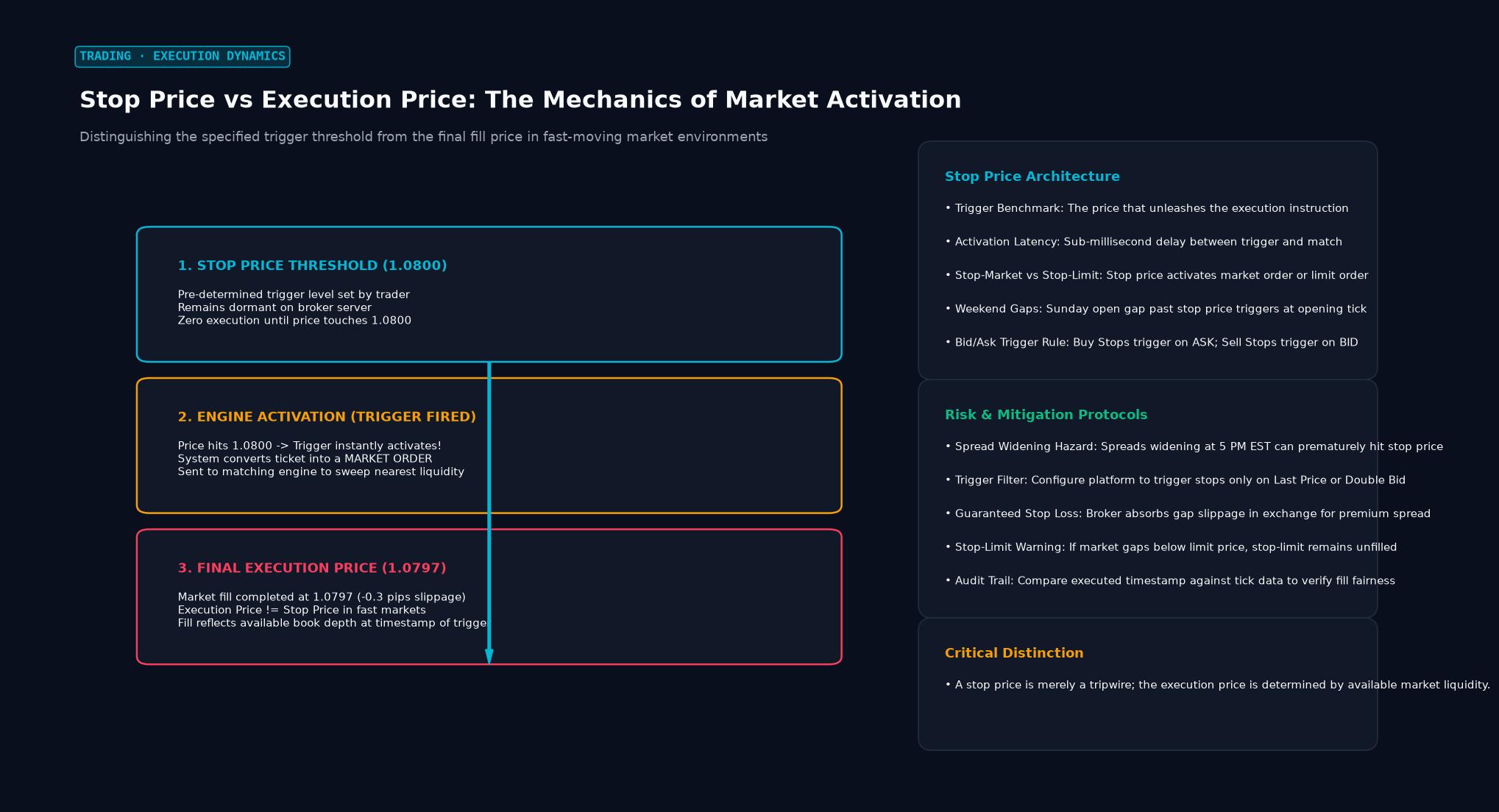 Figure: Distinguishing the specified trigger threshold from the final fill price in fast-moving market environments
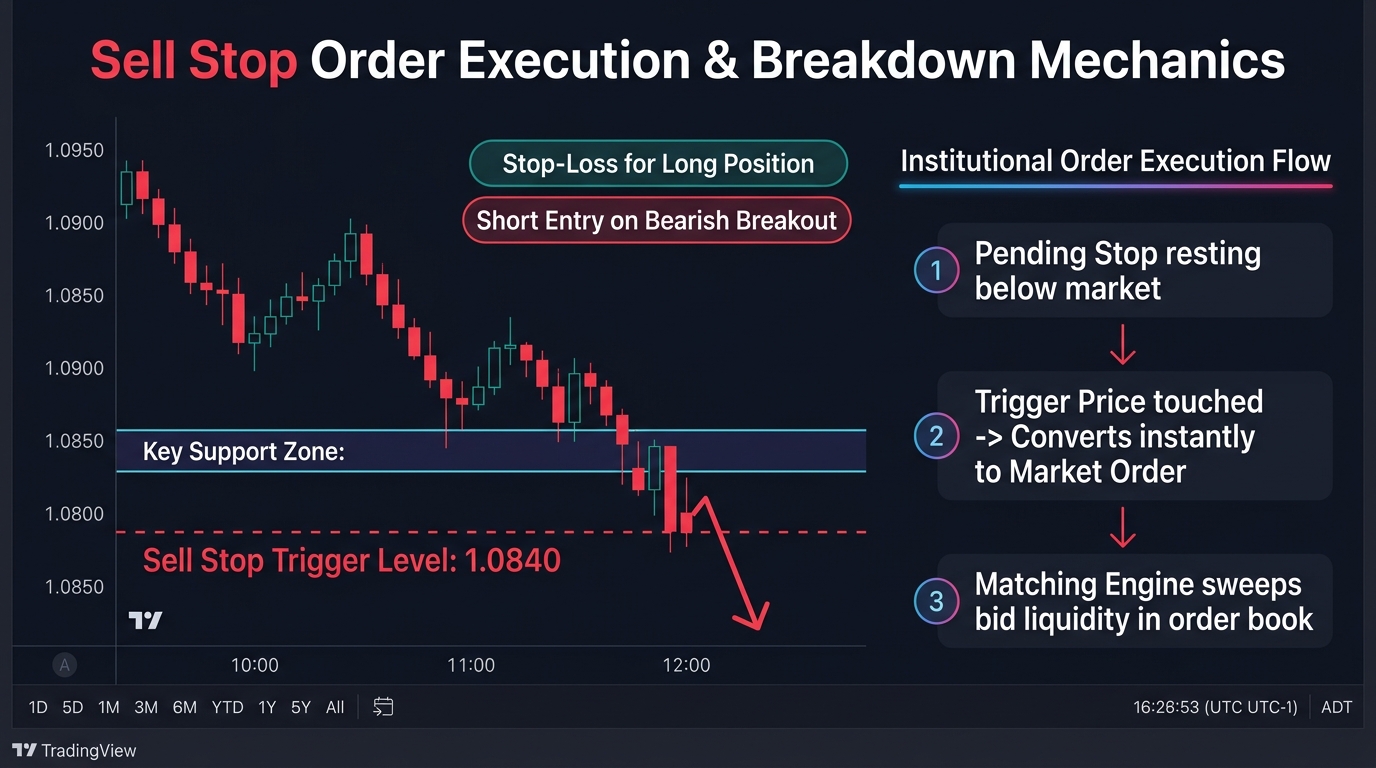
Trigger Protocols: Last Price vs. Bid vs. Ask
How a stop price is triggered depends on the execution rules established by the exchange or retail broker:
1. The Bid / Ask Rule (Standard in Foreign Exchange)
Because foreign exchange trades across a continuous two-way quotation, brokers trigger stop orders based on the specific side of the spread:
- Buy Stop Orders: Triggered exclusively when the market Ask (Offer) price rises to touch the stop price.
- Sell Stop Orders: Triggered exclusively when the market Bid price falls to touch the stop price.
Crucial Retail Insight: A trader with a short position and a buy stop-loss set at 1.0850 can be stopped out even if the candlestick chart (which standardly displays Bid prices) only reaches 1.0848, because a 0.2-pip spread caused the Ask price to touch 1.0850.
2. The Last Traded Price (LTP) Rule (Standard in Equities and Futures)
On centralized public exchanges (such as the NYSE or CME), stop prices are standardly triggered only when a confirmed, cleared transaction officially prints at or beyond the stop price on the consolidated tape.
3. Double-Tick / Double-Print Protection
To protect institutional clients from erroneous execution caused by isolated electronic glitches (“bad ticks”), sophisticated prime brokerages require two consecutive trades or a sustained time threshold (e.g., 50 milliseconds) at the stop price before activating the order.
Stop Price vs. Limit Price vs. Executed Fill Price
| Price Benchmark | Primary Function | Is It Guaranteed? | Who Determines It? |
|---|---|---|---|
| Stop Price | Activation threshold that converts a dormant order into an active order | No (Only guaranteed as a trigger condition) | Specified by the trader upon order entry |
| Limit Price | The absolute worst acceptable execution price on a limit or stop-limit order | Yes (Order will never execute at a worse price) | Specified by the trader upon order entry |
| Executed Fill Price | The actual, final price at which the transaction clears in the market | Yes (Recorded on official trade confirmation) | Determined by available order-book liquidity and slippage |
Quantitative Methodologies for Setting Stop Prices
Professional traders avoid picking arbitrary stop prices based on round numbers or emotional pain thresholds. Instead, they calculate stop prices using systematic, objective models:
1. Volatility-Based Stops (Average True Range)
Anchoring the stop price to market volatility ensures that normal random intraday price fluctuations will not prematurely trigger the order:
$$\text{Long Stop Price} = \text{Entry Price} - (k \times \text{ATR}_{14})$$
$$\text{Short Stop Price} = \text{Entry Price} + (k \times \text{ATR}_{14})$$
Where $k$ is a multiplier (typically $1.5$ to $2.5$). If the 14-day ATR of EUR/USD is 70 pips, a $2.0 \times \text{ATR}$ stop price is set 140 pips away from entry.
2. Market Structure Anchor (Swing Highs and Lows)
Under classical technical analysis, a trend is invalidated only when price breaks the prevailing structural swing point:
- For a Long Trade, the stop price is placed 1 to 2 pips below the most recent higher low.
- For a Short Trade, the stop price is placed 1 to 2 pips above the most recent lower high.
                   MARKET STRUCTURE STOP PRICE ANCHOR

 Price ($)
   │                           /\  (New Swing High)
   │              /\          /  \
   │             /  \        /    \
   │            /    \      /
   │           /      \    /
102┼─ ─ ─ ─ ─ ─ ─ ─ ─ ─\/─ ─ ─ ─ ─ ─ ─ ─ ─ ─ ─ ─ ─ ─ ─ ─ ─ ─ ─ ─ ─ ─ ─ ─ ─ ─
   │                   * [ Confirmed Higher Low Swing Pivot ]
101┼─ ─ ─ ─ ─ ─ ─ ─ ─ ─ ─ ─ ─ ─ ─ ─ ─ ─ ─ ─ ─ ─ ─ ─ ─ ─ ─ ─ ─ ─ ─ ─ ─ ─ ─ ─
   │                   ▲ [ OPTIMAL STOP PRICE PLACEMENT: $101.80 ]
   │                     (Placed safely below the structural invalidation point)
   └────────────────────────────────────────────────────────────────────────► Time
Real-World Institutional Case Study: Stop-Hunting Algorithms and Liquidity Sweeps
In modern electronic markets, high-frequency trading (HFT) algorithms and institutional prop desks actively exploit predictable stop price placement:
       LIQUIDITY SWEEP INTO CLUSTERED STOP PRICES

 1. Retail Clustering:
    - Retail traders buy EUR/USD at 1.0820, clustering stop prices precisely at
      the major round psychological support level of 1.0800.

 2. The Algorithmic Drive:
    - Institutional algorithms drive prices downward into 1.0798, deliberately
      triggering the stop prices of thousands of retail longs.

 3. The Liquidity Capture:
    - As retail stops trigger, they generate a wave of MARKET SELL ORDERS.
    - Institutional desks use this sudden flood of sell liquidity to fill massive
      institutional BUY orders at a discount.

 4. The V-Reversal:
    - Having absorbed all available liquidity, the institutional buying drives
      EUR/USD sharply back to 1.0850, leaving stopped-out retail traders behind.
Professional institutional execution protocols account for this behavior by placing stop prices outside standard retail clusters, utilizing synthetic hidden stops, or relying on algorithmic TWAP executions.
Frequently Asked Questions
Can I modify the stop price of an active order?
Yes. As long as the stop order has not yet been triggered and filled, you can adjust the stop price at any time through your trading platform. This flexibility is commonly used when trailing a stop-loss forward to lock in accumulated profits as the market moves favorably.
Why did my stop order trigger when the price chart never showed that price?
In retail trading software, candlestick charts almost universally display only the Bid price. If you hold an open short position, your stop-loss is a Buy Stop, which triggers on the Ask price. During volatile events or session rollovers, the bid-ask spread can widen significantly; if the Ask spikes upward to touch your stop price, your order triggers even though the Bid chart never reached that level.
What is the difference between a Stop Price and a Limit Price?
A stop price acts strictly as an activation trigger placed at a price worse than the current market, converting the order into an aggressive market order when touched. A limit price acts as a price boundary placed at a price better than the current market, guaranteeing that the order will execute only at the limit price or better.
Ready to trade forex?
Open a free demo account with a regulated broker. Practice with virtual funds before risking real money.