Swaption
An over-the-counter derivative contract granting the buyer the right, but not the obligation, to enter into an underlying interest rate swap with the seller at a specified fixed rate and future expiration date.
What Is a Swaption?
A swaption (a portmanteau of “swap option”) is an over-the-counter (OTC) financial derivative that gives the purchaser the option—without the legal obligation—to enter into an underlying interest rate swap (IRS) with the counterparty on or before a specified maturity date at a predetermined rate (the strike rate).
In modern wholesale finance, swaptions represent one of the largest and most liquid sectors of the global fixed-income derivatives market. They allow corporate treasuries, commercial banks, pension funds, and mortgage aggregators to establish non-linear protection against interest rate volatility, effectively serving as an insurance policy on future borrowing costs or investment yields.
Swaptions are structured across two primary directional types:
- Payer Swaption: Grants the holder the right to pay a fixed interest rate and receive a floating benchmark rate (such as SOFR or EURIBOR). It functions analogously to a protective put on bond prices, providing a hedge against surging interest rates.
- Receiver Swaption: Grants the holder the right to receive a fixed interest rate and pay a floating benchmark rate. It functions analogously to a call on bond prices, providing a hedge against declining interest rates.
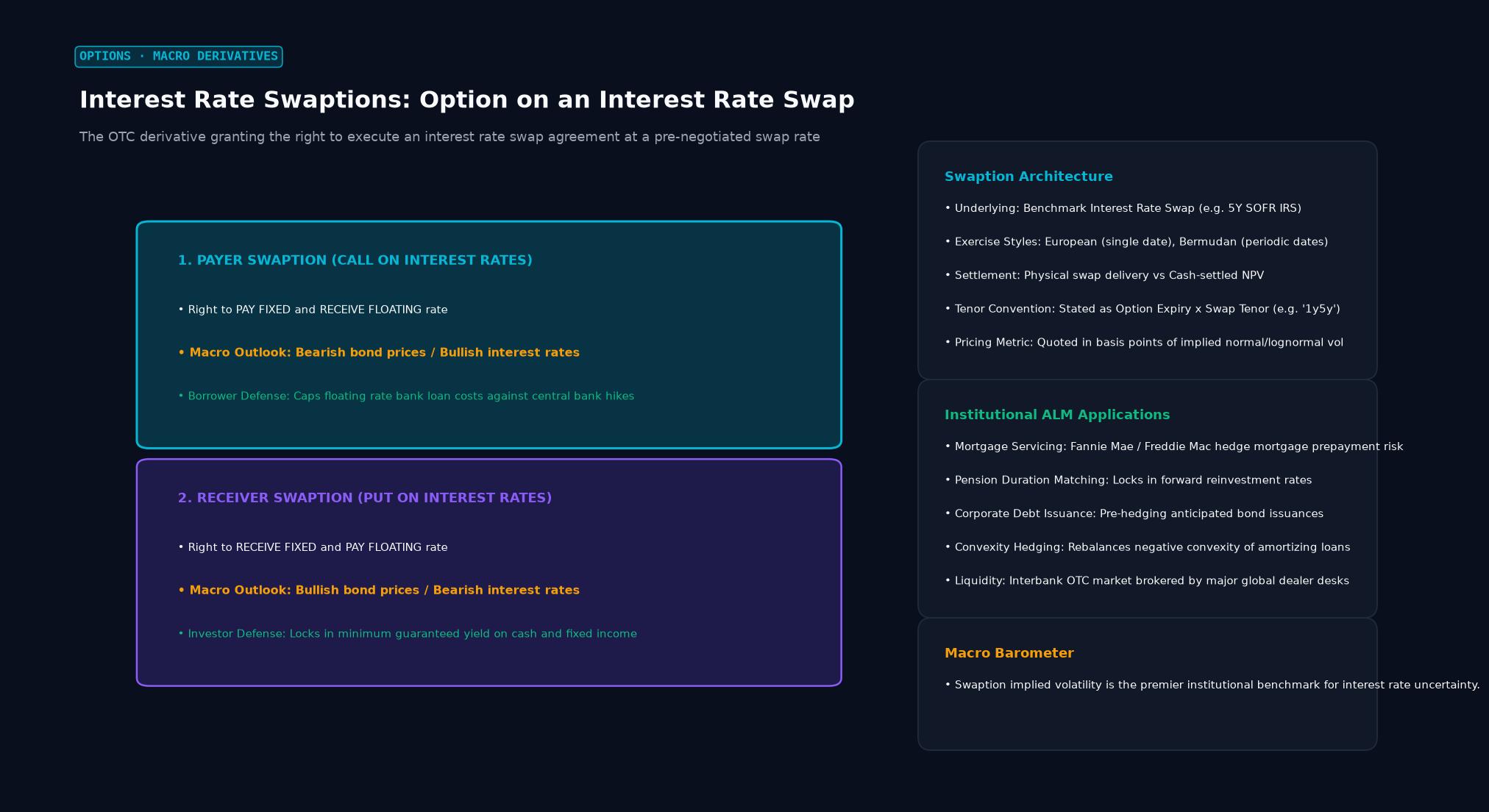 Figure: The OTC derivative granting the right to execute an interest rate swap agreement at a pre-negotiated swap rate
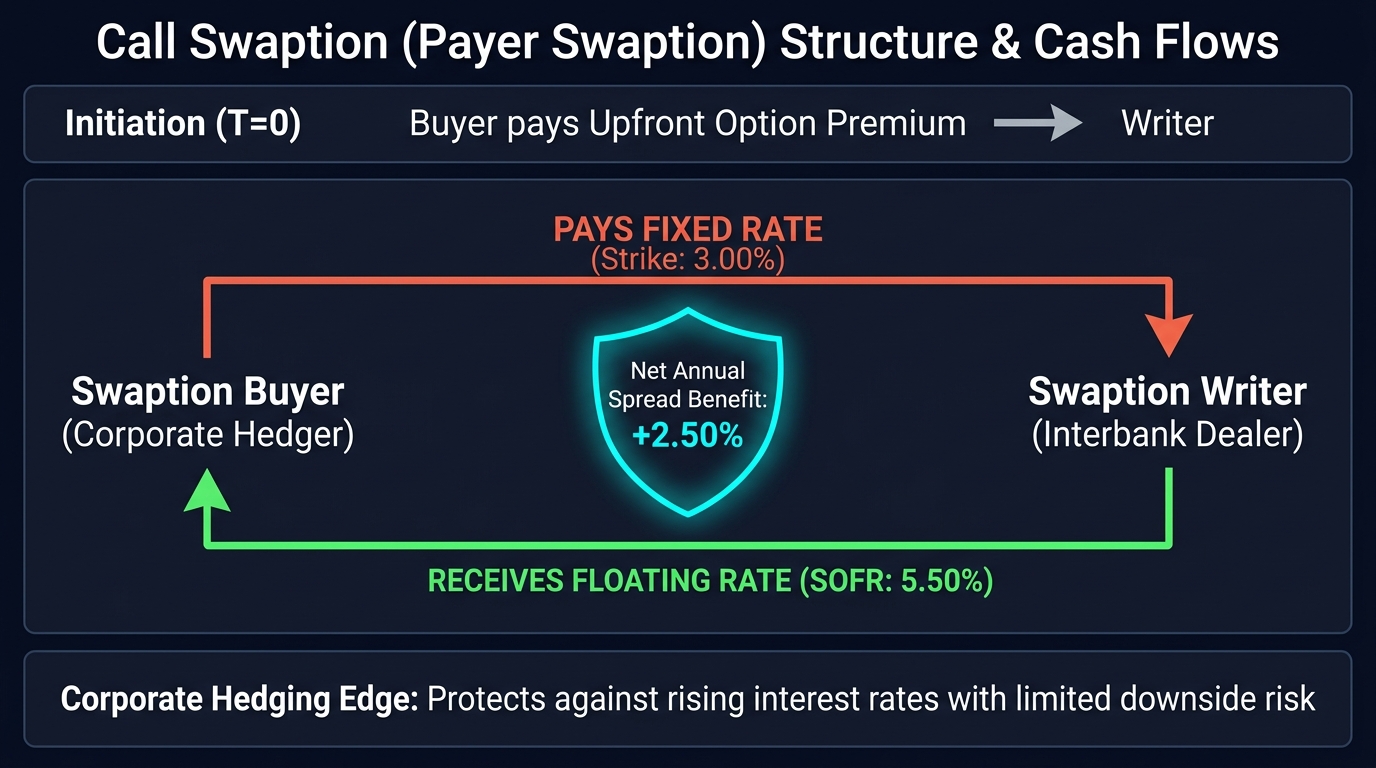
Exercise Styles: European, Bermudan, and American
Swaptions are traded under three distinct legal exercise conventions:
| Exercise Style | Operational Rule | Market Prevalence | Primary Application |
|---|---|---|---|
| European Swaption | Exercisable only on the single maturity date of the option | High (Standard OTC interbank benchmark) | Pure interest rate volatility trading, macro directional hedging |
| Bermudan Swaption | Exercisable on specific scheduled dates (e.g., quarterly or semi-annually) | Extremely High in institutional structured debt | Callable corporate bonds, mortgage servicing rights (MSR) hedging |
| American Swaption | Exercisable on any business day prior to final expiration | Rare (High valuation complexity and premium cost) | Bespoke specialized corporate debt structures |
Quantitative Valuation: The Black-76 Model for Swaptions
In wholesale interbank markets, European swaptions are mathematically valued using the Black-76 model (an extension of the Black-Scholes formula for forward contracts):
$$\text{Payer Swaption Price} = A \cdot \left[ F \cdot \Phi(d_1) - K \cdot \Phi(d_2) \right]$$
$$\text{Receiver Swaption Price} = A \cdot \left[ K \cdot \Phi(-d_2) - F \cdot \Phi(-d_1) \right]$$
Where:
- $F$: The forward swap rate.
- $K$: The strike swap rate agreed upon in the contract.
- $\Phi(\cdot)$: The standard normal cumulative distribution function.
- $d_1 = \frac{\ln(F/K) + \frac{1}{2}\sigma^2 T}{\sigma \sqrt{T}} \quad \text{and} \quad d_2 = d_1 - \sigma \sqrt{T}$.
- $\sigma$: Swaption implied volatility (derived from the interbank “Swaption Volatility Cube”).
- $A$ (Annuity Factor / PV01): The present value of a one-basis-point cash flow across the underlying swap payments:
$$A = \sum_{i=1}^{n} P(0, T_i) \cdot \tau_i$$
Where $P(0, T_i)$ is the risk-free discount factor for payment date $T_i$, and $\tau_i$ is the year fraction.
Swaption vs. Interest Rate Swap vs. Interest Rate Cap
| Financial Instrument | Obligation vs. Right | Upfront Premium | Payoff Profile | Market Role |
|---|---|---|---|---|
| Swaption | Right, not obligation to enter a multi-year swap | Yes (Option premium paid upfront) | Asymmetric / Non-linear (Loss capped at premium) | Strategic insurance against future rate shifts |
| Interest Rate Swap | Mandatory obligation to exchange cash flows | Zero upfront cost (Priced at par) | Symmetrical / Linear (Unlimited risk on both sides) | Immediate transformation of fixed/floating liability |
| Interest Rate Cap | Series of European call options on single rate fixings (caplets) | Yes (Premium paid upfront) | Asymmetric periodic payouts on each fixing date | Capping floating borrowing rates directly |
Real-World Institutional Case Study: Callable Corporate Bonds and Bermudan Swaptions
Multinational corporations regularly deploy swaptions to dramatically lower their corporate debt financing costs:
       SYNTHETIC CALLABLE BOND HEDGING FLOW

 1. Bond Issuance:
    - Corporation issues a 10-year, 5.00% fixed-rate bond with a call provision
      allowing the company to redeem the bond after 5 years (Callable Bond).

 2. Embedded Optionality:
    - By granting itself the call right, the company implicitly OWNS an option
      to refinance debt if market interest rates collapse.

 3. Monetizing the Option via Swaption:
    - The corporate treasury SELLS a 5-year Bermudan Receiver Swaption to an
      investment bank at a 5.00% strike rate.
    - The corporation collects a massive upfront cash premium from the bank.

 4. Resolution:
    - The upfront swaption premium reduces the company's effective borrowing
      cost from 5.00% down to 4.15% over the first five years.
    - If interest rates collapse, the bank exercises the swaption, and the corporation
      simultaneously calls the bond, resulting in a perfectly hedged refinancing.
The Swaption Volatility Surface (The “Cube”)
Unlike equities—where implied volatility is mapped across a two-dimensional grid of strike and expiration—swaptions operate in three mathematical dimensions, collectively termed the Swaption Cube:
- Option Expiry (Tenor of the Option): Time until the swaption must be exercised (e.g., 1 month, 1 year, 5 years).
- Swap Tenor (Duration of Underlying Swap): Length of the underlying interest rate swap (e.g., 2 years, 10 years, 30 years).
- Moneyness (Strike relative to Forward Swap Rate): In-the-money, at-the-money, or out-of-the-money offsets (quoted in basis points).
Tier-1 interbank dealers continuously quote volatility across this matrix (e.g., a “1Y into 10Y” swaption represents a 1-year option to enter a 10-year swap).
Frequently Asked Questions
What happens when an in-the-money swaption expires?
Upon expiration, an in-the-money swaption can be settled in one of two ways specified at contract inception:
- Physical Delivery: Counterparties legally enter into the live multi-year interest rate swap at the pre-agreed strike rate.
- Cash Settlement: The swaption writer pays the holder an immediate lump-sum cash amount equal to the market present value (PV) of the swap’s future expected cash flows, extinguishing the contract without entering a multi-year commitment.
Why do mortgage-backed securities (MBS) servicers trade swaptions?
Homeowners hold the legal right to prepay their mortgages early when interest rates drop (refinancing). This creates negative convexity for mortgage investors: when interest rates plunge, homeowners refinance, and bondholders are paid back early just when reinvestment yields are terrible. MBS portfolio managers buy receiver swaptions to offset this negative convexity.
Who are the primary market makers in swaptions?
Swaptions are dominated by global tier-1 investment banks (such as JPMorgan Chase, Goldman Sachs, Citi, Deutsche Bank, and Barclays). These institutions maintain dedicated swaption trading desks that act as market makers, quoting continuous two-way prices to institutional clients and managing portfolio risk across global yield curves.
Ready to trade forex?
Open a free demo account with a regulated broker. Practice with virtual funds before risking real money.