Take the Offer
A standard interbank dealing command and market microstructure action whereby a buyer accepts the seller's quoted asking price, immediately executing a market buy order at the prevailing offer rate.
What Does “Take the Offer” Mean?
In financial market trading and interbank dealing rooms, “take the offer” (synonymous with “lifting the offer” or typing “MINE” on institutional dealing terminals) is an explicit instruction to buy an asset immediately at the seller’s current asking price.
Every two-way market quote consists of a Bid (the price at which dealers are willing to buy) and an Offer / Ask (the price at which dealers are willing to sell). When a trader decides not to wait passively in the order book with a limit order and instead demands immediate execution, they “take the offer.”
In modern electronic market microstructure, taking the offer categorizes the trader as an aggressor (liquidity taker). The transaction consumes resting sell liquidity from the top of the central limit order book, crossing the bid-ask spread and finalizing the trade instantaneously.
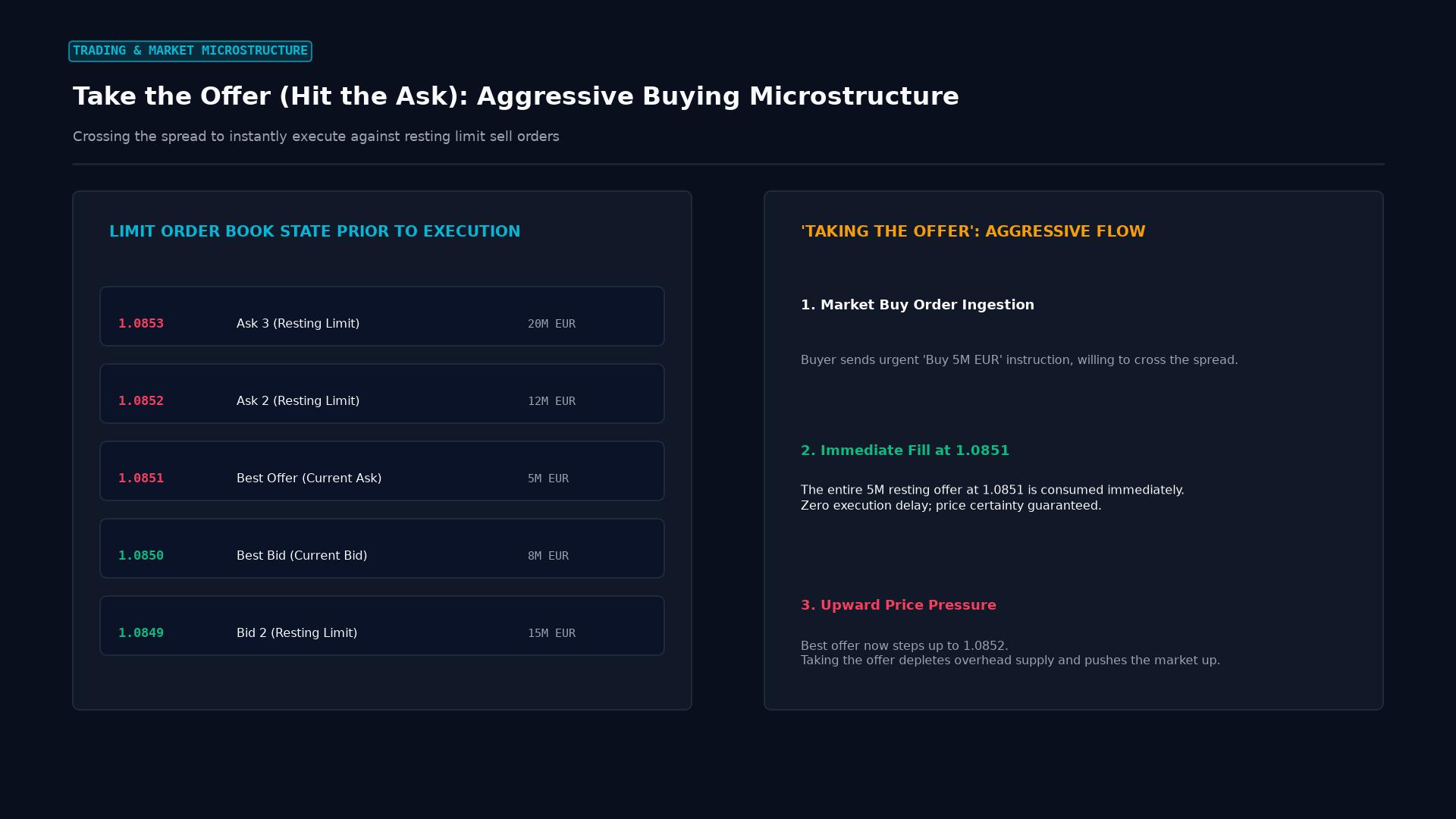 Figure: Aggressive order book execution: buyer crossing the spread to consume resting limit offers, removing liquidity and driving price upward.
Market Microstructure: Maker vs. Taker Dynamics
Taking the offer fundamentally alters the economic cost of trade execution compared to passive limit quoting:
| Execution Action | Structural Role | Fee Structure | Execution Speed | Price Certainty |
|---|---|---|---|---|
| “Take the Offer” (Market Buy) | Liquidity Taker (Aggressor) | Pays standard taker fee or crosses the retail spread | Instantaneous (Microseconds) | High fill certainty, but vulnerable to book sweeping |
| “Place a Limit Bid” (Passive Buy) | Liquidity Maker (Provider) | Receives exchange fee rebate or pays lower commission | Delayed (Must wait for seller to hit bid) | Guaranteed limit price, but risks never being filled |
When an institutional algorithm or large trader takes the offer, it pays a liquidity premium: it voluntarily surrenders the bid-ask spread to obtain absolute execution certainty and immediate settlement priority.
Sweeping the Order Book: What Happens When Volume Exceeds the Offer
In high-volume institutional trading, taking the offer is rarely as simple as buying at a single price. If the buyer’s order volume exceeds the liquidity available at the top-of-book (Level 1) offer, the order sweeps through multiple price tiers:
                      DEPTH OF MARKET (DOM) OFFER SWEEP

 Order Request: Institutional Buy Market Order for 100,000,000 EUR
 ─────────────────────────────────────────────────────────────────────────────
 Offer Book Level 1:   €30,000,000 available @ 1.08520  ──► Filled (€30M)
 Offer Book Level 2:   €40,000,000 available @ 1.08525  ──► Filled (€40M)
 Offer Book Level 3:   €30,000,000 available @ 1.08530  ──► Filled (€30M)
 ─────────────────────────────────────────────────────────────────────────────
 Outcome: Full €100,000,000 filled in 12 milliseconds.
          Volume-Weighted Average Price (VWAP): 1.08525 (0.5 pip slippage incurred).
In institutional trade tickets, taking the offer for large blocks is executed using Smart Order Routers (SOR) or algorithmic slicing (TWAP / VWAP) to avoid sweeping thin offer tiers and driving execution prices artificially higher.
Real-World Institutional Case Study: Voice Broking and the Reuters Dealing Era
Before modern point-and-click graphical interfaces and automated ECN matching engines dominated foreign exchange, interbank transactions were negotiated verbally or via green-screen teleprinters on the Reuters Dealing 2000-1 system:
       HISTORICAL REUTERS DEALING TRANSCRIPT (EARLY 1990S)

 Citibank Desk:       "SPOT EUR/USD 50 PLS"   (Requesting two-way quote for $50M)
 Deutsche Bank Desk:  "50-52"                 (Quoting Bid 1.0850 / Offer 1.0852)
 Citibank Desk:       "MINE 50"               (TRADER TAKES THE OFFER: Buys $50M @ 1.0852)
Deutsche Bank Desk: "OK CONFIRMED TO CITI" (Trade locked; clearing instructions routed)- The Jargon: On voice trading desks and Reuters terminals, shouting or typing “MINE” was the binding legal equivalent of taking the offer. Conversely, shouting or typing “YOURS” signaled that the trader hit the bid (sold to the quoter).
- The Transition: Today, this entire verbal negotiation occurs within sub-millisecond algorithmic execution loops on platforms like EBS, Refinitiv Matching, and Currenex, where clicking “Buy” at market executes the exact historical action of taking the offer.
Strategic Implications: When Should a Trader Take the Offer?
Professional traders follow disciplined execution rules regarding when to cross the spread and take the offer versus when to wait with a limit order:
- High-Urgency Breakout Trading: When price bursts through multi-month resistance on surging volume, waiting with a passive limit order often results in being left behind as the market runs vertically. In high-momentum conditions, taking the offer ensures participation.
- Exiting Trapped Positions: When an adverse fundamental event strikes (e.g., an unexpected central bank interest rate hike), waiting for buyers to hit your limit order is dangerous. Taking the available liquidity immediately caps further catastrophic drawdown.
- Avoid During Wide Spread Windows: During illiquid session transitions (such as 5:00 PM EST New York close), bid-ask spreads widen significantly. Taking the offer during these hours incurs an excessive liquidity penalty.
Frequently Asked Questions
What is the exact opposite of “Take the Offer”?
The exact opposite market action is “Hit the Bid” (traditionally signaled on dealing desks by the command “YOURS”). Hitting the bid means accepting the buyer’s posted purchase price, executing an immediate aggressive market sell order.
Does taking the offer always result in execution at the quoted price?
In normal liquid market conditions with standard retail order sizes, yes. However, during high-volatility events (such as economic data releases) or when executing large institutional blocks that exceed Level 1 depth, taking the offer can result in negative slippage as the order sweeps upward through multiple ascending offer tiers.
Why do some algorithmic trading firms never take the offer?
High-frequency market-making firms (such as Citadel Securities or Virtu Financial) survive primarily by providing liquidity, not taking it. They profit by capturing the bid-ask spread and earning maker fee rebates from exchanges. Consistently taking the offer would force them to pay the spread, undermining their statistical business model.
Ready to trade forex?
Open a free demo account with a regulated broker. Practice with virtual funds before risking real money.