Hit the Bid
To hit the bid is a trading action where an aggressive market participant executes an immediate sell order matching against the highest active buy price (the bid) currently resting on the order book, crossing the spread to achieve immediate execution.
What Does It Mean to “Hit the Bid”?
In financial trading and order book mechanics, hitting the bid describes the action of an aggressive seller who chooses not to wait passively with a limit order, but instead immediately sells at the highest price a prospective buyer is currently offering. By clicking “Sell at Market” or submitting an aggressive sell instruction, the trader “crosses the spread” and consumes resting liquidity from the top of the order book.
The counterpart action on the buy side is “lifting the offer” (or taking the ask), where an aggressive buyer executes a market purchase at the seller’s asking price. Together, aggressive sellers hitting the bid and aggressive buyers lifting the offer drive all active price discovery and tick movement across modern electronic currency exchanges and ECN matching engines.
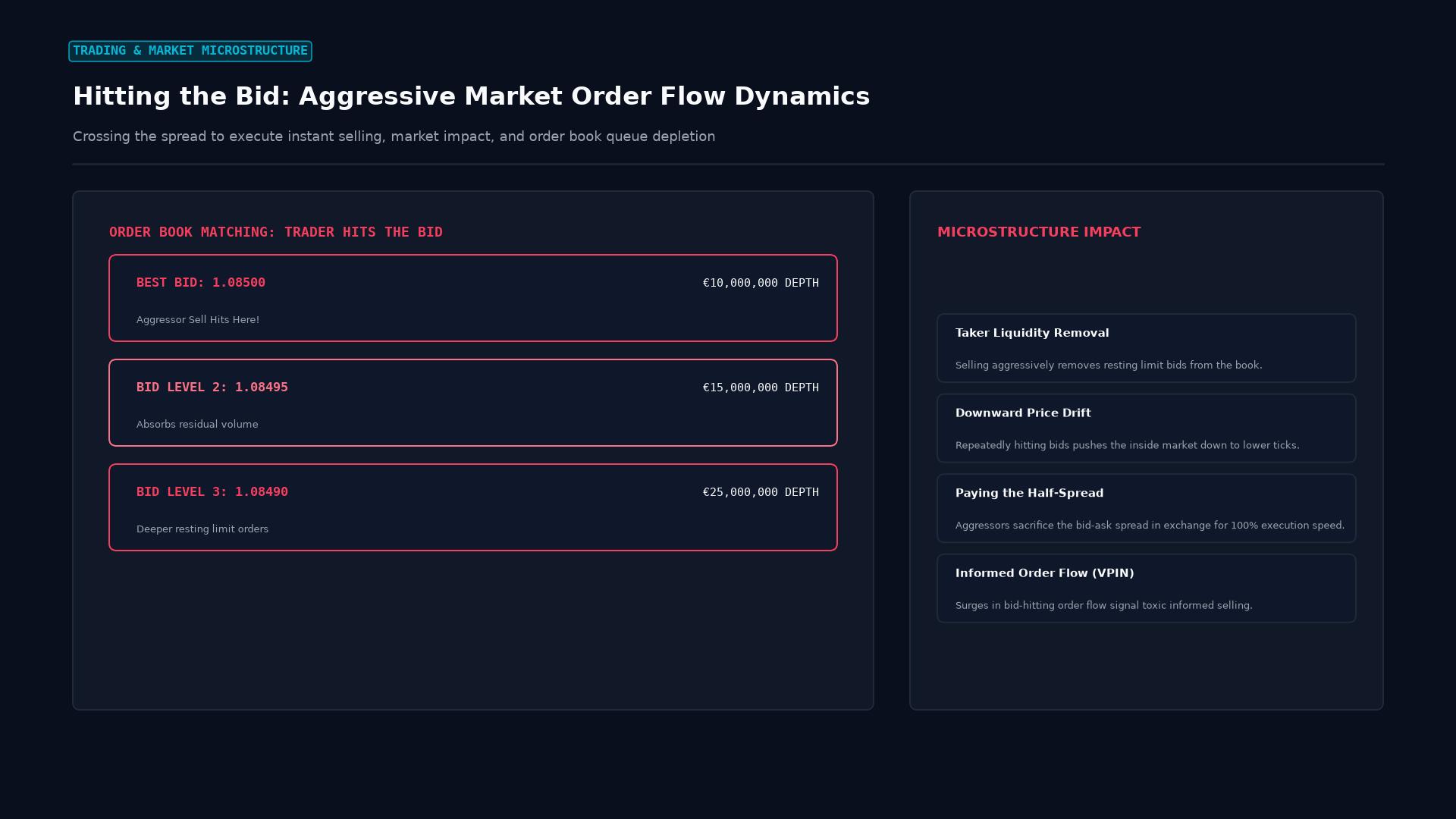 Figure: Order book microstructure: aggressive market sell orders crossing the spread to execute immediately against the best resting buyer bid, driving downward price discovery.
Key Takeaways
- Aggressive Execution: Hitting the bid represents an urgent desire to sell immediately; the trader prioritizes guaranteed execution speed over capturing the bid-ask spread.
- Liquidity Consumer (Taker): When you hit the bid, you consume passive liquidity provided by resting limit buyers, categorizing you as a market taker (which often incurs taker fees on ECNs).
- Market Microstructure Impact: If aggressive sellers repeatedly hit the bid with high volume, they completely exhaust all resting buy orders at that price level, forcing the market to tick downward to the next bid tier.
- Footprint & Order Flow Tracking: Modern order flow software tracks the volume of contracts that hit the bid versus lift the offer, displaying this data on Volume Footprint charts to quantify institutional selling aggression.
Order Book Actions Compared
| Trader Action | Order Type Deployed | Order Book Side Touched | Liquidity Role | Market Impact |
|---|---|---|---|---|
| Hit the Bid | Market Sell | Matches against the Best Bid | Liquidity Taker | Drives price downward if bid depth is exhausted |
| Lift the Offer (Take the Ask) | Market Buy | Matches against the Best Ask | Liquidity Taker | Drives price upward if ask depth is exhausted |
| Post a Bid | Buy Limit | Adds to resting Bid Queue | Liquidity Maker | Deepens support; cushions market against drops |
| Post an Offer | Sell Limit | Adds to resting Ask Queue | Liquidity Maker | Deepens resistance; caps upward rallies |
Order Flow Analysis: Cumulative Volume Delta (CVD)
Quantitative and footprint traders analyze transactions at the bid and ask to detect institutional accumulation or distribution:
$$\text{Delta} = \text{Volume Lifted at Ask (Aggressive Buyers)} - \text{Volume Hit at Bid (Aggressive Sellers)}$$
- Negative Delta (-Delta): Indicates that market participants are predominantly hitting the bid with aggressive sell orders, signaling strong downward momentum.
- Delta Absorption (Bullish Signal): If heavy volume repeatedly hits the bid (e.g., -5,000 lots), but the price refuses to tick down, an institutional participant is passively absorbing all selling pressure with iceberg buy orders. This absorption frequently precedes an explosive upward reversal.
When Do Traders Hit the Bid?
- Urgent Panic Liquidation: When a black-swan headline hits the terminal, traders do not place limit orders hoping someone will buy from them at a higher price; they immediately hit the bid to exit all risk exposure at market.
- Breakout Execution: When an exchange rate decisively breaks down through a multi-week support level, momentum traders hit the bid to initiate fresh short positions, anticipating that cascading stop-loss orders will accelerate the downward move.
- Stop-Loss Triggers: When a long trader’s stop-loss order is triggered, the platform automatically converts it into a market sell order that instantly hits the highest available bid.
Frequently Asked Questions
Does hitting the bid guarantee my requested price?
No. Hitting the bid guarantees that your order will execute immediately against the best available bid, but if your order size exceeds the available liquidity at that bid tier, your order will sweep through lower bids, filling at a lower average price (negative slippage).
What is the difference between a “Maker” and a “Taker” fee?
On institutional ECNs and cryptocurrency exchanges, liquidity makers (who post resting limit orders) receive rebates or lower commission fees for adding depth to the book. Liquidity takers (who hit the bid or take the offer) pay higher commissions because they remove liquidity from the exchange.
What is an “Offer” in foreign exchange?
In foreign exchange terminology, the Offer (synonymous with the Ask) is the price at which a market maker or dealer is willing to sell a currency pair. The Bid is the price at which the dealer is willing to buy it from you.
Ready to trade forex?
Open a free demo account with a regulated broker. Practice with virtual funds before risking real money.