Target Costing
Target costing is a product pricing and cost management methodology where allowable production cost is derived by subtracting a desired profit margin from a competitive market-determined selling price.
What is Target Costing?
Target costing is a customer-oriented, market-driven cost management framework utilized during the product design and development phase.
Unlike traditional Western “cost-plus” accounting, where an enterprise designs a product, calculates the total manufacturing expenses, and adds an arbitrary profit markup to arrive at the selling price, target costing reverses the equation:
$$\text{Competitive Market Selling Price} - \text{Required Target Profit Margin} = \text{Allowable Target Cost}$$
Under this discipline, the market selling price is treated as an uncompromisable external reality dictated by customer willingness to pay and competitive substitutes. The corporate profit margin is mandated by executive leadership to satisfy institutional shareholder return-on-capital hurdles.
Consequently, the target cost becomes a strict design constraint. Cross-functional teams of engineers, procurement specialists, and cost accountants must design the product to meet that exact cost ceiling before any capital is committed to tooling, factories, or assembly lines.
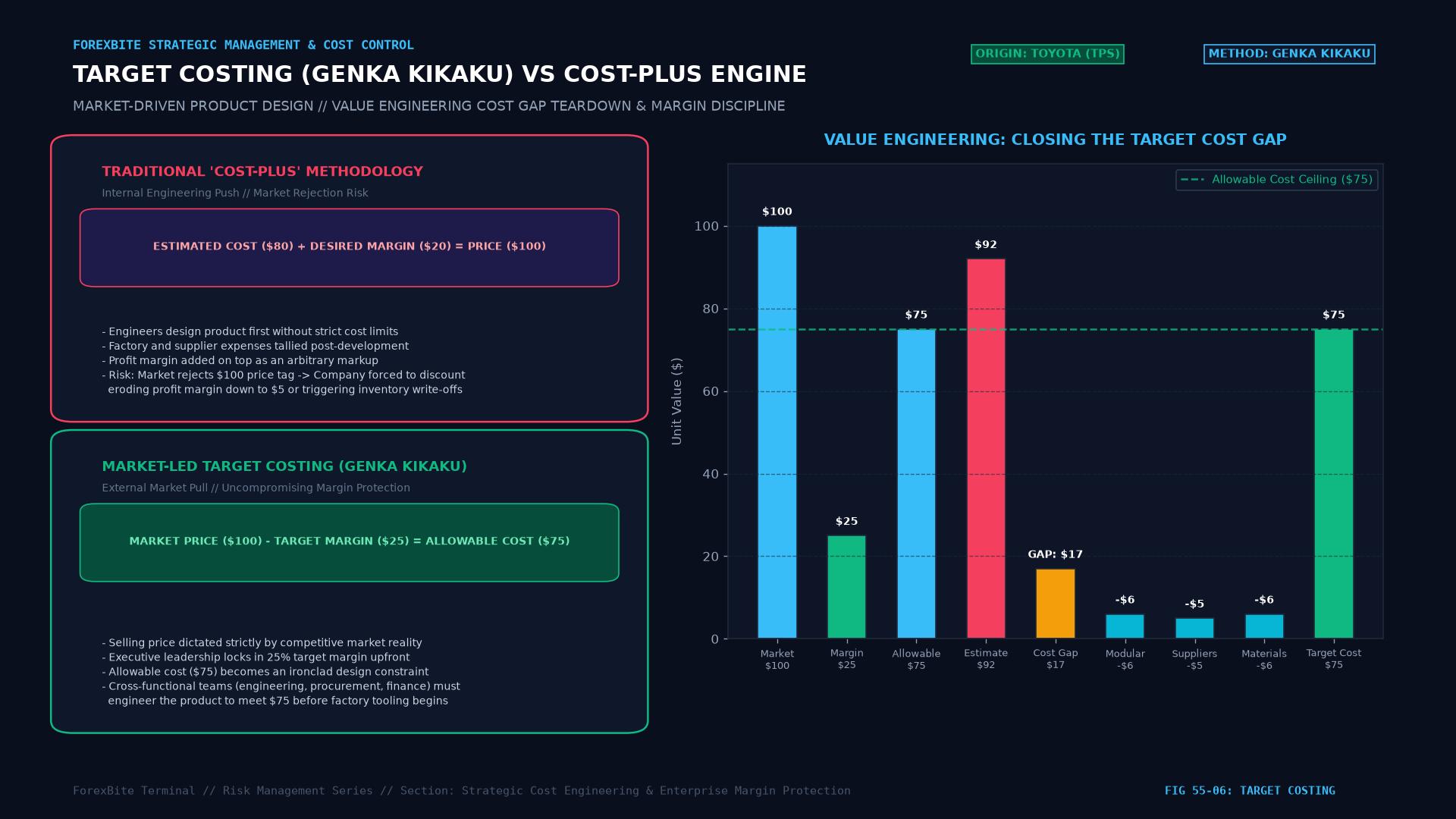 Figure: Market-driven target costing (Genka Kikaku) paradigm compared to traditional cost-plus accounting, showing value engineering cost gap closure.
Historical Origins: The Japanese “Genka Kikaku” Revolution
Target costing originated in post-World War II Japan, where it is known as Genka Kikaku (cost planning).
1960s: Toyota Production System (TPS)
Taiichi Ohno and Eiji Toyoda pioneer Genka Kikaku;
Shift from post-production cost tracking to design-phase cost planning
                      │
                      ▼
1970s: Global Oil Shocks & Japanese Auto Dominance
Toyota, Nissan, and Honda conquer Western automotive markets by delivering
higher quality, fuel-efficient vehicles at lower price points
                      │
                      ▼
1980s-1990s: Electronics & Global Industry Adoption
Sony, Olympus, Canon, and Komatsu systematize Target Costing;
Western academic literature (CAM-I) formalizes methodology
                      │
                      ▼
2000s-Present: Digital Tech & Hardware Modernization
Applied across global aerospace, consumer electronics,
medical devices, and cloud computing infrastructure
The Toyota Breakthrough
In the 1960s, Toyota Motor Corporation recognized a core limitation of Western industrial accounting: by the time a newly designed automobile entered physical assembly on the factory floor, corporate management had lost control over product costs.
Empirical studies demonstrated that 70% to 80% of a manufactured product’s total lifetime cost is permanently locked in during the concept, design, and engineering phase.
- Decisions regarding material selection (aluminum versus high-strength steel), component complexity, assembly geometry, and parts standardization determine the cost structure.
- Attempting to reduce costs after production tooling is ordered yields modest savings.
- By introducing target costing, Toyota forced engineers to design vehicles to a pre-set cost target from day one, laying the foundation for modern lean manufacturing.
The 5-Stage Target Costing Lifecycle Process
Implementing target costing follows an iterative, five-stage cycle managed by cross-functional teams:
               +-------------------------------------------------+
               |        1. DETERMINE TARGET SELLING PRICE        |
               |  - Competitive teardown analysis                |
               |  - Customer willingness-to-pay (Conjoint study) |
               +-------------------------------------------------+
                                        │
                                        ▼
               +-------------------------------------------------+
               |       2. ESTABLISH REQUIRED PROFIT MARGIN       |
               |  - Corporate Return on Capital Employed (ROCE)  |
               |  - Long-term strategic business unit hurdles    |
               +-------------------------------------------------+
                                        │
                                        ▼
               +-------------------------------------------------+
               |        3. CALCULATE ALLOWABLE TARGET COST       |
               |        Target Cost = Target Price - Target Margin|
               +-------------------------------------------------+
                                        │
                                        ▼
               +-------------------------------------------------+
               |          4. ESTIMATE "AS-IS" DRIFTING COST      |
               |  - Calculate projected cost based on current    |
               |    technologies and standard supplier quotes    |
               +-------------------------------------------------+
                                        │
                                        ▼
               +-------------------------------------------------+
               |   5. CLOSE THE COST GAP VIA VALUE ENGINEERING   |
               |  - Component teardowns & parts standardization  |
               |  - Supply chain collaboration & waste elimination|
               +-------------------------------------------------+
                                        │
                                        ▼
                         Does Projected Cost ≤ Target Cost?
                           ├── YES ──► Release to Production Tooling
                           └── NO  ──► Re-Engineer or Cancel Project
Stage 1: Determine the Target Selling Price
The enterprise does not set the selling price based on internal financial desires. Instead, marketing and pricing teams conduct market research:
- Conjoint Analysis: Measures customer willingness to pay for specific features (e.g., battery life versus screen resolution).
- Competitor Teardown Analysis: Disassembles competing market products to analyze their functionality, component count, and estimated bill of materials (BOM).
- The target price reflects what customers will pay for the product throughout its expected market life cycle.
Stage 2: Establish the Required Target Profit Margin
The corporate finance team mandates the required profit margin based on:
- Long-term strategic return on sales (ROS) targets.
- The company’s Weighted Average Cost of Capital (WACC) and Return on Capital Employed (ROCE) hurdles required by institutional equity investors.
- For example, if executive leadership requires an operating margin of 20% on all new product lines, the target profit margin is fixed at 20%.
Stage 3: Calculate the Allowable Target Cost
Subtracting the target profit margin from the target price yields the allowable cost:
$$\text{Target Cost} = \text{Target Price} \times (1 - \text{Target Margin Percentage})$$
Applied Numerical Example:
- Projected Competitive Retail Price: $$500.00$
- Mandated Operating Profit Margin: $25%$ ($$125.00$)
- Allowable Target Cost: $$500.00 - $125.00 = $375.00$
The entire vehicle, electronic gadget, or medical device must be produced, including direct materials, direct labor, subassembly tooling, and allocated manufacturing overhead, for no more than $$375.00$.
Stage 4: Estimate the “Drifting” (Current) Cost
Engineers calculate the drifting cost, the estimated cost of manufacturing the product using current standard components, existing manufacturing processes, and historical vendor pricing.
In almost every industrial setting, the drifting cost exceeds the allowable target cost:
- Assume the initial drifting cost is calculated at $$435.00$.
- This creates a Cost Gap of:
$$\text{Cost Reduction Gap} = $435.00 (\text{Drifting Cost}) - $375.00 (\text{Target Cost}) = $60.00$$
Stage 5: Close the Cost Gap via Value Engineering (VE)
The core operational work of target costing occurs in closing the cost reduction gap. Rather than allowing cost overruns or arbitrarily raising prices, the cross-functional team applies Value Engineering (VE).
Value Engineering (VE) and Value Analysis (VA)
Value Engineering systematically evaluates the relationship between the function of a product component and its manufacturing cost:
$$\text{Value} = \frac{\text{Perceived Function / Utility}}{\text{Manufacturing Cost}}$$
+------------------------------------------------------------------------------------+
|                         VALUE ENGINEERING COST-CUTTING LEVERS                      |
+-------------------+----------------------------------------------------------------+
| VE LEVER          | OPERATIONAL IMPLEMENTATION & OUTCOME                           |
+-------------------+----------------------------------------------------------------+
| Component         | Eliminate redundant screws, brackets, and clips by designing   |
| Reduction         | single snap-fit molded structural casings.                     |
+-------------------+----------------------------------------------------------------+
| Parts             | Use identical sensors, microcontrollers, and wiring harnesses  |
| Standardization   | across multiple model lines to achieve volume discounts.       |
+-------------------+----------------------------------------------------------------+
| Material          | Substitute high-cost machined alloy parts with high-grade      |
| Substitution      | injection-molded polymers where structural integrity allows.   |
+-------------------+----------------------------------------------------------------+
| Design for        | Simplify subassemblies so robotic arms or factory technicians  |
| Manufacturability | can assemble components in 30 seconds rather than 2 minutes.   |
+-------------------+----------------------------------------------------------------+
| Tier-1 Supplier   | Provide Tier-1 suppliers with explicit component target costs, |
| Collaboration     | working jointly with vendor engineers to lower parts costs.    |
+-------------------+----------------------------------------------------------------+
If the value engineering process successfully removes the $$60.00$ cost gap, the project is signed off and released to tooling.
If the cost gap cannot be eliminated without compromising the product’s quality or core value proposition, the project is formally canceled before expensive capital investments are wasted.
Target Costing vs. Kaizen Costing
In comprehensive cost accounting, target costing works in tandem with Kaizen Costing:
+------------------------------------------------------------------------------------+
|                         TARGET COSTING VS. KAIZEN COSTING                          |
+---------------------+-------------------------------+------------------------------+
| ATTRIBUTE           | TARGET COSTING (GENKA KIKAKU) | KAIZEN COSTING               |
+---------------------+-------------------------------+------------------------------+
| Timing              | Pre-Production (Design phase) | Post-Production (Live plant) |
| Primary Objective   | Establish cost ceiling via VE | Continuous incremental waste |
|                     | before tooling is locked      | reduction during assembly    |
| Primary Actor       | Design engineers, R&D teams,  | Factory floor technicians,   |
|                     | and procurement specialists   | supervisors, and operators   |
| Cost Reduction Scale| Large leaps (20% to 40% cuts) | Small increments (1% to 3%/yr|
+---------------------+-------------------------------+------------------------------+
While target costing secures the initial cost structure during the design phase, Kaizen costing takes over once the assembly line starts, driving ongoing marginal efficiencies through the product’s commercial lifecycle.
Application in Modern Tech and Cloud Software (SaaS)
While developed in heavy industrial manufacturing, target costing is applied across digital technology, consumer fintech, and Software-as-a-Service (SaaS):
Target Subscription Price: $30 / User / Month (Set by Competitive SaaS Market)
Required Operating Margin: 70% ($21 / User / Month)
                     │
                     ▼
Allowable Target COGS = $9 / User / Month
(Cloud Infrastructure, Database Hosting, Third-Party API Calls, Customer Support)
                     │
                     ▼
Engineering Optimization Mandate:
- Optimize database queries to cut AWS / Azure cloud compute runtime.
- Compress video and media pipelines to minimize CDN bandwidth costs.
- Automate onboarding workflows to reduce Tier-1 customer support tickets.
In software, target costing ensures that cloud hosting architectures and API dependencies are engineered to protect gross margins as user acquisition scales.
Key Takeaways
- Market-Driven Philosophy: Target costing calculates allowable costs by subtracting a required profit margin from a competitive market-determined selling price ($Price - Margin = Cost$).
- Early-Stage Cost Lock-In: Over 70% to 80% of an asset’s total lifecycle cost is locked in during the design phase, making pre-production cost management essential.
- Cross-Functional Discipline: Integrates product design engineers, marketing teams, procurement buyers, and financial accountants into a unified development unit.
- Value Engineering Engine: Uses value engineering to eliminate component complexity, standardize parts, and substitute materials to close the gap between drifting costs and target costs.
- Strict Go/No-Go Discipline: If a proposed product cannot meet its target cost ceiling without sacrificing quality, the project is canceled before capital expenditure occurs.
- Complementary to Kaizen: Target costing operates pre-launch, while Kaizen costing drives ongoing incremental waste reduction once physical production begins.
Frequently Asked Questions (FAQ)
What is the difference between cost-plus pricing and target costing?
In traditional cost-plus pricing, an enterprise designs a product first, determines how much it costs to build, adds its desired profit markup, and attempts to sell the product at that price in the market. In target costing, the process is reversed: the company analyzes what price customers are willing to pay based on competitive alternatives, subtracts its required corporate profit margin, and mandates that engineers design the product so its total production cost does not exceed the remaining target amount.
What is the “80/20 rule” in product design and target costing?
In target costing, the 80/20 rule refers to empirical engineering data showing that roughly 80% of a manufactured product’s total lifetime costs are permanently committed during the initial design phase (which typically consumes only 20% of the total project timeline). Choices made on blueprint drawings, such as component geometry, material grade, tolerance specifications, and assembly procedures, dictate future factory tooling, labor hours, and supplier costs. Attempting to cut costs after production begins yields marginal savings compared to designing the product correctly from inception.
What happens if an engineering team cannot meet the target cost?
If an engineering team applies value engineering and exhausts all component redesigns, material substitutions, and supplier negotiations but still cannot eliminate the cost gap, management faces a choice. The company can either redesign the feature set to alter the product’s market positioning, accept a lower profit margin, or cancel the project entirely. In disciplined organizations like Toyota, projects that cannot achieve their target cost are routinely scrapped before millions of dollars are wasted on physical factory tooling and uncompetitive production runs.
Ready to trade forex?
Open a free demo account with a regulated broker. Practice with virtual funds before risking real money.