Tasks
In finance and trading operations, a task is an individual, discrete operational unit of work within a broader business activity or trading workflow, governing execution, compliance, and settlement.
What are Operational Tasks in Finance?
In financial market operations, investment management, and managerial cost accounting, a task is a discrete, granular unit of work performed to complete a broader operational activity or business process.
Every financial transaction, from an institutional foreign exchange swap to a retail equity trade, relies on a series of sequential tasks. If a single task in the chain fails or is executed incorrectly, the institution risks trade breaks, execution slippage, regulatory fines, or catastrophic settlement defaults.
The concept of a task operates across three primary financial disciplines:
- Trading Desk Operations: The chronological, step-by-step checklist executed by traders and risk officers to monitor positions, parameters, and risk limits throughout the trading day.
- Post-Trade Processing and Clearing: The middle- and back-office administrative tasks that transition an executed order from confirmation to legal settlement under regulatory frameworks.
- Activity-Based Costing (ABC): The micro-level work elements that consume organizational labor, software runtime, and equipment capacity, serving as the building blocks for assigning overhead expenses to cost objects.
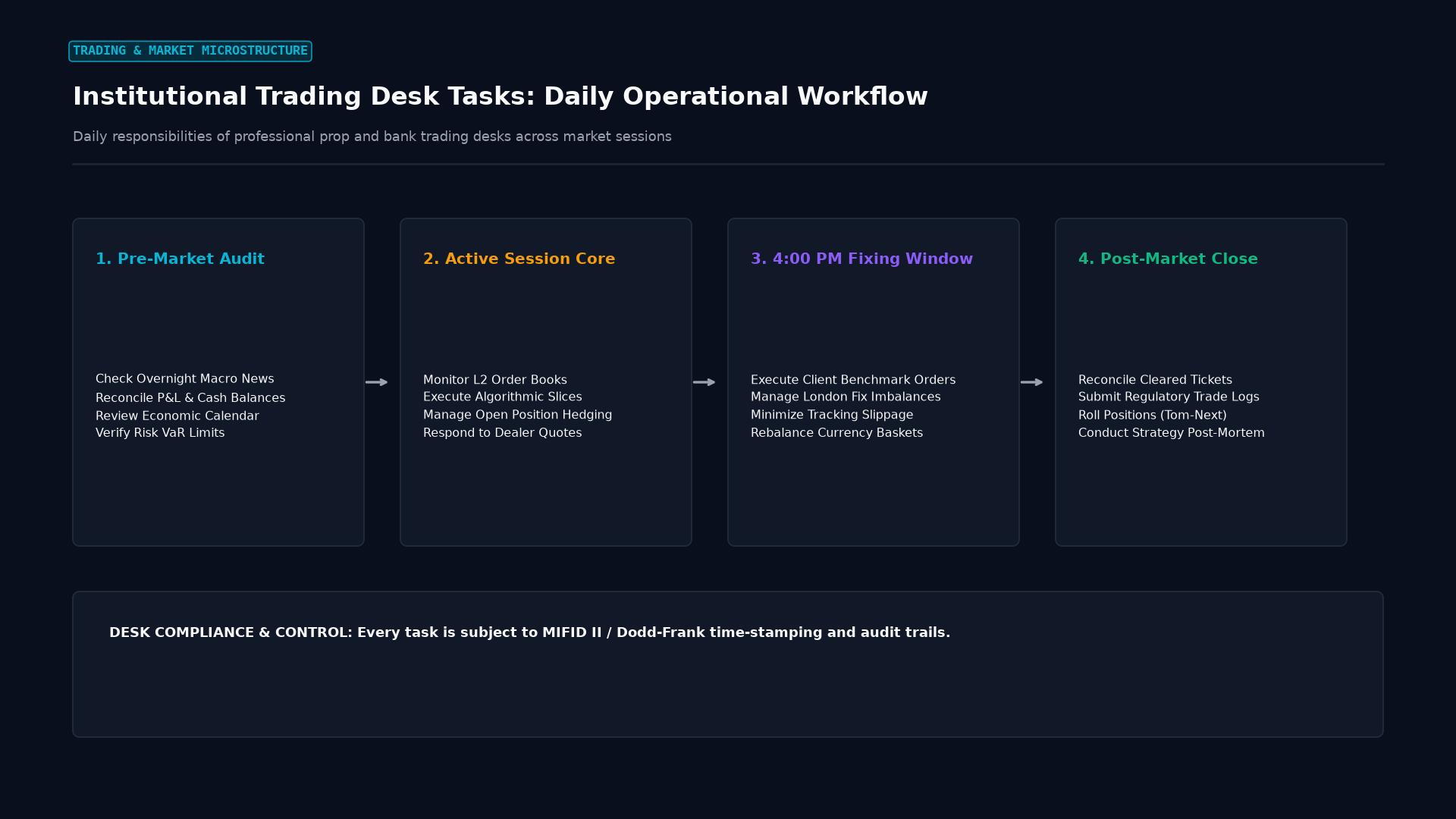 Figure: Trading desk operational routine: pre-market risk audit, active session algorithmic execution, 4:00 PM fixing rebalance, and post-close reconciliation.
The Daily Trading Desk Operational Task Lifecycle
Institutional trading desks operate under strict operational routines. Tasks are scheduled chronologically across four trading phases:
                  THE 4-PHASE TRADING DESK TASK PIPELINE

    [ PHASE 1: PRE-MARKET ]           [ PHASE 2: IN-MARKET EXECUTION ]
    - Reconcile overnight positions   - Smart order routing & child slicing
    - Audit economic data calendar    - Real-time intraday VaR surveillance
    - Verify broker credit lines      - Monitor execution slippage vs VWAP
               │                                     │
               └──────────────────┬──────────────────┘
                                  │
                                  ▼
    [ PHASE 3: POST-MARKET EOD ]      [ PHASE 4: MIDDLE/BACK-OFFICE ]
    - Reconcile trader blotters       - Match & confirm trades (Omgeo CTM)
    - Generate official EOD P&L       - Calculate initial & variation margin
    - Document trade rationale logs   - Authorize PvP/DvP settlement rails
Phase 1: Pre-Market Preparation Tasks
Before market open, trading desks execute essential verification tasks:
- Position Reconciliation: Matching front-office internal portfolio records against the custodian bank’s official settled records from the previous evening to confirm opening share and currency balances.
- Economic Calendar Surveillance: Reviewing high-impact scheduled macroeconomic releases (such as US Nonfarm Payrolls, CPI inflation reports, or central bank interest rate decisions) to set volatility buffers.
- Credit and Margin Limit Audits: Verifying that prime brokerage credit facilities, clearing margin balances, and overnight repo financing lines are open and funded.
Phase 2: Live In-Market Execution Tasks
During active market hours, execution traders focus on algorithmic and risk management tasks:
- Algorithm Selection & Parameterization: Choosing execution strategies (e.g., Time-Weighted Average Price - TWAP, Volume-Weighted Average Price - VWAP, or Implementation Shortfall) and setting participation rate caps (e.g., maximum 10% of market volume).
- Slippage and Market Impact Tracking: Monitoring execution fills in real time against the prevailing National Best Bid and Offer (NBBO) to minimize market impact.
- Risk Limit Surveillance: Continuously monitoring intraday Value at Risk (VaR), max drawdown limits, and single-name issuer concentration caps.
Phase 3: Post-Market End-of-Day (EOD) Tasks
Once the market closes:
- Trade Blotter Balancing: Verifying that all open orders are either filled, canceled, or carried over, ensuring zero orphan orders remain in trading systems.
- Mark-to-Market Valuation: Valuing open positions using official exchange closing prices to calculate gross and net daily Profit and Loss (P&L).
- Compliance Trade Journaling: Logging trade execution justifications, exception reports, and off-market fills to comply with regulatory audits.
Middle- and Back-Office Post-Trade Processing Tasks
Once a transaction is executed, middle- and back-office personnel execute operational tasks to ensure legal clearing and financial settlement:
+------------------------------------------------------------------------------------+
|                         POST-TRADE OPERATIONAL TASK MATRIX                         |
+-------------------+----------------------------------------------------------------+
| OPERATIONAL TASK  | TASK OBJECTIVE & COMPLIANCE REQUIREMENTS                       |
+-------------------+----------------------------------------------------------------+
| Trade Capture     | Electronic ingestion of execution fills from FIX messaging     |
| & Booking         | engines into internal Order Management Systems (OMS).          |
+-------------------+----------------------------------------------------------------+
| Allocation &      | Breaking block trades into underlying client sub-accounts and  |
| Confirmation      | matching terms with counterparties via Omgeo CTM or SWIFT.     |
+-------------------+----------------------------------------------------------------+
| Margin Call       | Calculating daily initial margin and variation margin demands  |
| Management        | based on counterparty derivative exposures under ISDA rules.   |
+-------------------+----------------------------------------------------------------+
| Settlement        | Transmitting settlement instructions to central depositories   |
| Instruction (SSI) | (DTCC, Euroclear, CLS) under Delivery-versus-Payment rails.    |
+-------------------+----------------------------------------------------------------+
| Cash & Custody    | Reconciling cash balances across Nostro and Vostro bank        |
| Reconciliation    | accounts to identify breaks, missing dividends, or failed wires.|
+-------------------+----------------------------------------------------------------+
The Cost of Failed Tasks: Trade Breaks and CSDR Penalties
If an operational task fails, for example, if a back-office analyst enters an incorrect Standard Settlement Instruction (SSI) code or fails to confirm an allocation before cutoff time, the trade “breaks”:
- Under the European Union’s Central Securities Depositories Regulation (CSDR), late-settling trades face mandatory daily cash penalty fines levied against the failing party.
- Under the accelerated $T+1$ settlement cycle in the United States and Canada, failure to complete trade confirmation tasks on trade date ($T+0$) can result in failed settlements, overdraft interest fees, and counterparty credit reviews.
Operational Risk Controls: Separation of Duties (SoD)
A foundational principle of financial risk management is that critical tasks must be segregated among different individuals.
                           THE FOUR-EYES TASK SEGREGATION

          FRONT OFFICE                      MIDDLE / BACK OFFICE
       [ Trade Execution ]               [ Trade Confirmation ]
       Trader initiates and              Independent operations clerk
       executes market orders.           confirms price & volume with broker.
                │                                    │
                │        CANNOT OVERRIDE             │
                └─────────────── X ──────────────────┘
                                 │
                                 ▼
                     [ Cash Transfer & Wire ]
                     Treasury officer authorizes
                     funds release (Dual Approval).
The Rogue Trader Threat
Financial history demonstrates that the most catastrophic banking collapses (including Barings Bank in 1995 and Société Générale in 2008) were caused by a breakdown in task segregation:
- In the Barings Bank failure, rogue trader Nick Leeson was allowed to execute trades in the front office while simultaneously managing back-office trade settlement tasks.
- By controlling both tasks, he hid massive unhedged derivative losses in secret error accounts (the infamous “88888” account) without independent verification.
Modern institutional compliance mandates the Four-Eyes Principle: the professional who executes an order can never perform the tasks of confirming trades, adjusting margin, or authorizing outgoing wire transfers.
Computing and Algorithmic Automation: Task Orchestration
In quantitative finance, high-frequency trading (HFT), and enterprise financial engineering, tasks are automated using software orchestration engines:
+------------------------------------------------------------------------------------+
|                         FINANCIAL COMPUTING TASK ENGINES                           |
+-------------------+----------------------------------------------------------------+
| ARCHITECTURE      | AUTOMATED OPERATIONAL TASKS PERFORMED                          |
+-------------------+----------------------------------------------------------------+
| Asynchronous Task | Distributes computational workloads across server clusters     |
| Queues (Celery)   | (e.g., executing 100,000 Monte Carlo portfolio risk paths).   |
+-------------------+----------------------------------------------------------------+
| Event Streaming   | Ingests real-time tick-by-tick market data feeds, triggering   |
| (Apache Kafka)    | automated compliance surveillance and algorithmic orders.      |
+-------------------+----------------------------------------------------------------+
| Robotic Process   | Software bots that extract PDF trade confirmations, parse      |
| Automation (RPA)  | data fields, and book entries into legacy mainframe systems.   |
+-------------------+----------------------------------------------------------------+
Automating routine operational tasks eliminates manual data-entry errors, speeds up transaction clearing, and enables institutions to scale trading volume without expanding operational headcount.
Tasks in Activity-Based Costing (ABC)
In managerial cost accounting, a task represents the smallest tracked unit of labor and machine consumption:
$$\text{Activity Cost} = \sum (\text{Task Duration} \times \text{Resource Cost per Minute})$$
By decomposing activities into discrete tasks (e.g., reviewing a mortgage loan application versus ordering a property title report), cost accountants identify operational bottlenecks, evaluate automation feasibility, and determine the exact unit cost of servicing financial accounts.
Key Takeaways
- Foundational Operational Unit: In finance, a task is a discrete unit of work within a broader business activity or trading workflow that ensures transaction completion.
- Structured Trading Cycle: Professional trading desks follow chronological task checklists across pre-market preparation, live execution, and post-market reconciliation.
- Settlement Integrity: Middle- and back-office tasks (trade allocation, confirmation, margin management) prevent trade breaks and regulatory penalties under accelerated $T+1$ settlement rules.
- Separation of Duties (SoD): Regulatory governance mandates that front-office trading tasks be strictly separated from back-office confirmation and cash wiring tasks to eliminate rogue trading risks.
- Algorithmic Automation: Financial institutions use asynchronous task queues, event streaming (Kafka), and robotic automation (RPA) to automate high-volume clearing tasks.
- Activity-Based Costing Foundation: In managerial accounting, tasks represent the base unit for measuring labor and computing time, enabling accurate product and customer cost allocation.
Frequently Asked Questions (FAQ)
What is the difference between a process, an activity, and a task in financial operations?
A process is an overarching end-to-end business function designed to achieve a major strategic outcome (such as the complete trade lifecycle from order entry to settlement). An activity is a specific operational stage within that process (such as pre-trade risk screening or trade allocation). A task is a discrete, measurable unit of work executed by an individual or automated system to complete the activity (such as querying a client’s available buying power or transmitting a SWIFT MT300 confirmation message).
Why is the separation of trading tasks and settlement tasks mandatory under financial regulations?
Separating trading tasks from settlement tasks is mandatory to prevent fraud, unauthorized speculation, and rogue trading. If a trader were permitted to execute transactions and also perform the task of reconciling trade blotters with clearing banks, they could conceal losing trades or fabricate artificial profits. By assigning settlement and confirmation tasks to an independent back-office team, any discrepancy between what the trader reports and what the clearinghouse records is identified immediately.
What happens when an operational settlement task fails in an institutional trade?
When an operational settlement task fails (such as an incorrect account number or delayed cash transfer), a “trade break” occurs. The trade cannot settle on the mandated settlement date (e.g., $T+1$). The institution must deploy operational support staff to investigate the break, contact counterparty settlement desks, and re-issue corrected instructions. In addition to operational friction, failed trades expose the failing party to monetary penalties under settlement discipline regulations (such as Europe’s CSDR) and force banks to hold extra regulatory capital against failed delivery exposures.
Ready to trade forex?
Open a free demo account with a regulated broker. Practice with virtual funds before risking real money.