Gross Domestic Product (GDP)
Gross Domestic Product (GDP) is the total monetary value of all goods and services produced within a country's borders over a specific period — usually a quarter or a year. It is the broadest measure of economic output and health. Strong GDP growth relative to expectations typically strengthens a country's currency; contraction or weak growth weakens it.
GDP and the Currency Market
GDP is the economic scorecard. Every quarter, major economies publish their GDP figure — and currency markets react immediately to whether that number beat, met, or missed the consensus forecast. But the reaction is more nuanced than “GDP up → currency up.”
What actually moves forex is the surprise — how the actual reading compares to market expectations. US Q2 GDP printed at 3.0% annualized in August 2024. The consensus was 2.4%. The dollar strengthened sharply that day not because 3.0% is high in absolute terms, but because it was significantly above what the market had priced in.
Understanding GDP means understanding the difference between economic reality and market expectations — and trading the gap between them.
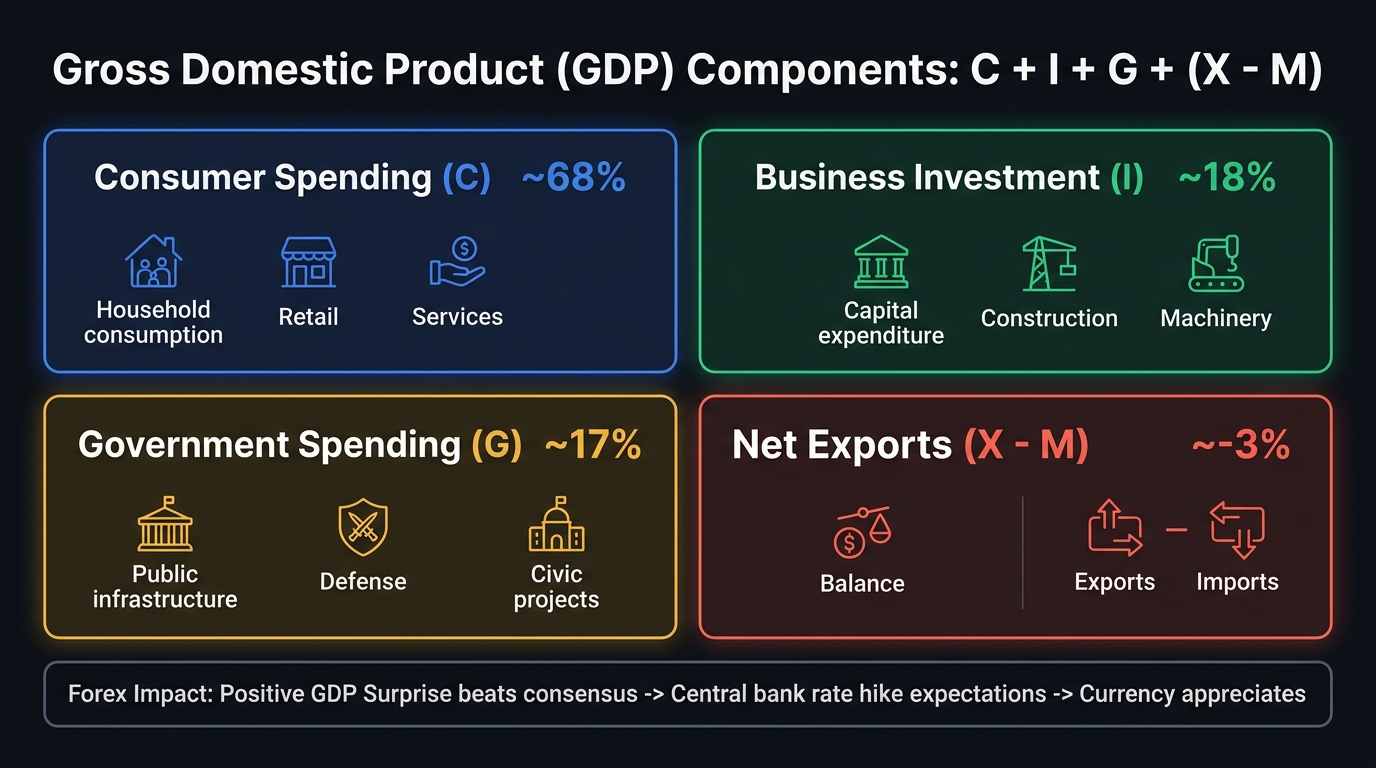
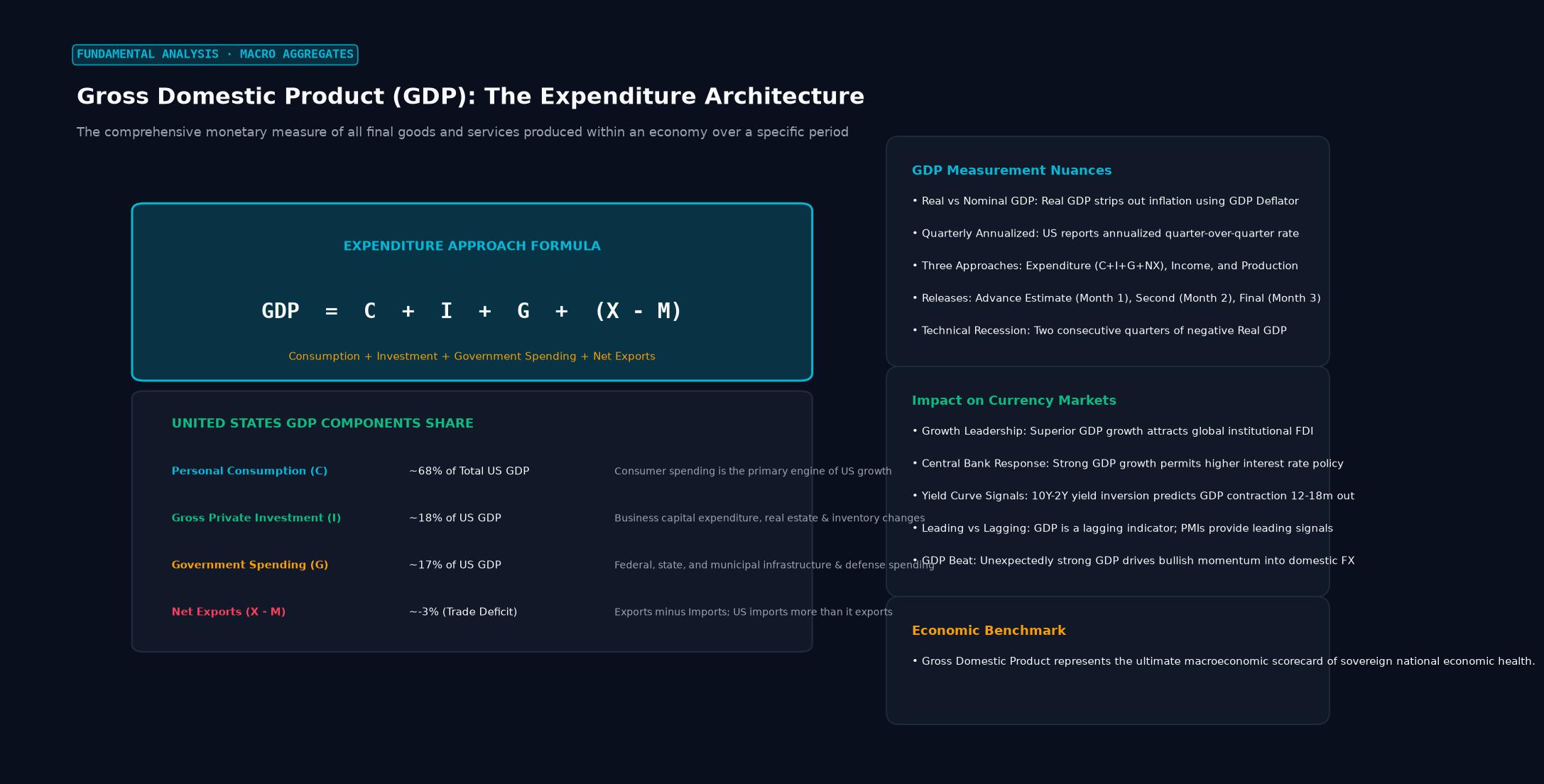 Figure: The comprehensive monetary measure of all final goods and services produced within an economy over a specific period
The Four Components of GDP
GDP is calculated using the expenditure approach:
GDP = C + I + G + (X - M)
Where:
- C = Consumer Spending (private consumption) — typically 60-70% of GDP in developed economies
- I = Investment (business capital expenditure, residential construction)
- G = Government Spending
- (X - M) = Net Exports (exports minus imports)
Consumer spending dominates. When households are confident and spending, GDP grows. When fear takes hold and savings rates rise, GDP contracts. This is why consumer confidence surveys and retail sales data are treated as leading indicators — they foreshadow GDP before the actual figure is released.
GDP Releases: Three Iterations
Major economies release GDP in stages:
Advance GDP estimate: Released approximately 30 days after the quarter ends. First look at the data. Often highly anticipated and most market-moving, but subject to significant revision.
Second (Preliminary) estimate: Released approximately 60 days after quarter end. Incorporates more complete data. Often closer to final.
Third (Final) estimate: Released approximately 90 days after quarter end. Rarely differs significantly from the preliminary but confirms the number.
Traders primarily react to the advance estimate — it’s the first glimpse and carries the highest uncertainty premium. The revisions rarely move markets significantly unless they’re dramatic.
Quarterly vs. Annual GDP: Avoiding Common Confusion
Most financial media in the US reports GDP as an annualized quarterly rate — taking the quarter-over-quarter growth and extrapolating it over a full year. A 0.75% quarter-over-quarter growth becomes a 3.0% annualized figure.
European economies typically report the actual quarter-over-quarter figure (0.3%, 0.4%, etc.) without annualizing. When comparing US and European GDP figures, be careful not to compare annualized US numbers directly against non-annualized European numbers — the gap is typically a factor of 4x.
GDP and the Recession Signal
The traditional recession definition: two consecutive quarters of negative GDP growth. When GDP contracts for two straight quarters, central banks typically shift toward cutting rates to stimulate recovery — which is currency-negative.
The relationship between GDP and currency is most direct when:
- GDP data diverges meaningfully from the other country in a currency pair (relative performance)
- GDP is close to zero growth — the recessionary threshold — because it affects rate cut expectations
- GDP data contradicts other economic indicators, creating uncertainty about the true economic picture
Nominal vs. Real GDP: What to Watch
Nominal GDP measures output in current prices — it includes the effect of inflation. If prices rose 5% and output grew 2%, nominal GDP grew 7%.
Real GDP strips out inflation, measuring actual volume of output. Central banks and forex traders focus on real GDP because it reflects genuine economic expansion, not just price increases.
High nominal GDP during high inflation isn’t necessarily positive for a currency. If inflation is 8% and nominal GDP grew 9%, real growth is only 1% — modest, not impressive.
GDP and Currency Pairs: Practical Application
For EUR/USD, the key comparison is US GDP growth vs. Eurozone GDP growth. When US growth is accelerating and Eurozone growth is stagnating (as in 2023-2024), the divergence in central bank policy — Fed holding rates higher for longer while ECB contemplates cuts — drives EUR/USD lower.
For commodity-linked currencies like AUD and CAD, GDP of their major trading partners matters as much as their own domestic GDP. Australia’s growth story is closely tied to China’s demand for iron ore and coal — so Chinese GDP surprises move AUD meaningfully, sometimes more than Australian domestic data.
Key Takeaways
- GDP = C + I + G + (X − M); consumer spending typically accounts for 60-70% of the total
- The GDP surprise relative to consensus moves markets; the absolute level matters less
- US GDP is reported as annualized rates; European GDP is reported as actual quarterly changes
- Two consecutive quarters of negative real GDP = official recession definition
- Relative GDP growth between countries drives currency pairs — not absolute national output
FAQ
Why does GDP sometimes come out strong but the currency falls? Several reasons: the strong GDP reading was already fully priced in, forward guidance from the central bank was dovish despite the data, or currency markets were pricing a different trajectory for future GDP based on leading indicators. The market is always forward-looking.
How does GDP differ from GNP? GDP measures output produced within a country’s borders regardless of who owns the productive assets. GNP (Gross National Product) measures output produced by a country’s residents regardless of where they are located. For most purposes, GDP is the preferred measure — GNP becomes more relevant in countries with large overseas worker remittances.
Ready to trade forex?
Open a free demo account with a regulated broker. Practice with virtual funds before risking real money.