Stockbroker
A licensed financial intermediary or professional registered entity authorized to buy and sell equities, derivatives, and securities on public exchanges on behalf of retail and institutional investors, operating under agency execution or dual broker-dealer frameworks.
What Is a Stockbroker?
A stockbroker (officially classified in regulatory frameworks as a Registered Representative or Broker-Dealer Agent) is a regulated financial professional or institutional brokerage firm licensed to facilitate the purchase and sale of stocks, exchange-traded funds (ETFs), bonds, and options on behalf of clients.
Because individual investors cannot directly walk onto the trading floor of the New York Stock Exchange (NYSE) or connect unvetted servers directly to Nasdaq matching engines, stockbrokers serve as the indispensable legal and technological bridge between public capital and centralized financial exchanges.
In legal terms, a stockbroker operates primarily under an agency capacity: they act as an agent on behalf of the customer, owing duties of best execution, regulatory compliance, and fair dealing, in exchange for a commission, mark-up, or administrative fee.
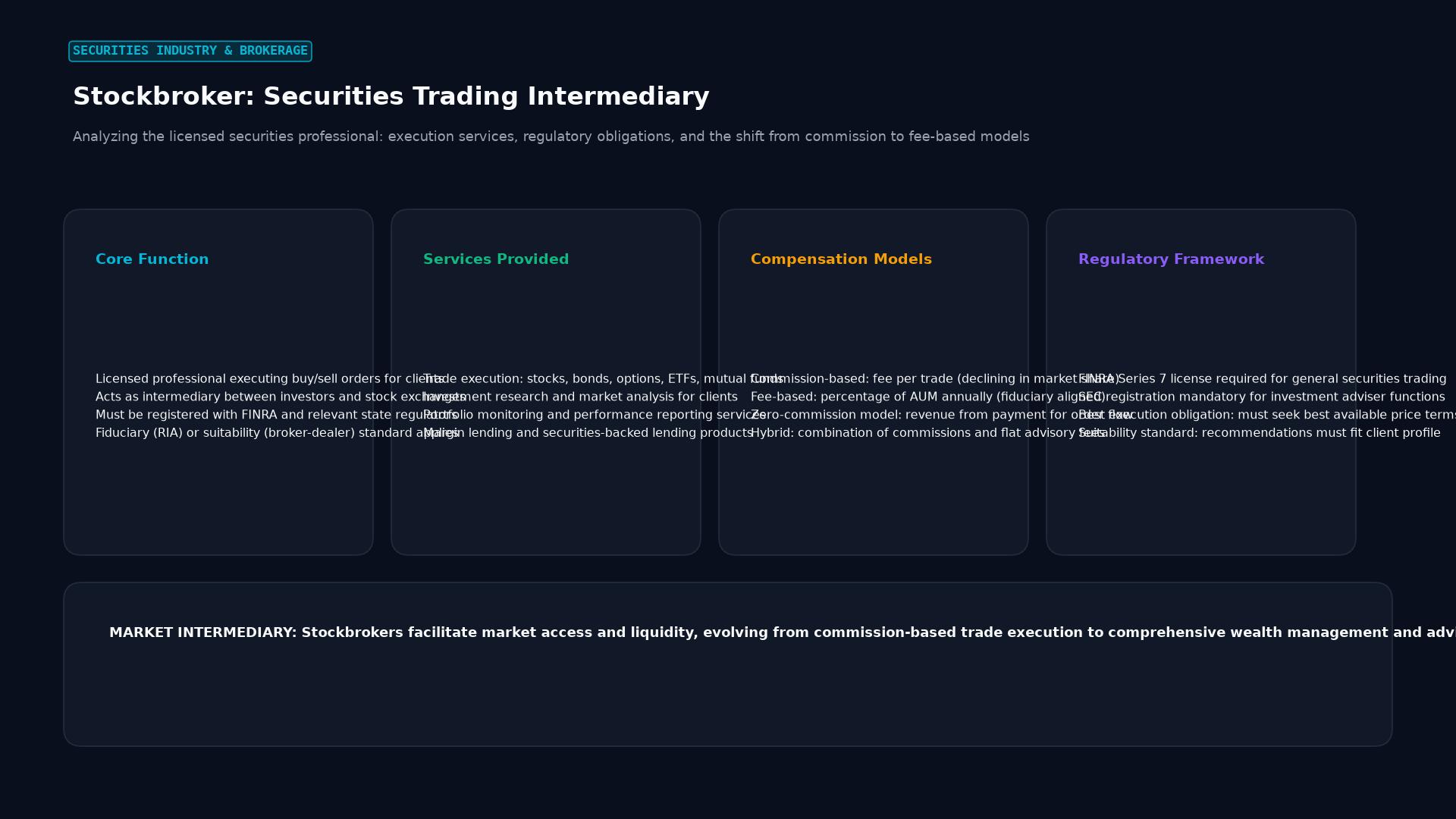 Figure: Analyzing the licensed securities professional: execution services, regulatory obligations, and the shift from commission to fee-based models
The Brokerage Spectrum: Full-Service vs. Discount vs. Zero-Commission
The brokerage landscape has evolved into three distinct operating models catering to different client segments:
| Brokerage Category | Core Services Provided | Fee / Revenue Model | Target Audience | Representative Firms |
|---|---|---|---|---|
| Full-Service Broker | Discretionary portfolio management, estate planning, IPO access, bespoke research | High percentage of AUM ($1% - 2%$) or high fixed commissions | High-net-worth individuals, family offices, endowments | Morgan Stanley, Merrill Lynch, UBS |
| Discount / Direct Broker | Direct market access (DMA), professional charting platforms, options & futures execution | Low flat commission per trade or per contract ($0.005/share) | Active retail traders, self-directed investors, prop firms | Interactive Brokers, Charles Schwab, Fidelity |
| Zero-Commission (Neobroker) | Simplified mobile interface, fractional shares, automated cash sweeps | Payment for Order Flow (PFOF), securities lending, margin interest | Retail beginners, mobile-first millennial/Gen-Z traders | Robinhood, Webull, Trade Republic |
How Modern “Commission-Free” Stockbrokers Generate Revenue
The elimination of upfront trading commissions across retail equities did not eliminate transaction costs; rather, it shifted the revenue architecture:
- Payment for Order Flow (PFOF): Retail brokers route non-directed market orders to high-frequency wholesale market makers (such as Citadel Securities or Virtu Financial). The wholesalers pay the broker a fraction of a cent per share for the privilege of executing against uninformed retail order flow, profiting from the bid-ask spread.
- Net Interest Margin (Cash Drag): Brokers pay clients low interest (e.g., 0.50%) on uninvested cash balances while sweeping those deposits into overnight money markets or commercial loans yielding 5.00%+, retaining the spread.
- Securities Lending Programs: Brokers lend clients’ fully paid shares to short sellers and hedge funds, collecting borrowing fees.
- Margin Interest: Charging interest (typically 6% to 13%) on leveraged margin loans extended to traders.
Real-World Institutional Case Study: “May Day” 1975 and the Birth of the Discount Broker
For 183 years, Wall Street operated as an explicit price-fixing cartel. Under the Buttonwood Agreement of 1792, member brokers of the New York Stock Exchange were legally prohibited from competing on price; every customer paid mandatory, exorbitant fixed commissions regardless of trade volume.
       "MAY DAY" (MAY 1, 1975) DEREGULATION OF WALL STREET

 Pre-1975 Cartel Environment:
 - Fixed commission on 1,000 shares: ~$400.00 to $800.00 in 1970s dollars.
 - High cost locked everyday retail citizens out of direct equity ownership.

 Regulatory Intervention:
 - The U.S. Securities and Exchange Commission (SEC) abolished fixed commissions,
   mandating completely deregulated, competitive broker pricing.

 The Industry Revolution:
 1. Wall Street firms predicted widespread bankruptcy and financial collapse.
 2. Instead, Charles Schwab founded Charles Schwab & Co., slashing commissions
    by 75% and unbundling investment research from pure trade execution.
 3. Outcome: Demolished barriers to entry, unleashing a 50-year explosion in retail
    equity participation and index investing.
Regulatory Licensing and Investor Protections
Because stockbrokers handle billions in client custody, regulatory authorities enforce strict solvency and operational mandates:
- Licensing Examinations: In the United States, individual brokers must pass the Securities Industry Essentials (SIE), Series 7 (General Securities Representative), and Series 63 examinations administered by the Financial Industry Regulatory Authority (FINRA).
- Client Asset Segregation: Brokers must legally segregate customer fully paid securities from the firm’s proprietary assets.
- Insolvency Insurance (SIPC & FSCS): In the U.S., the Securities Investor Protection Corporation (SIPC) protects investor accounts up to $500,000 (including $250,000 for cash claims) if a brokerage firm collapses. In the UK, the Financial Services Compensation Scheme (FSCS) covers deposits and investments up to £85,000.
Frequently Asked Questions
What is the difference between a stockbroker and a financial adviser?
A stockbroker is an execution specialist licensed to facilitate the buying and selling of securities; their regulatory duty is traditionally to ensure that recommendations are “suitable” and executed efficiently. A registered investment adviser (RIA) is held to a strict fiduciary standard, legally requiring them to put the client’s best financial interests above their own at all times and disclose all conflicts of interest.
Can a stockbroker trade against their own clients?
A pure agency broker cannot trade against their clients. However, an institution registered as a broker-dealer operates two separate arms: an agency desk executing client orders, and a proprietary trading desk trading firm capital. Strict regulatory “Chinese walls” and information barriers are legally required to prevent proprietary desks from front-running or exploiting client order flow.
What happens to my shares if my stockbroker goes out of business?
Client securities are held in “street name” by central depositories (such as the DTCC) in segregated accounts. If the brokerage firm enters bankruptcy, client shares are not considered assets of the bankrupt estate; they are simply transferred intact to another solvent, clearing custodian broker under SIPC or court supervision.
Ready to trade forex?
Open a free demo account with a regulated broker. Practice with virtual funds before risking real money.