Transaction Date
The transaction date, or trade date (designated as T), is the exact calendar date on which a financial contract or trade execution is legally agreed upon by counterparties, establishing the benchmark from which clearing, valuation, and settlement cycles proceed.
What Is a Transaction Date?
In financial markets and institutional trade operations, the transaction date (synonymous with trade date and designated in settlement conventions as T) is the precise date on which a buy or sell transaction is officially executed and legally formalized. On this date, the economic terms of the contract—including instrument identification, transaction price, quantity, and currency denomination—become binding upon both counterparties.
Although ownership obligations and pricing are permanently locked on the transaction date, the physical exchange of securities and monetary cash flows typically occurs on a subsequent date known as the settlement date or value date (e.g., $T+1$ or $T+2$). The transaction date serves as the immutable reference point for market risk transfer, regulatory reporting, financial accounting recognition, and performance benchmarking.
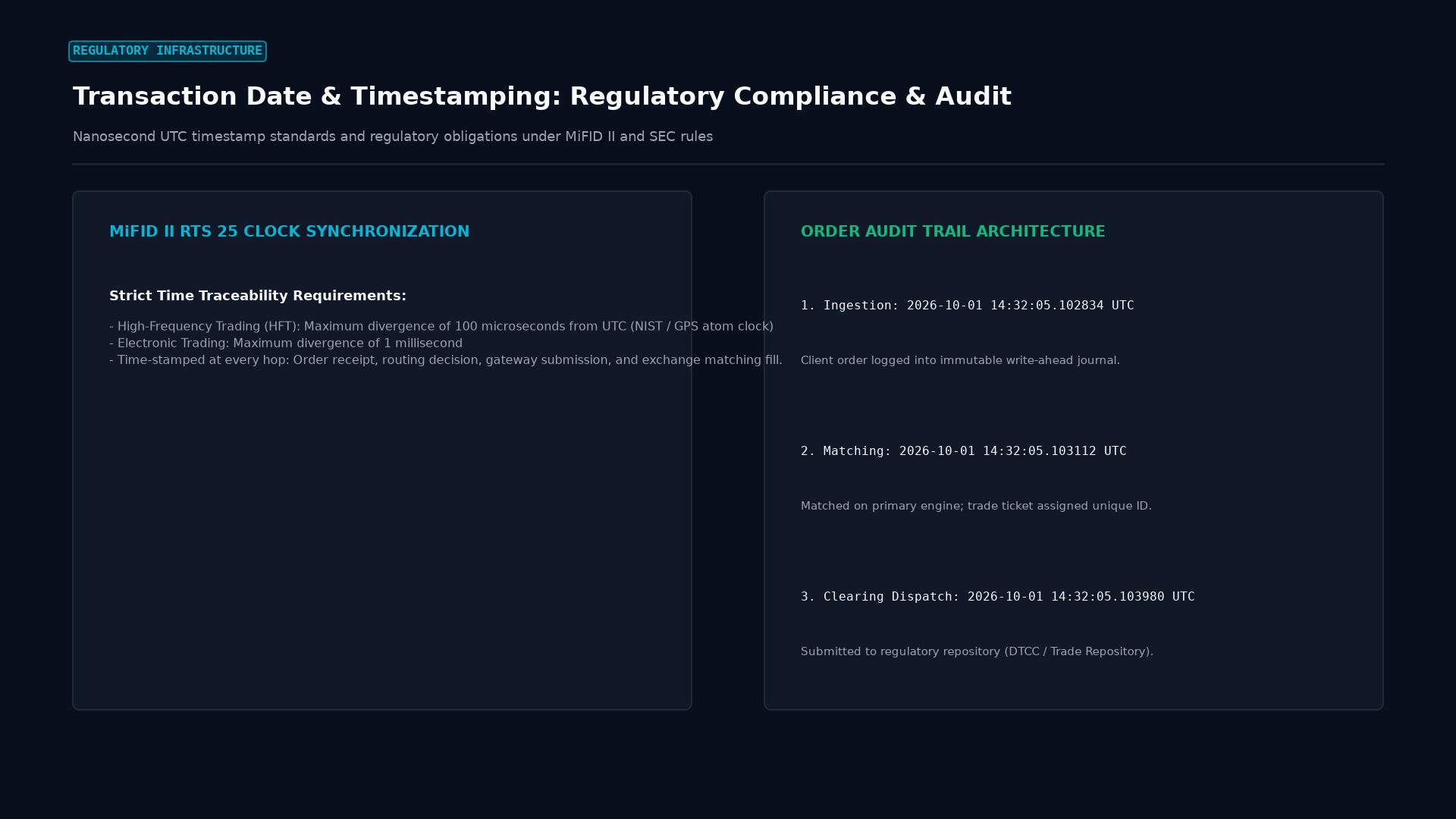 Figure: Regulatory clock synchronization under MiFID II: nanosecond UTC timestamps recorded across order ingestion, matching, and clearing.
Transaction Date Settlement Mechanics
The interval separating the transaction date from the settlement date is governed by market conventions, asset classes, and financial center banking calendars:
1. Value Date Determination
In foreign exchange spot markets, standard spot settlement occurs on a $T+2$ basis (two valid business days following the transaction date), with notable exceptions like USD/CAD, USD/TRY, and USD/PHP settling on $T+1$:
$$T_{\text{settlement}} = T_{\text{transaction}} + k \cdot \mathbb{B}(\text{Calendar}_1 \cap \text{Calendar}_2)$$
Where:
- $k$: Settlement lag ($k=1$ for $T+1$, $k=2$ for $T+2$).
- $\mathbb{B}$: Valid business day operator requiring central bank clearing facilities (e.g., Fedwire, TARGET2) in both currency jurisdictions to be operational simultaneously.
If a public holiday intervenes in either jurisdiction, the settlement date advances to the next joint business day.
2. Accrued Interest Calculation (Fixed Income)
In debt markets, the transaction date dictates the exact pricing, but accrued interest is calculated from the last coupon payment date through the settlement date:
$$\text{Accrued Interest} = \text{Par Value} \times \left( \frac{c}{m} \right) \times \left( \frac{\text{Days}(T_{\text{last_coupon}}, T_{\text{settlement}})}{\text{Days in Coupon Period}} \right)$$
Date Conventions Across Financial Contracts
Institutional portfolio management distinguishes between several interdependent transaction-related dates:
| Date Designation | Definition | Primary Function | Operational Impact |
|---|---|---|---|
| Transaction Date (Trade Date, T) | Date an execution is matched and confirmed. | Locks price, volume, and legal ownership liability. | Determines tax year, regulatory reporting cutoff, and performance returns. |
| Settlement Date (Value Date) | Date cash and assets are irrevocably transferred. | Fulfills delivery obligations between counterparties. | Affects bank liquidity balances and cash-flow interest accruals. |
| Fixing Date | Date a benchmark rate (e.g., SOFR, EURIBOR, WM/R) is determined. | Calculates settlement cash flow for swaps and options. | Precedes settlement date by 2 business days in derivatives. |
| Effective Date | Date a contract or swap begins accruing obligations. | Commences interest accrual or insurance protection. | Can coincide with or post-date the transaction date. |
Accounting Treatment: Trade-Date vs. Settlement-Date Accounting
Under international accounting frameworks (IFRS 9 and US GAAP ASC 815/820), financial institutions must elect a consistent policy for recognizing financial assets:
Trade-Date Accounting (Preferred by Capital Markets):
[Transaction Date (T)]  ----------------------------------->  [Settlement Date (T+2)]
 Asset & Payable recognized on balance sheet immediately.      Cash delivered; payable cleared.
 Daily MTM changes flow to P&L or OCI from Day T.              No P&L impact on Day T+2.

Settlement-Date Accounting:
[Transaction Date (T)]  ----------------------------------->  [Settlement Date (T+2)]
 Off-balance sheet commitment; asset not booked.              Asset formally booked to balance sheet.
 MTM fluctuations between T and T+2 tracked as derivative.     Initial cash outflow occurs.
Financial trading desks utilize trade-date accounting because it reflects market risk immediately upon execution, ensuring hedging models and Value at Risk (VaR) measures capture open exposures without latency.
Real-World Institutional Case Study: Year-End Tax Harvesting & Accounting Mismatches
The distinction between the transaction date and settlement date creates high-stakes operational friction during year-end tax-loss harvesting and institutional window dressing.
In late December, institutional equity and hedge fund managers sell unprofitable positions to realize capital losses, offsetting realized capital gains for the calendar year. Under US Internal Revenue Service (IRS) regulations and SEC trade compliance rules:
[Scenario: December 30 Transaction Date (T)]
Execution Date: December 30 (Day T)
Settlement Date under T+2: January 2 of the following year (Day T+2)

Regulatory Tax Ruling:
* Realized gain/loss is established on the TRANSACTION DATE (December 30).
* The capital loss applies legally to Year 1 tax filings, not Year 2.
Prior to the transition to shortened settlement cycles ($T+1$ implemented by the US SEC in May 2024), fund administrators frequently struggled with custodian reporting discrepancies: custodians running settlement-date accounting showed positions as open assets on December 31 balance sheets, while fund managers’ trading systems running trade-date accounting showed zero exposure. This multi-billion dollar reporting divergence caused audited net asset value (NAV) restatements across private wealth management firms.
Frequently Asked Questions
Does the market price moving between the transaction date and settlement date alter the trade price?
No. The execution price agreed upon on the transaction date is legally fixed. Any subsequent price appreciation or depreciation during the transit period between transaction date ($T$) and settlement date ($T+1$ or $T+2$) represents unrealized market risk borne entirely by the purchasing party.
What is the difference between transaction date and order date?
The order date is the date a trader submits an order instruction into an order management system or broker terminal. The transaction date is the date that order is actually matched, executed, and confirmed in the market. For limit orders that rest in the order book for multiple days before execution, the transaction date will occur days or weeks after the initial order date.
How did the SEC’s transition to T+1 affect transaction dates?
In May 2024, US, Canadian, and Mexican equity and corporate debt markets transitioned from a $T+2$ settlement cycle to $T+1$. While the transaction date remains the date of order matching ($T$), the compression of the post-trade clearing window to a single business day drastically reduced counterparty credit risk and margin requirements, requiring institutions to automate trade affirmations on transaction date evenings.
Ready to trade forex?
Open a free demo account with a regulated broker. Practice with virtual funds before risking real money.