Trade Date
The exact calendar business day on which a financial transaction is executed and legally finalized between buyer and seller, establishing the contractual price, volume, and specifications, distinguished from the subsequent settlement date.
What Is a Trade Date?
In financial markets, the trade date (standardly designated by the letter $T$) is the precise calendar date on which an order is officially matched, executed, and confirmed between a buyer and a seller.
The moment a trade date is established:
- The transaction price, notional volume, and contract terms become legally binding.
- The buyer assumes immediate directional market risk on the purchased asset, and the seller assumes market risk on the received proceeds.
- The trade is assigned an official time stamp on exchange clearing logs or institutional order management systems (OMS).
It is essential to distinguish the trade date from the settlement date (or value date). While the trade date represents the agreement to transact, the settlement date ($T+1$, $T+2$) represents the actual transfer of legal title and central bank cash.
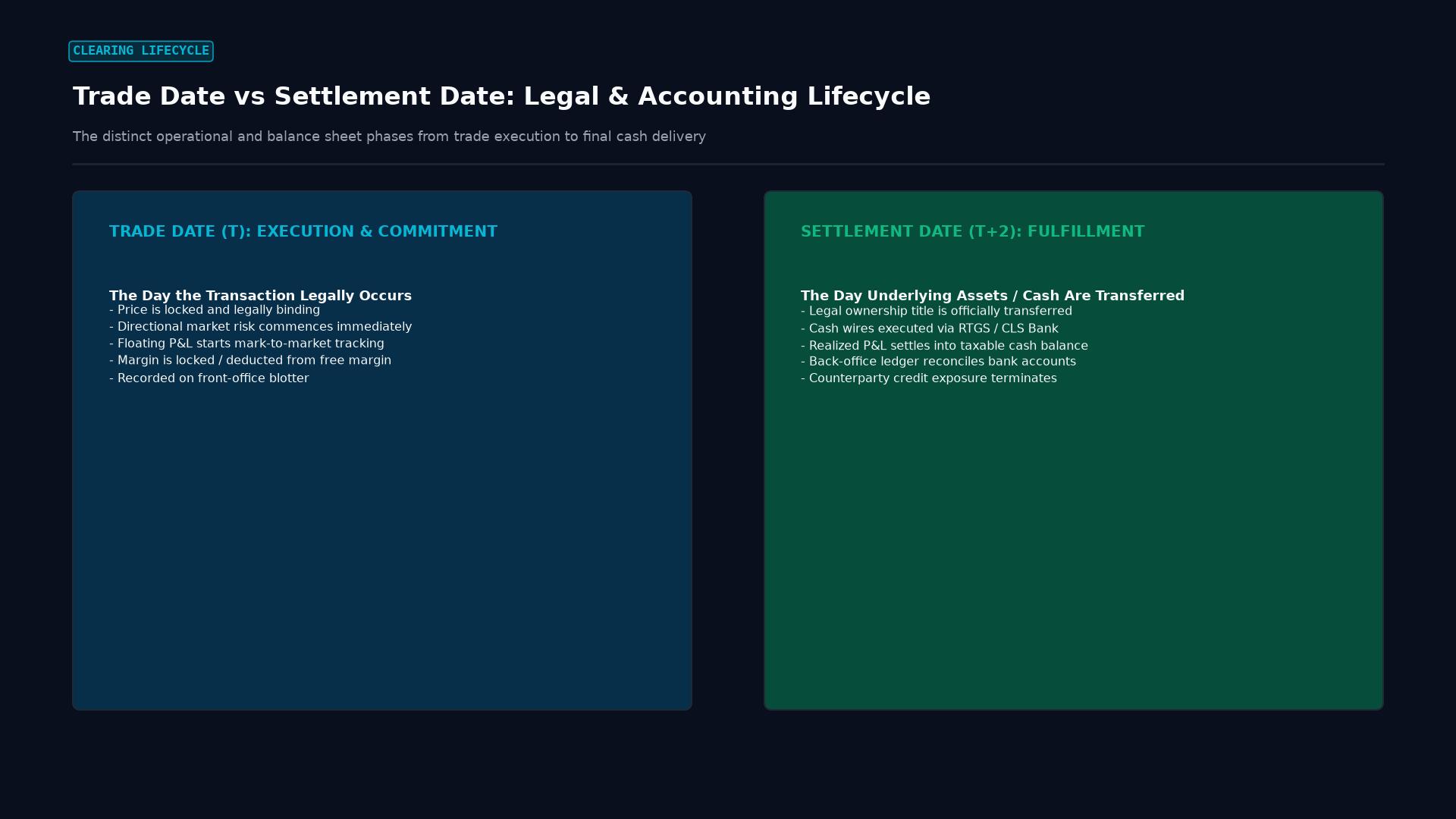 Figure: Operational phases of trade positioning: trade date price commitment and floating P&L tracking versus settlement date cash fulfillment.
Legal, Accounting, and Tax Implications
The establishment of the trade date carries profound regulatory and legal consequences:
1. Capital Gains Tax Recognition
Under tax authorities worldwide—including the U.S. Internal Revenue Service (IRS) and the UK HM Revenue & Customs (HMRC)—the trade date, not the settlement date, dictates the tax year in which an asset was bought or sold. A transaction executed on December 31 belongs to that tax year, even though cash settlement will not occur until early January of the subsequent calendar year.
2. Trade Date vs. Settlement Date Accounting
Corporate treasuries and institutional funds operate under two distinct accounting frameworks:
- Trade Date Accounting (Mandated by IFRS 9 / US GAAP): Financial assets and corresponding liabilities are recognized on the balance sheet immediately on the trade date. This ensures that floating mark-to-market fluctuations are transparently reported from day one.
- Settlement Date Accounting: Transactions are recorded only when assets are physically delivered. While permitted for select physical loans, modern accounting frameworks standardly require trade-date recognition for all liquid securities and derivatives.
Trade Date vs. Settlement Date vs. Value Date
| Parameter | Trade Date ($T$) | Settlement Date ($T+X$) | Value Date |
|---|---|---|---|
| Core Definition | Date contract is executed and price is locked | Date cash and assets are formally exchanged | Date financial funds become legally usable and begin earning interest |
| Market Risk | Inception: Investor bears 100% of price volatility | Extinguished: Counterparty credit risk terminates | Dictates interest accruals and Tom-Next swap points |
| Foreign Exchange Role | The day EUR/USD order is filled on the terminal | Usually two business days post-trade ($T+2$) | Functionally identical to the settlement date in spot FX |
| Example | Monday, October 12 | Wednesday, October 14 ($T+2$) | Wednesday, October 14 (Interest begins) |
Real-World Institutional Case Study: Year-End Tax-Loss Harvesting
Every December, institutional wealth managers and hedge funds engage in aggressive tax-loss harvesting, selling losing equity and currency positions to offset realized capital gains:
       YEAR-END TAX LOSS HARVESTING EXECUTION

 Scenario:
 - December 31 (15:55 EST): Fund manager holds a $500,000 unrealized loss
   in an underperforming tech position.
 - The fund needs to realize this loss to offset prior $500,000 capital gains,
   lowering the fund's net tax liability.

 The Execution:
 - The manager sells the shares on December 31 (Trade Date).
 - Because of the New Year's Day holiday and standard settlement rules,
   the trade does not settle until January 3 of the following year.

 The Tax Ruling:
 - Under IRS rules, the realized loss belongs to the departing tax year because
   the TRADE DATE occurred on December 31.
 - The fund successfully saves $100,000+ in corporate capital gains taxes.
What Happens to Corporate Actions Between Trade Date and Settlement Date?
Because multi-day settlement introduces a delay between agreement and legal transfer, financial exchanges enforce precise rules regarding dividends, voting rights, and corporate spin-offs:
- Dividend Entitlement (Ex-Dividend Date): To receive a company’s declared dividend, an investor must execute their purchase prior to the Ex-Dividend Date on trade date ($T$). If you buy stock on the ex-dividend date, you will not be the legal owner of record on the settlement date, and the dividend belongs to the seller.
- Shareholder Voting Rights: Voting rights belong to the legal owner of record on the central depository ledger (such as DTCC). If a shareholder vote occurs between the trade date and settlement date, the legal right to vote remains with the seller until settlement finality clears.
Frequently Asked Questions
Can a trade date ever be backdated?
No. In regulated financial markets, backdating a trade date is illegal. Electronic exchanges and brokerages maintain immutable, millisecond-accurate audit trails (mandated by FINRA Order Audit Trail System - OATS, and European MiFID II RTS 25 clock synchronization rules). Artificially manipulating or backdating a trade date constitutes securities fraud.
Does market risk begin on the trade date or the settlement date?
Market risk begins the exact millisecond the trade date is established. If you purchase an asset on Monday at $100 and it collapses to $80 by Tuesday, you have absorbed a $20 mark-to-market loss, even though cash settlement will not execute until Wednesday.
What is a “Trade Date Confirmation”?
An official electronic or physical document generated by a brokerage immediately following order execution. It details the unique trade ID, trade date, expected settlement date, ticker symbol, executed price, quantity, commission fees, and the capacity in which the broker acted (agency or principal).
Ready to trade forex?
Open a free demo account with a regulated broker. Practice with virtual funds before risking real money.