Transaction
A financial transaction is a legally binding agreement between counterparties to exchange an asset, currency, or derivative obligation under defined pricing, volume, and settlement terms, encompassing trade capture, clearing, and final delivery.
What Is a Transaction?
In financial and foreign exchange markets, a transaction is the complete operational and legal process through which two market counterparties commit to buying and selling a specified quantity of a financial instrument at an agreed-upon price. While everyday market discourse often treats “trade” and “transaction” as synonyms, in institutional market microstructure, a transaction encompasses the entire end-to-end lifecycle: pre-trade credit verification, price matching, trade capture, clearing, multilateral netting, and final payment or delivery.
In the global foreign exchange ecosystem—the largest financial market with daily turnover exceeding $$7.5$ trillion—transactions occur predominantly across decentralized, over-the-counter (OTC) interbank networks rather than centralized stock exchanges. Each foreign exchange transaction inherently consists of two simultaneous currency legs: one party sells a base currency while purchasing a quote currency, creating synchronized credit, market, and settlement exposures.
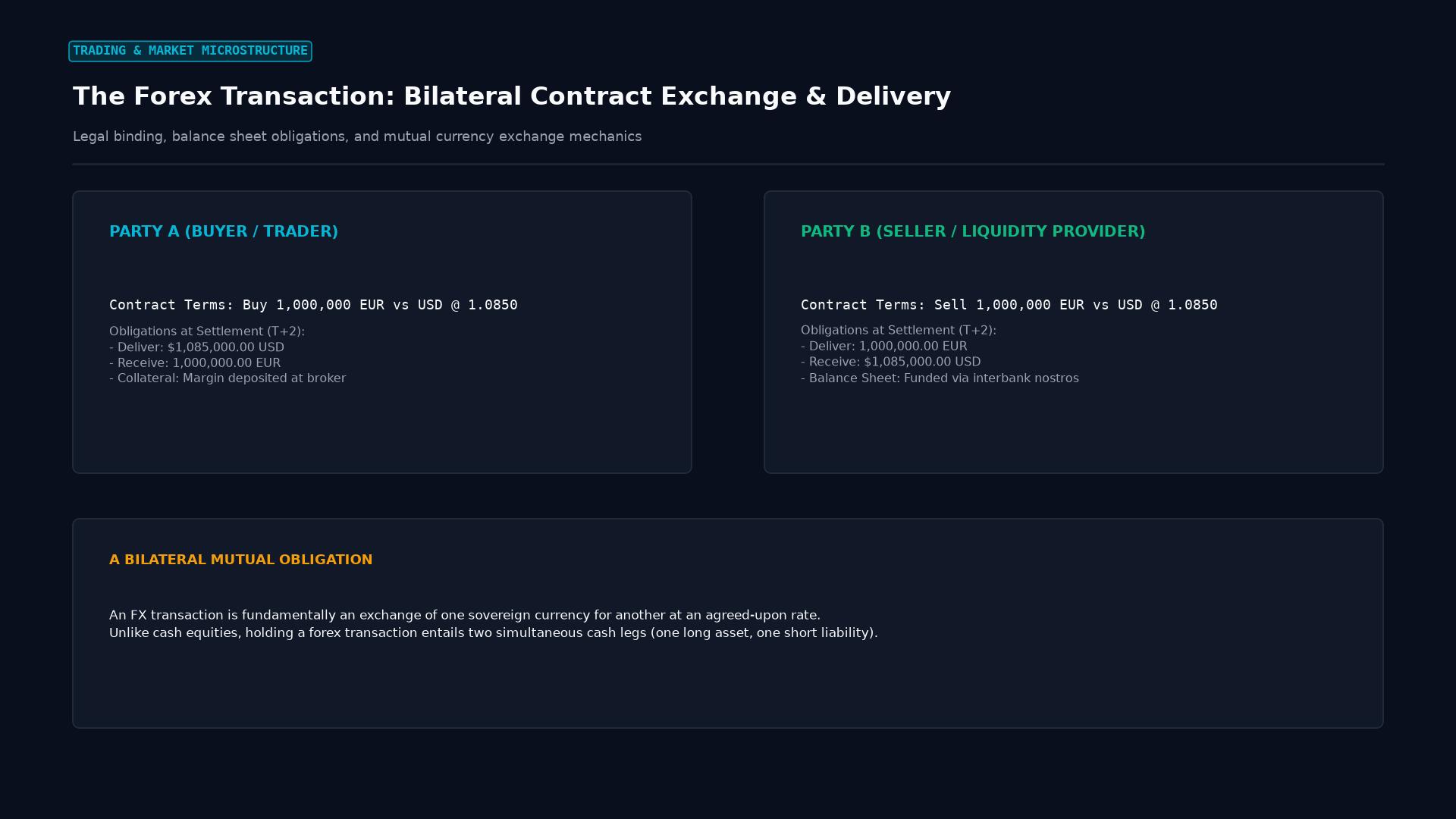 Figure: Bilateral foreign exchange contract: simultaneously buying one currency asset while incurring an offsetting liability in another.
Transaction Valuation & Cash Flow Mechanics
Every spot or forward currency transaction establishes an immediate contractual exchange of cash flows:
1. Spot Notional Determination
For a foreign exchange transaction buying base currency $B$ against quote currency $Q$ at executable spot rate $S$:
$$\text{Counter Value}_Q = \text{Notional}B \times S{B/Q}$$
For example, a transaction purchasing $€10,000,000$ EUR/USD at $1.0850$ requires the buyer to deliver $$10,850,000$ USD on the value date while receiving $€10,000,000$ EUR.
2. Mark-to-Market Realized Profit & Loss
When an offsetting transaction is executed to liquidate an open exposure, net cash flow is determined by:
$$\text{Net P&L} = Q \times \left( S_{\text{exit}} - S_{\text{entry}} \right) \times \text{Multiplier} - \sum \text{Transaction Costs}$$
Where transaction costs encompass explicit broker commissions, exchange access fees, and financing carry adjustments.
Transaction Modalities Across Financial Markets
Financial transactions differ markedly across trading venues based on counterparty credit risk, regulatory reporting, and clearing architecture:
| Transaction Type | Execution Venue | Counterparty Structure | Settlement Mechanism | Regulatory Reporting |
|---|---|---|---|---|
| Bilateral OTC FX Spot | Direct Interbank / Single-Bank Portals | Principal-to-Principal (Bilateral ISDA Master Agreement) | Payment-versus-Payment (PvP) via CLS Bank on T+2 | Dodd-Frank / EMIR Trade Repository |
| Exchange-Traded Futures | Centralized Exchanges (CME, ICE) | Central Counterparty Novation (CME Clearing) | Daily variation margin + physical or cash settlement at expiry | CFTC Large Trader Reporting |
| Cleared FX Swaps | Multilateral Trading Facilities (MTF) | CCP Cleared (LCH ForexClear) | Multilateral daily cash flow netting | Real-time SDR public dissemination |
| Retail CFD Transaction | Retail Broker Dealing Desk (B-Book / STP) | Broker acts as sole principal counterparty | Synthetic cash balance adjustment; no physical delivery | National regulator oversight (FCA, CySEC, ASIC) |
Transaction Settlement Risk: Herstatt Risk
Because foreign exchange transactions involve cross-border transfers spanning disparate time zones and domestic central bank operating hours, transactions are exposed to settlement risk (historically termed Herstatt Risk).
Settlement risk arises when one counterparty delivers its sold currency leg during its local operating hours, but the opposing counterparty enters insolvency before delivering the corresponding purchased currency in its time zone.
Counterparty A (Frankfurt)                Counterparty B (New York)
            |                                         |
            | --- Delivers Deutsche Marks (08:00 CET) |
            |                                         |
     [Bank Failure / Regulatory Closure at 15:30 CET] |
            |                                         |
            X <--- FAILS to Deliver USD (09:00 EST) --+
            |
Result: Counterparty A loses 100% of transaction principal
To eliminate this systemic threat, the world’s leading central banks and commercial dealers founded CLS Bank International in 2002. CLS operates a dedicated Payment-versus-Payment (PvP) settlement engine, ensuring that neither leg of a transaction settles unless both legs settle simultaneously.
Real-World Case Study: The 1974 Herstatt Bank Failure
On June 26, 1974, German banking regulators abruptly revoked the banking license of Bankhaus Herstatt—a mid-sized bank in Cologne that had accumulated massive speculative foreign exchange losses—and ordered its liquidation at 4:30 PM Central European Time.
Before the shutdown that afternoon, multiple international banks had already delivered hundreds of millions of Deutsche Marks to Herstatt in Frankfurt to fulfill their legs of spot foreign exchange transactions. Those banks were expecting to receive the corresponding US Dollar legs in New York later that day.
When news of the German regulatory shutdown reached New York at 10:30 AM Eastern Time, Herstatt’s correspondent banks immediately suspended all outgoing US Dollar transfers. Counterparties that had successfully fulfilled their contractual obligation were left entirely empty-handed, losing over $$620$ million in unpaid principal. The resulting panic froze the New York interbank payments system and triggered a global crisis in OTC transaction clearing. This historic event led directly to the creation of the Basel Committee on Banking Supervision and modern PvP transaction infrastructure.
Frequently Asked Questions
What is the distinction between an order, a trade, and a transaction?
An order is an unexecuted instruction submitted by a trader specifying parameters to buy or sell. A trade refers to the instantaneous matching of buy and sell orders. A transaction is the comprehensive legal and financial contract that follows trade matching, covering post-trade confirmation, credit allocation, clearing novation, and final asset delivery.
What is transaction netting?
Transaction netting is a post-trade process that consolidates multiple offsetting payment obligations between counterparties into a single net payment. In institutional foreign exchange, multilateral netting reduces gross interbank payment flows by over $95%$, substantially shrinking liquidity requirements and systemic counterparty credit exposures.
Does a retail forex trader actually take delivery of currency in a transaction?
No. Retail forex traders engage in leveraged Contracts for Difference (CFDs) or rolling spot contracts. These transactions are speculative cash-settled agreements where positions are automatically rolled over each evening via synthetic swap transactions (Tom-Next rolls), ensuring open positions never enter physical interbank settlement.
Ready to trade forex?
Open a free demo account with a regulated broker. Practice with virtual funds before risking real money.