T+ (Settlement Convention)
A standardized financial market notation indicating the settlement period of a trade, where 'T' represents the transaction trade date and '+' specifies the exact number of subsequent business days required for cash and assets to be legally delivered.
What Is “T+”?
In global banking and financial exchanges, “T+” (pronounced “T-plus”) is the universal shorthand notation used to designate the official settlement cycle of a financial trade.
In this formula:
- T stands for the Trade Date—the specific calendar business day on which an order is agreed upon, executed, and confirmed between buyer and seller.
- The plus sign (+) followed by an integer ($0, 1, 2, 3$) specifies the exact number of additional banking business days that must elapse before the physical or electronic transfer of cash and legal asset ownership is finalized.
Until the designated $T+$ horizon is reached, the transaction remains an off-balance-sheet contractual obligation subject to counterparty risk, clearinghouse netting, and broker margin monitoring.
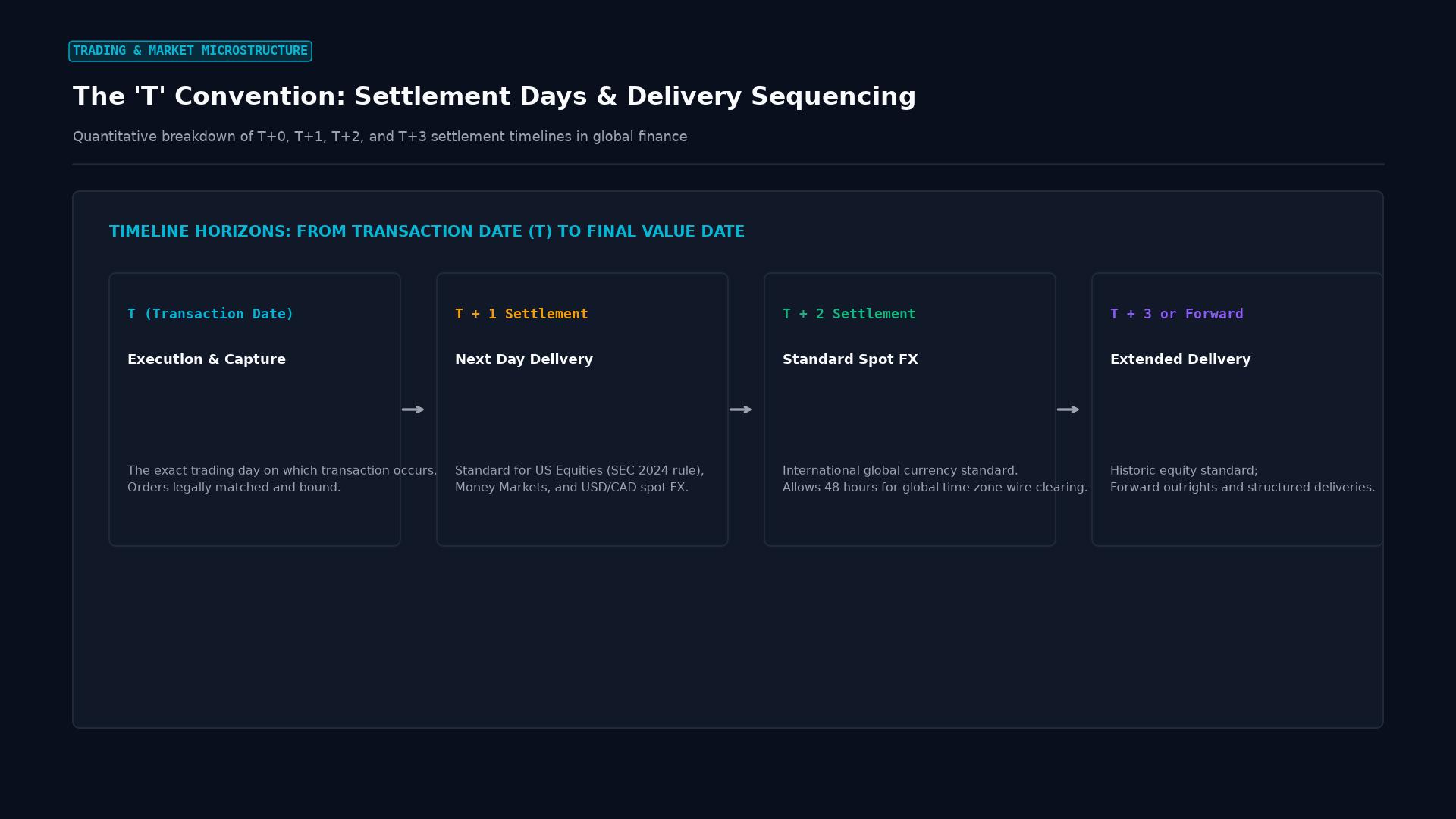 Figure: Financial timeline conventions: Transaction Date (T), Next-Day (T+1), Spot FX (T+2), and forward delivery cycles.
The Historical Evolution of T+ Horizons
Over the past century, advancements in telecommunications and clearinghouse automation have progressively compressed the global settlement window:
| Era | Standard Horizon | Primary Clearing Infrastructure | Catalysts for Compression |
|---|---|---|---|
| Pre-1970s | $T+5$ | Physical paper stock certificates delivered via couriers | Wall Street “Paperwork Crisis” of 1968 |
| 1990s | $T+3$ | Depository Trust Company (DTC) electronic book-entry ledgers | 1987 Stock Market Crash post-mortem recommendations |
| 2017 | $T+2$ | Automated Continuous Net Settlement (CNS) by the DTCC | Mitigating counterparty credit risk following 2008 GFC |
| 2024+ | $T+1$ | Real-time algorithmic matching and API clearing integration | GameStop 2021 volatility, clearinghouse margin spikes |
| Future | $T+0$ / Instant | Real-Time Gross Settlement (RTGS) & Distributed Ledger Tech | Ongoing pilot programs for instant atomic settlement |
Why Doesn’t the Entire Financial System Settle Instantly ($T+0$)?
Novice market participants frequently question why electronic markets do not settle trades instantly the microsecond an order is filled. Financial infrastructure engineers deliberately preserve a multi-day settlement window ($T+1$ or $T+2$) for three critical institutional reasons:
1. Multilateral Netting Efficiency
In high-frequency markets, broker-dealers execute millions of transactions daily. By aggregating trades over a $T+1$ or $T+2$ window, central clearinghouses execute Continuous Net Settlement (CNS), offsetting thousands of matching buys and sells into a single net payment per participant. This multilateral netting reduces the actual volume of cash moving through central bank payment rails by up to 98%, preventing systemic liquidity gridlocks.
2. Collateral and Cash Management
Institutional asset managers, sovereign wealth funds, and pension endowments manage complex global liquidity allocations. A multi-day horizon gives portfolio managers sufficient operational time to recall lent securities, borrow shares, liquidate money-market instruments, and wire cash across international correspondent banking networks.
3. Cross-Border Time Zone Synchronization
When a London-based asset manager executes a transaction on the Tokyo Stock Exchange or New York Stock Exchange, banking centers in Japan, Europe, and the United States operate across opposing time zones. The $T+$ buffer ensures that both central bank payment engines (e.g., BOJ-NET and Fedwire) can operate during daylight business hours to verify funds.
Real-World Institutional Case Study: The May 2024 U.S. Shift to $T+1$ and the FX Disconnect
On May 28, 2024, the U.S. Securities and Exchange Commission (SEC) officially compressed the settlement cycle for U.S. equities, corporate bonds, and municipal debt from $T+2$ down to $T+1$:
       THE CROSS-BORDER FX DISCONNECT UNDER T+1

 Monday 15:30 EST: London fund manager purchases $100,000,000 in U.S. equities.
 Tuesday 16:00 EST: U.S. equity trade MUST settle irrevocably (T+1 Deadline).

 The Operational Dilemma:
 - Standard spot GBP/USD settles on a T+2 basis (Wednesday).
 - If the London desk executes a standard spot FX conversion on Monday,
   the U.S. Dollars arrive 24 HOURS TOO LATE, triggering a costly settlement fail.

 The Solution:
 - International custodians were forced to redesign global FX execution desks,
   shifting staff to New York afternoon shifts and utilizing accelerated T+1 or
   same-day (T+0) FX swaps to guarantee dollar funding within the 24-hour window.
Rules Governing Business Days in T+ Calculations
Calculating the exact maturity date of a $T+$ contract requires strictly observing international banking calendars:
- Exclusion of Weekends: Saturdays and Sundays do not count toward the $T+$ day count. A $T+2$ trade executed on Thursday settles on Monday; a $T+2$ trade executed on Friday settles on Tuesday.
- Multi-Currency Holiday Verification: In foreign exchange, for a $T+2$ spot trade to settle, the commercial banking networks of both sovereign nations must be open. If Tuesday is a public holiday in Japan, a USD/JPY trade executed on Friday rolls its settlement date forward from Tuesday to Wednesday.
Frequently Asked Questions
Why does USD/CAD settle on a T+1 basis while EUR/USD settles on T+2?
USD/CAD (along with USD/MXN) operates on an accelerated $T+1$ settlement cycle because the United States and Canada share identical North American time zones, synchronized clearing holidays, and direct interbank liquidity links. Most other global currency pairs (EUR/USD, GBP/USD, USD/JPY) maintain the $T+2$ convention to accommodate transatlantic and transpacific time-zone differences.
How does the T+ cycle affect when I can withdraw trading profits?
In a standard cash brokerage account, you cannot withdraw the proceeds of a stock sale until the trade officially settles. Under the $T+1$ regime, selling stock on Monday allows cash withdrawal on Tuesday afternoon once clearing finality is verified. In margin accounts, brokers provide immediate credit against unsettled trades, though the underlying legal settlement still obeys $T+1$.
What is the difference between Trade Date (T) and Value Date?
The Trade Date (T) is the day the price is locked and the transaction contract is created. The Value Date is the designated settlement day ($T+1, T+2$) when the legal transfer of assets and payment of cash actually occurs across bank ledgers.
Ready to trade forex?
Open a free demo account with a regulated broker. Practice with virtual funds before risking real money.